Mississippi Firearms Discharge Setback Rules
It can be incredibly frustrating to feel like you're doing everything right for your hunt, only to second-guess whether you're too close to a road, a house, or another property line when it's time to take a shot. The rules around discharging firearms in Mississippi aren't always crystal clear, leaving many hunters anxious about potential legal issues or, worse, accidental harm. This guide is here to untangle those complexities, walking you through Mississippi's firearm discharge setback rules so you can hunt with confidence and peace of mind.
Understanding Mississippi's Firearms Discharge Setback Rules
Navigating the legal landscape of hunting can sometimes feel like trying to track a mature buck through a briar patch – it's dense, confusing, and you might get snagged if you're not careful. One of the most critical aspects of responsible hunting, often overlooked until it’s crunch time, involves understanding exactly where you can legally discharge a firearm. Mississippi has specific regulations designed to ensure safety, respect private property, and prevent conflicts between hunters and non-hunters. These aren't just suggestions; they're laws that carry real consequences if ignored.
The "Safety Zone" Concept Explained
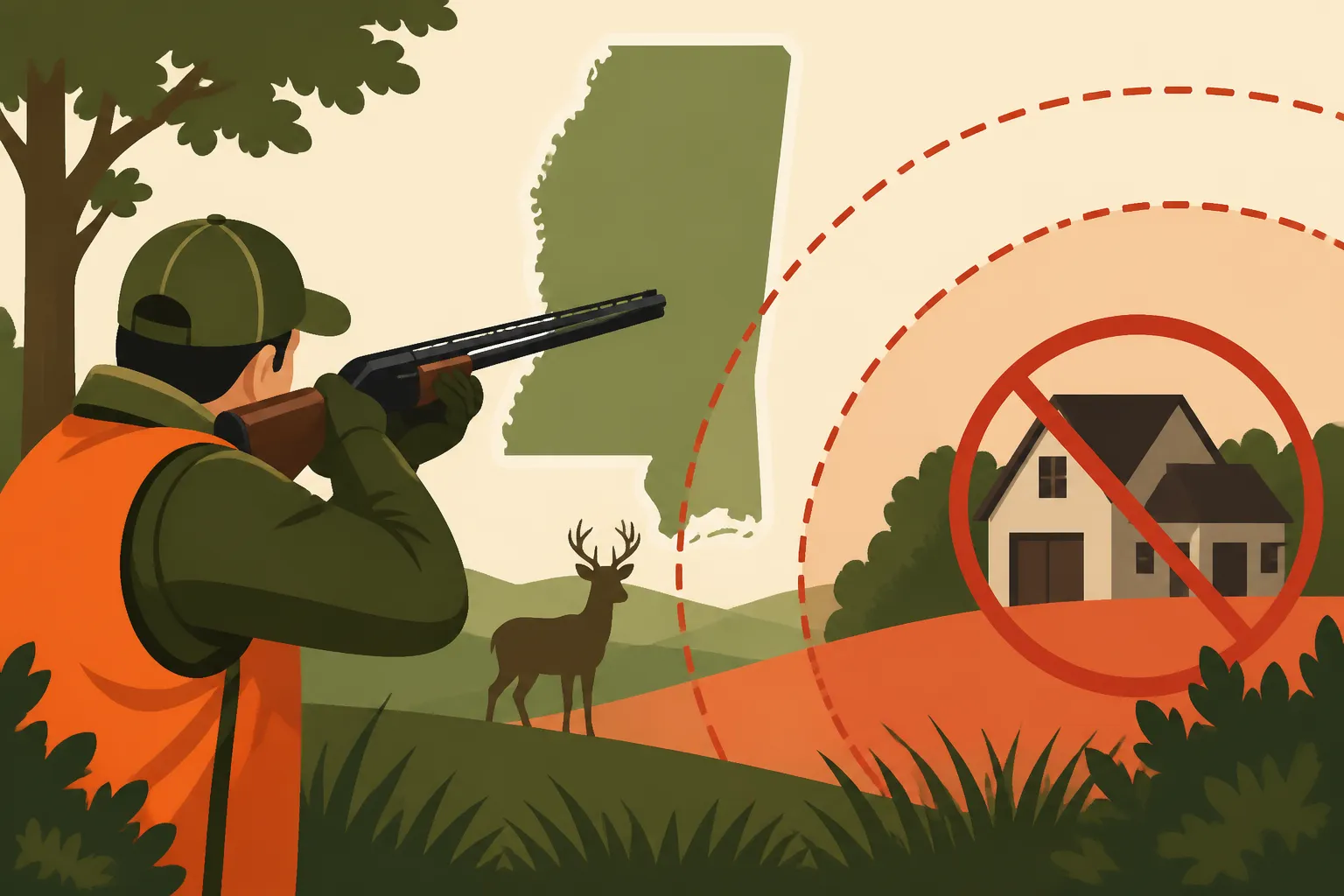
At the heart of firearm discharge rules is the concept of a "safety zone." Think of it as an invisible bubble around certain structures or areas where discharging a firearm is strictly prohibited, regardless of whether you're on public or private land. This isn't about deliberately aiming at a house or a vehicle; it's about the potential for a projectile to travel beyond your intended target and cause harm or damage. Even a missed shot, a ricochet, or a bullet passing through an animal can cover significant distances. The safety zone provides a buffer to account for these possibilities, protecting homes, people, and property that might be out of sight or further away than you realize. It's a proactive measure, acknowledging that even the most experienced hunter can't always predict every variable, especially when hunting in areas that are increasingly encroaching on residential developments.
Key Distances and Legal Requirements
Mississippi law outlines specific minimum distances that must be maintained when discharging a firearm. According to state statute, it is unlawful to discharge any firearm on or across any public road, or within 100 yards of any dwelling, school, church, or other occupied building without the express permission of the owner or occupant. Let's break that down a bit. The "on or across any public road" part is pretty straightforward – you can't stand in the road and shoot, nor can you shoot over it. This is a common sense safety measure, considering traffic and the unpredictability of projectiles. The "100 yards of any dwelling, school, church, or other occupied building" is where things often get tricky for hunters. This means if you're hunting within 300 feet (approximately 100 yards) of any house, even if it's your own hunting camp, you need permission from anyone occupying that structure. This applies even if the building is on an adjacent property and you’re on your own land. It's a critical distinction many hunters miss. These rules are in place not to hinder your hunt, but to provide a clear boundary, minimizing the risk of a stray bullet impacting a structure or, heaven forbid, a person.
Nuances for Different Property Types
While the 100-yard rule is a baseline, its application can vary slightly depending on whether you're hunting public or private land. On private land, if you own the land or have explicit permission to hunt, you still must respect that 100-yard setback from any neighboring dwelling or occupied building. This means if your deer stand is right on a property line and there's a house just over that line, you need to ensure you're more than 100 yards away from that house, or you need the explicit permission of that homeowner. It's not enough to just be on your side of the fence. On public lands, like many of Mississippi's Wildlife Management Areas, or the extensive tracts of the Delta National Forest, the same 100-yard rule applies to any private dwellings bordering the public land. You'll often see specific signage in these areas reminding hunters of these setbacks. Always check the specific WMA regulations, as some might have even stricter local rules or designated "no hunting" zones near public access points or campsites. For detailed information on specific areas, resources like the MDWFP app or even platforms like GoHunt can provide boundary information, but the final responsibility lies with the hunter to verify these distances on the ground.
Why These Rules Matter for Hunters and Landowners
These setback rules might feel like another hurdle to jump through, especially when you've finally found the perfect stand location or are trying to make a quick move on a game animal. However, understanding and respecting them is absolutely crucial. They're not just bureaucratic red tape; they are foundational to maintaining a safe hunting environment, protecting the future of our hunting heritage, and fostering good relationships within communities.
Preventing Accidents and Ensuring Public Safety
Let's face it, safety is paramount. The primary reason for these rules is to prevent tragic accidents. Firearms are powerful tools, and while we all strive for ethical, clean shots, the reality is that bullets can travel much further than most people realize. A typical rifle bullet, for instance, can travel for miles. Even a shotgun slug has a significant range. When you discharge a firearm too close to an occupied building, a public road, or even an area where people might be recreating, you're introducing an unacceptable risk. Imagine the horror of a stray round impacting a child's bedroom or passing through someone's car. Such incidents not only devastate families but also cast a dark shadow over hunting as a whole, leading to increased public opposition and stricter regulations that impact all of us. These setback rules act as a vital buffer, providing a margin of error that keeps both hunters and non-hunters safe, ensuring that our sport remains responsible and respected.
Avoiding Legal Trouble and Property Disputes
Ignoring these setback rules can land you in a heap of legal trouble. Discharging a firearm unlawfully can result in hefty fines, loss of hunting privileges, and even criminal charges, depending on the severity of the infraction. If your bullet damages property or, worse, injures someone, you could face civil lawsuits that can bankrupt you. Beyond legal repercussions, these situations often lead to bitter property disputes with neighbors. Nobody wants to be the hunter whose actions cause a local uproar, leading to "No Hunting" signs popping up everywhere. I've seen situations where entire hunting leases were lost because one hunter didn't respect a neighbor's property line or dwelling. By adhering to the setback rules, you're not just following the law; you're actively protecting yourself from legal woes and helping to preserve positive relationships within the community. It's a small concession that pays huge dividends in peace of mind and continued access to hunting opportunities. Remember, understanding Mississippi Trespass and Permission Law is also critical here.
Respecting Neighbors and Maintaining Community Harmony
Hunting is a privilege, not a right, and maintaining that privilege requires being a good neighbor. In Mississippi, where agriculture and rural living often intertwine with hunting lands, many people live near areas where hunting takes place. While most understand and even participate in hunting, they also deserve to feel safe and secure in their homes. Discharging a firearm too close to someone’s house, even if no harm is done, can cause alarm and resentment. It’s about respect. Imagine sitting on your porch, enjoying a quiet afternoon, and suddenly hearing a gunshot that sounds like it came from your backyard. That's a feeling of unease nobody wants. By observing the setback rules, you demonstrate respect for your neighbors' peace, privacy, and safety. This fosters good will, which can be invaluable. A positive relationship with landowners adjacent to your hunting grounds can sometimes even open doors to new hunting opportunities or help resolve minor issues peacefully, rather than escalating them into major conflicts.
Practical Application and Real-World Scenarios
Understanding the letter of the law is one thing, but applying it in the unpredictable environment of the Mississippi woods or fields is another entirely. Hunting rarely happens in a perfectly measured, sterile environment. We're dealing with moving animals, changing light, and often, unclear boundaries. That's why thinking through common scenarios before you're in the moment is so important.
Hunting Near Residential Areas or Roads
This is perhaps the most common scenario where setback rules come into play, especially as suburban sprawl creeps further into traditional hunting grounds. You're set up on a deer stand on a private timber tract, maybe you've got permission to hunt a small woodlot, and a beautiful buck steps out. But then you notice a rooftop peeking through the trees, or you realize a busy road is just beyond your shooting lane. What do you do?
First, always scout your hunting area thoroughly before the season. Use aerial maps, like those available through onX Layers for Mississippi Land Status or even free online resources, to identify nearby dwellings, schools, churches, and public roads. Physically walk the boundaries and use a rangefinder to measure distances from potential stand locations to these structures. If you find yourself within that 100-yard perimeter, you absolutely cannot shoot in that direction without direct, express permission from the owner or occupant of that building. Even if you have permission to hunt the land, that specific permission for the setback needs to be obtained separately.
Consider a scenario in the Hills Unit where you're set up on a ridge, hoping to catch a cruising buck. Below the ridge, maybe a quarter-mile away, is a small farm with a house. You see a buck moving on the side of the ridge that's sloping down towards the house. Even if the house is a quarter-mile out, if your shot angle takes the bullet towards or over the house within that 100-yard bubble of its trajectory, you're in violation. It's not just about the distance from your stand, but the path of the projectile. This means sometimes you might have to pass on a shot, even if it feels agonizing. It’s a bitter pill, but one that prevents far worse outcomes.
Public vs. Private Land Distinctions
The setback rules apply universally, but their enforcement and your awareness of them take on different characteristics on public versus private lands. On private land, your primary responsibility is to know your property lines and the locations of neighboring structures. Communication with adjoining landowners is key. If you’re lucky enough to have permission to hunt a parcel adjacent to a non-hunting neighbor, it’s always a good idea to introduce yourself, let them know you’ll be hunting, and reassure them that you understand and respect the setback rules. Transparency can go a long way in preventing future headaches. If you're Getting Private Land Permission in Mississippi, make sure these points are clear.
On public lands, such as WMAs or national forests, you often have less direct interaction with the property lines or adjacent landowners. This means you need to be extra diligent. When Scouting Mississippi Public Land Before Season, prioritize identifying these boundaries and setbacks. The MDWFP app, while helpful, is not a substitute for eyes on the ground. Look for fence lines, signage, and natural breaks that might indicate private property. Remember, the 100-yard rule still applies. If you're deep in the woods of Homochitto National Forest but find yourself close to a privately owned cabin bordering the forest, that setback is still in effect. Being on public land doesn't grant you immunity from respecting private property or safety zones. Always assume there could be a dwelling just out of sight, and err on the side of caution.
Dealing with Adjacent Properties
Adjacent properties are the most common source of issues. You might have a perfectly legal, well-placed stand on your own land, but if your shooting lane points directly at a neighbor’s barn or home, you’ve got a problem. This is where shot angles become critically important. It's not just about where you are, but where your bullet will go.
Consider a large, open field hunt for deer in the Delta Unit. You're set up on a field edge, and the deer are moving along a distant treeline. On the far side of that treeline, you know there's another property with a house. Even if the deer are 200 yards away, and the house is 300 yards beyond that, your bullet's trajectory might still put the house within that 100-yard "danger zone" from the point of impact or even a pass-through. This means you must adjust your shot, or more likely, pass on it.
This is also a good argument for stand placement and shot selection. If possible, set up stands that offer clear, safe backstops, such as a hill, a thick wooded area where the bullet would dissipate, or at least away from any potential structures. When a game animal presents itself, mentally trace the path of your projectile. If there's any doubt, any uncertainty about what's beyond your target and within that 100-yard buffer zone of a dwelling, you simply cannot take the shot. It’s a tough decision sometimes, but it’s the responsible one.
| Target Type / Location | Minimum Setback Distance | Permission Required? (If within setback) | Notes |
|---|---|---|---|
| Dwelling (Occupied Building) | 100 yards (300 feet) | Yes, from owner/occupant | Applies even if dwelling is on adjacent property. |
| School | 100 yards (300 feet) | Yes, from owner/occupant | This applies to any occupied building, including educational facilities. |
| Church | 100 yards (300 feet) | Yes, from owner/occupant | Any place of worship or public assembly. |
| Other Occupied Building | 100 yards (300 feet) | Yes, from owner/occupant | Includes businesses, community centers, etc. |
| Public Road | Do not discharge on or across | N/A | No shooting from or over any public road. |
| Adjacent Private Property | None, unless occupied building within 100 yards | Yes, for occupied building | You can shoot near a property line, but not within 100 yards of a neighbor's dwelling without permission. |
| Designated Safety Zones (WMAs) | Varies | N/A | Always check specific WMA regulations for additional restricted areas. |
Navigating Common Misconceptions and Local Ordinances
It’s easy to get caught up in rumors or misunderstandings when it comes to hunting laws. What you heard from a buddy at deer camp might not always be the letter of the law, and that’s especially true when we talk about firearm discharge rules. Furthermore, state laws aren't always the only laws you need to worry about.
State Law vs. Local Regulations
Here's a crucial point: while the Mississippi Department of Wildlife, Fisheries, and Parks (MDWFP) sets the statewide regulations, individual counties or municipalities can, and often do, enact their own ordinances regarding firearm discharge. This means that a 100-yard setback might be the state minimum, but your particular county or town could have a stricter 150-yard or even 200-yard rule, especially in more densely populated areas or suburban-rural interfaces.
For example, many cities and towns have "no discharge" zones within their city limits, regardless of the state's 100-yard rule. You might have a small patch of woods just outside a city line where state rules apply, but cross into the city and hunting might be entirely prohibited, or subject to much stricter setback distances. This can be incredibly confusing for hunters, especially those who hunt in multiple locations across the state. The best practice is always to check with the local sheriff's department or city/county clerk's office for any additional ordinances before you hunt a new area. Don't assume that because it's rural, there are no local rules. Ignorance of the law is never a valid defense.
What to Do When in Doubt
When you're out in the field and a situation arises where you're just not sure about the setback distance, or if there's an unseen structure you might be close to, the answer is always the same: don't take the shot. It's far better to let a game animal walk than to risk an accident, a legal penalty, or damaging your reputation as a responsible hunter. This might mean passing on a trophy buck or a prime turkey, and that can be a tough decision in the heat of the moment. But consider the alternative. The regret of missing a shot is temporary; the consequences of an unlawful or unsafe discharge can be permanent and devastating.
If you frequently find yourself in such situations, it's a clear sign you need to do more preseason scouting. Re-evaluate your stand locations. Can you move your setup to gain a safer angle or increase your distance from potential dwellings? Is there a natural backstop you can utilize? Sometimes, moving your stand just 50 yards can make all the difference in having a safe and legal shot. Using a good rangefinder is non-negotiable for verifying distances in the field, especially to potential hazards. This foresight, combined with an unwavering commitment to safety, is what defines a truly ethical hunter.
Technology and Resources for Hunters
Thankfully, we live in an age where technology can be a huge asset in navigating these rules. There are several tools available that can help you visualize property lines, identify structures, and measure distances, even in remote areas.
The MDWFP website is your first stop for official state regulations, and they often provide maps for WMAs that highlight boundaries and sometimes even specific restrictions. The MDWFP mobile app is also an excellent resource for checking regulations, reporting harvests, and often has mapping capabilities.
For more detailed mapping, hunting apps like GoHunt have become indispensable for many Mississippi hunters. These apps overlay property ownership information, parcel boundaries, and topographical maps onto aerial imagery. You can mark your stand locations, identify nearby dwellings, and use the built-in distance measuring tools to ensure you're well outside any setback zones before you ever step foot in the woods. While these apps are fantastic for planning, remember that they rely on publicly available data which might not always be 100% current or perfectly accurate down to the inch. Always cross-reference with actual physical scouting and look for posted signs on the ground. Think of them as powerful planning tools that complement, but don't replace, your due diligence in the field. They can save you hours of scouting and prevent potential headaches by giving you a bird's-eye view of your hunting area and its surroundings.
Remember, understanding Mississippi's Chronic Wasting Disease Zones and Mississippi Hunter Education Requirements are other key aspects of responsible hunting in our state. Stay informed, stay safe, and enjoy your time in the Mississippi outdoors!
Disclaimer
The information provided in this guide is for general informational purposes only and does not constitute legal advice. Hunting laws and regulations are subject to change. It is the responsibility of every individual hunter to review and understand all current Mississippi Department of Wildlife, Fisheries, and Parks regulations, as well as any applicable local ordinances, before engaging in hunting activities. Always prioritize safety and consult official sources for the most up-to-date and accurate legal requirements.