Vehicle Rules on Mississippi Public Land
There's nothing quite as frustrating as finally getting to your prime hunting spot on Mississippi's public land, only to find a "no vehicles beyond this point" sign, or worse, realizing you've driven down a road you shouldn't have been on in the first place. Trying to keep up with the myriad of vehicle rules across different wildlife management areas (WMAs) and national forests can feel like a full-time job, but this guide is here to untangle the complexities and help you navigate public lands legally and responsibly.
The Lay of the Land: Understanding Mississippi's Public Access Rules
Hunting public land in Mississippi offers incredible opportunities, but it comes with the responsibility of knowing and following the specific rules that govern each area. It’s not a one-size-fits-all situation; different agencies manage different lands, and their regulations regarding vehicle use can vary significantly. Ignoring these rules, even unknowingly, can lead to fines, impoundment, or even losing your hunting privileges.
Understanding the Governing Authorities
Mississippi's public hunting lands are primarily managed by a few key entities, and understanding who is in charge is the first step to knowing the rules. The Mississippi Department of Wildlife, Fisheries, and Parks (MDWFP) manages state Wildlife Management Areas (WMAs). Then, you have the United States Forest Service (USFS) overseeing the various National Forests like Delta, Homochitto, Bienville, and DeSoto. Additionally, National Wildlife Refuges (NWRs), managed by the U.S. Fish and Wildlife Service, also offer hunting opportunities, each with its own specific vehicle rules.
Each of these agencies operates under a different set of mandates, which translates directly to their regulations on vehicle access. For instance, MDWFP WMAs might have stricter rules about ATVs to protect sensitive habitats or control hunter pressure, while a National Forest might allow more widespread use of designated forest roads. The key takeaway is this: always check the specific regulations for the exact piece of public land you plan to hunt. Don't assume that what's allowed on one WMA is permitted on another, or that National Forest rules are universal across all USFS lands in the state. Getting familiar with these distinctions is paramount to a successful and legal hunt.
Importance of Maps and Scouting
Before you even load your gear, the most crucial tool in your arsenal is a good map and thorough scouting. Modern mapping apps, like onX Hunt, have revolutionized this by overlaying public land boundaries, roads, and land ownership information directly on your phone or tablet. This allows you to clearly see what roads are designated, where gates are located, and which areas are off-limits to vehicles. Relying solely on a paper map is still a good backup, especially in areas with no cell service, but digital tools provide invaluable real-time information.
Pre-season scouting, either virtually or physically, allows you to identify designated parking areas, understand trail systems, and pinpoint any gates or barriers that restrict vehicular access. Many public land regulations will state that only designated roads are open to vehicles, and it's up to you to know what those are. I've heard too many stories of hunters driving down what they thought was an old logging road, only to find it's a closed trail, leading to a frustrating backtrack or, worse, a citation. Scouting Mississippi Public Land Before Season can save you a lot of headache and ensure you're on the right side of the rules. Using tools like onX Layers for Mississippi Land Status can highlight roads and trails, helping you plan your approach and avoid potential violations.
Specifics on Wheels: Navigating Vehicle Types and Restrictions
Not all vehicles are created equal in the eyes of public land managers. What you drive can significantly impact where you can and cannot go. Understanding these distinctions is critical, as a four-wheel-drive truck capable of traversing rough terrain might still be restricted to different areas than an ATV or even an electric bicycle. The specific type of land—WMA, National Forest, or NWR—will dictate which vehicles are permitted and under what conditions.
ATVs and UTVs on WMAs and National Forests
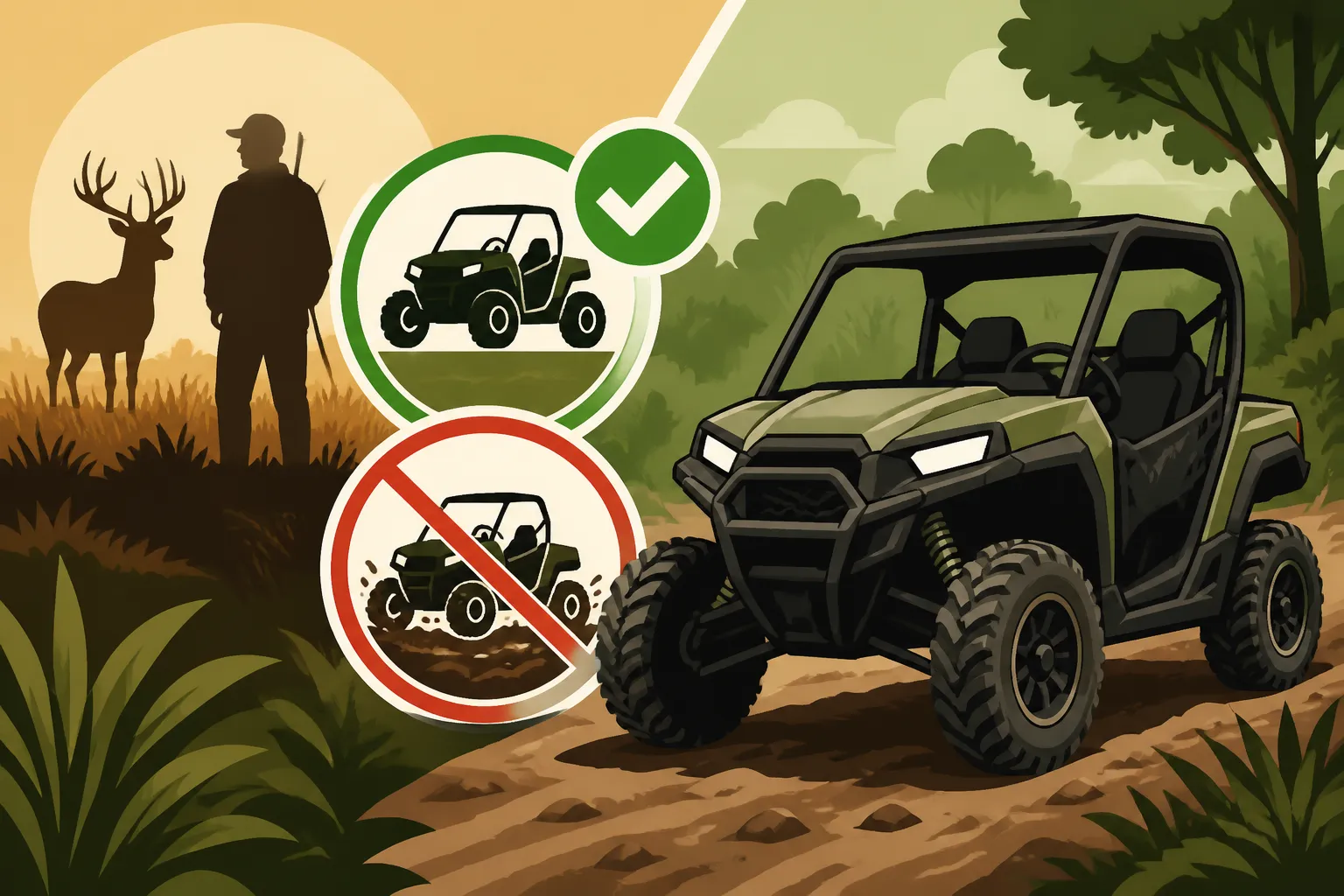
All-Terrain Vehicles (ATVs) and Utility Task Vehicles (UTVs) are incredibly useful for hauling gear, retrieving game, and covering ground, but their use on Mississippi's public lands is often subject to strict controls. On many MDWFP Wildlife Management Areas, ATV and UTV use is generally restricted to designated roads and trails, often marked clearly with signs. Some WMAs might even prohibit them entirely in certain units or during specific seasons to minimize disturbance to wildlife or to reduce user conflict. It's not uncommon to find areas where these vehicles are only allowed for game retrieval, and even then, often with specific permitting or time restrictions. For example, some WMAs might require you to obtain a daily permit to use an ATV for deer retrieval.
National Forests tend to have a more extensive network of forest service roads, and while many are open to street-legal vehicles, ATV and UTV access is typically limited to specifically designated ATV trails or roads that are part of an identified motorized vehicle use system. ATV Rules on Mississippi Forest Roads are very specific, and you absolutely need to consult the Motor Vehicle Use Maps (MVUMs) provided by the USFS for the particular forest you're hunting. These maps clearly mark which routes are open to what types of vehicles and during which times of the year. Violating these rules is a common way hunters end up with tickets, as these areas are regularly patrolled.
Pickup Trucks and Passenger Vehicles
For the majority of public land hunters, pickup trucks and passenger vehicles are their primary mode of transport to and through hunting areas. On most WMAs and National Forests, these vehicles are generally permitted on all roads that are open to public vehicular traffic, provided they are designated and maintained for such use. This means main gravel roads, paved access roads, and many well-maintained dirt roads are fair game. However, even with these vehicles, you cannot create your own road or drive cross-country. Stay on established, designated routes.
It’s important to note that many public land areas have gates that are seasonally closed or permanently locked to prevent unauthorized access and protect wildlife habitat. You might be able to drive a considerable distance, only to hit a gate that requires you to park and proceed on foot. Always pay attention to signage. Parking also falls under this category; generally, you must park in designated parking areas or safely off the traveled portion of the road, ensuring you don't block traffic or gates. Leaving your vehicle haphazardly can lead to a ticket or even having it towed, which is a headache no one needs.
Electric Bicycles and Game Carts
With the rise of electric bicycles (e-bikes) and other non-motorized or low-impact forms of transport, many hunters are wondering about their legality on public lands. Rules for e-bikes are still evolving and can be a bit of a gray area, often depending on how the managing agency classifies them. Some classify them as motorized vehicles, meaning they'd fall under ATV/UTV restrictions, while others treat them more like traditional bicycles, allowing them on foot-access-only trails. Always check with the specific WMA or National Forest before assuming you can ride an e-bike into restricted areas.
Traditional game carts, manual bicycles, and walking are always safe bets. These methods are generally allowed wherever foot traffic is permitted, which often includes roads and trails closed to motorized vehicles. When you hit a closed gate or a "foot traffic only" sign, a game cart can be a lifesaver for hauling gear further into the woods or for retrieving an animal. It’s a great way to access those deeper, less pressured areas without running afoul of vehicle rules.
| Vehicle Type | Typical WMA Restriction (MDWFP) | Typical National Forest Restriction (USFS) | Notes |
|---|---|---|---|
| Passenger Vehicle | Designated roads, parking areas only. No driving cross-country. | Designated paved/gravel/dirt roads only. Consult MVUMs. | Must be street-legal. Park off main thoroughfare, not blocking gates. |
| ATV/UTV | Designated roads/trails only, often with specific seasonal/daily permits for retrieval. | Designated ATV trails/roads shown on MVUMs. Strict enforcement. | Check specific WMA/Forest rules carefully. Often prohibited entirely in certain areas or during specific times. |
| Electric Bicycle | Varies widely. May be treated as motorized or non-motorized. | Varies widely. Check specific Forest/WMA for current interpretation. | Always verify with the managing agency. Assume motorized until confirmed otherwise to avoid issues. |
| Game Cart/Manual Bike | Generally allowed anywhere foot traffic is permitted. | Generally allowed anywhere foot traffic is permitted. | Excellent for accessing areas beyond vehicle gates and for game retrieval. Low impact and always compliant where motorized vehicles are not. |
Staying on the Right Track: Road Access, Parking, and Closures
Understanding the rules on paper is one thing, but applying them in the field requires vigilance. Public lands are dynamic, and conditions can change. What was open last week might be closed today due to weather, maintenance, or specific management actions. Always approach with a mindset of verification rather than assumption.
Designated Roads and Trails
The golden rule on most public lands in Mississippi is to stick to designated roads and trails. This means roads clearly marked as open for vehicle traffic and maintained for that purpose. These are not just any two-track dirt path that looks passable. Official maps, especially USFS Motor Vehicle Use Maps (MVUMs) for National Forests, explicitly show which routes are open to motorized travel. These maps are often updated annually and are your legal guide. I always recommend downloading the relevant MVUM to your phone's mapping app, or printing a physical copy, before heading out. Using the MDWFP App Without Cell Service can also be incredibly helpful for WMAs, allowing you to view boundaries and some road information even when offline.
Driving off-road, creating new trails, or bypassing barriers is strictly prohibited. This type of activity causes significant environmental damage, including soil erosion, destruction of vegetation, and disturbance to wildlife. It also leads to stricter regulations for everyone. If a road is gated, signed as "foot traffic only," or simply doesn't appear on your official map as a designated vehicle route, assume it's closed to your truck, ATV, or UTV. When in doubt, walk it out.
Parking and Access Points
Finding a legal and considerate place to park your vehicle is just as important as knowing where you can drive. Most WMAs and National Forests will have designated parking areas at trailheads, along main roads, or near popular access points. These spots are usually clearly marked and designed to accommodate hunters and other users. When these designated spots are full, or if none are available, you must park in a way that does not obstruct roads, gates, or other access points.
This usually means pulling completely off the main traveled portion of the road, ensuring there’s ample room for other vehicles, including emergency services or agency personnel, to pass easily. Never park in a way that blocks a gate, even if it's currently open. Those gates can be closed at any time, and your vehicle could be trapped or towed. Be mindful of private property boundaries when parking, especially near public land interfaces. You don't want to accidentally trespass while parking before your hunt.
Seasonal and Weather-Related Closures
Mississippi's weather can be unpredictable, and this often leads to seasonal or temporary road closures. Heavy rains can turn dirt roads into impassable mud bogs, or even make them structurally unsound. To prevent damage to infrastructure and to protect natural resources, land managers will close roads. These closures are typically announced on the MDWFP website for WMAs or the USFS website for National Forests. Always check these resources before your trip, especially after periods of significant rainfall.
Beyond weather, some roads are subject to seasonal closures to reduce disturbance to wildlife during critical periods, such as nesting season for ground-dwelling birds or during deer fawning. Other roads might be closed to vehicle traffic during certain hunting seasons, effectively turning them into walk-in zones to create quality hunting experiences in less-pressured areas. Understanding the specific WMA or National Forest's annual operating schedule is crucial. Don't just assume if it was open last year, it's open this year.
The Cost of Missteps: Penalties for Vehicle Violations
It’s easy to think of a minor transgression as "no big deal," but violating vehicle rules on public land in Mississippi can carry serious consequences. These aren't just polite suggestions; they are enforceable laws designed to protect wildlife, habitat, and ensure fair access for all users. The penalties can range from a minor inconvenience to significant financial burdens and even the loss of your right to hunt.
Fines and Penalties
Driving in restricted areas, operating an ATV on a closed trail, or parking illegally can result in substantial fines. These tickets often start in the hundreds of dollars, and they can escalate quickly depending on the severity of the violation and whether you're a repeat offender. For example, if you're found operating an illegal vehicle in a sensitive habitat, the fine could be much higher than a simple parking violation. Law enforcement officers, including game wardens and forest rangers, actively patrol these areas, and they are not hesitant to issue citations.
Beyond monetary fines, you might also face additional administrative fees or restitution for any damage caused to the land. Imagine driving through a newly planted food plot or tearing up a soft trail during wet conditions – you could be on the hook for those repair costs. These penalties are designed to deter illegal activity and remind everyone that public lands are a shared resource that must be respected. Nobody wants to end a successful hunt with a heavy wallet due to a preventable fine.
Vehicle Impoundment and Forfeiture
One of the most severe consequences of vehicle violations is the impoundment or even forfeiture of your vehicle. If your vehicle is found in an area where it's strictly prohibited, or if it's used in the commission of a serious offense (like illegal hunting activities), it can be seized by law enforcement. Getting an impounded vehicle back typically involves paying hefty towing fees, storage fees, and any associated fines, which can quickly add up to thousands of dollars.
In extreme cases, especially with repeat offenses or severe environmental damage, the vehicle could even be subject to forfeiture, meaning the state takes permanent possession of it. This is particularly true for ATVs and UTVs used repeatedly in areas designated as closed. It's a stark reminder that the rules are there for a reason, and ignoring them can cost you far more than just a hunting license. Don't let a moment of poor judgment or a lack of research lead to losing your valuable equipment.
Loss of Hunting Privileges
Perhaps the most impactful penalty for a hunter is the potential loss of hunting privileges. Violations of public land rules, especially those related to vehicle use, can lead to the suspension or revocation of your hunting license, not just in Mississippi, but potentially in other states as well through interstate compacts. This means you could be barred from hunting for a year, several years, or even for life, depending on the severity and frequency of your offenses.
For many of us, hunting is more than just a hobby; it's a way of life, a connection to nature, and a source of food. Losing that privilege because you couldn't be bothered to check a map or obey a sign is a devastating outcome. Always prioritize understanding and adhering to the specific rules for the area you're hunting. It's not just about avoiding fines; it's about preserving your ability to enjoy the outdoors and protecting the resources for future generations. Remember, the game wardens aren't out to ruin your day, they're enforcing rules that protect the very opportunities we all cherish on public land.
Disclaimer
This article is for general informational purposes only and does not constitute professional advice. Laws, prices and regulations vary by location and change over time. Consult a qualified professional for guidance on your specific situation.