Measuring a Ten-Inch Hills Spread by Eye
One of the trickiest parts of deer hunting in Mississippi, especially when you’re out in the Hills Unit, is accurately judging a buck's antler spread by eye. You've got precious seconds to make a decision, and misunderstanding that 10-inch rule can lead to a big headache. This guide is all about giving you the practical tools and visual cues to confidently judge a legal buck’s spread on the fly, helping you hunt smarter and stay within the regulations.
Understanding Mississippi's Hills Unit Antler Restrictions
Mississippi's deer management strategy includes specific antler restrictions in certain units, and the Hills Unit is a prime example where judgment calls are paramount. It’s not just about seeing a buck; it’s about making sure it’s a legal buck before you even think about raising your rifle or drawing your bow.
The Importance of Accurate Eye-Ball Measurement
Let's be real, nobody wants to harvest an illegal deer. It’s a gut-wrenching feeling, not to mention the potential fines and loss of hunting privileges. In the Hills Unit, the regulation states that a buck must have an outside antler spread of at least 10 inches or a main beam length of at least 13 inches. While main beam length requires a bit more estimation, the 10-inch spread rule is often where hunters get tripped up. You're trying to quickly assess a living, moving target through brush, changing light, and sometimes even the jitters of buck fever. It’s a challenge that demands practice and a solid understanding of what you’re looking for. Understanding Hills Unit Ten-Inch Spread Rule Explained is your first step to being a responsible hunter in this region. This rule isn't just arbitrary; it's designed to help foster a healthier deer herd and allow younger bucks to mature, contributing to better hunting opportunities down the line.
What a 10-Inch Spread Actually Looks Like
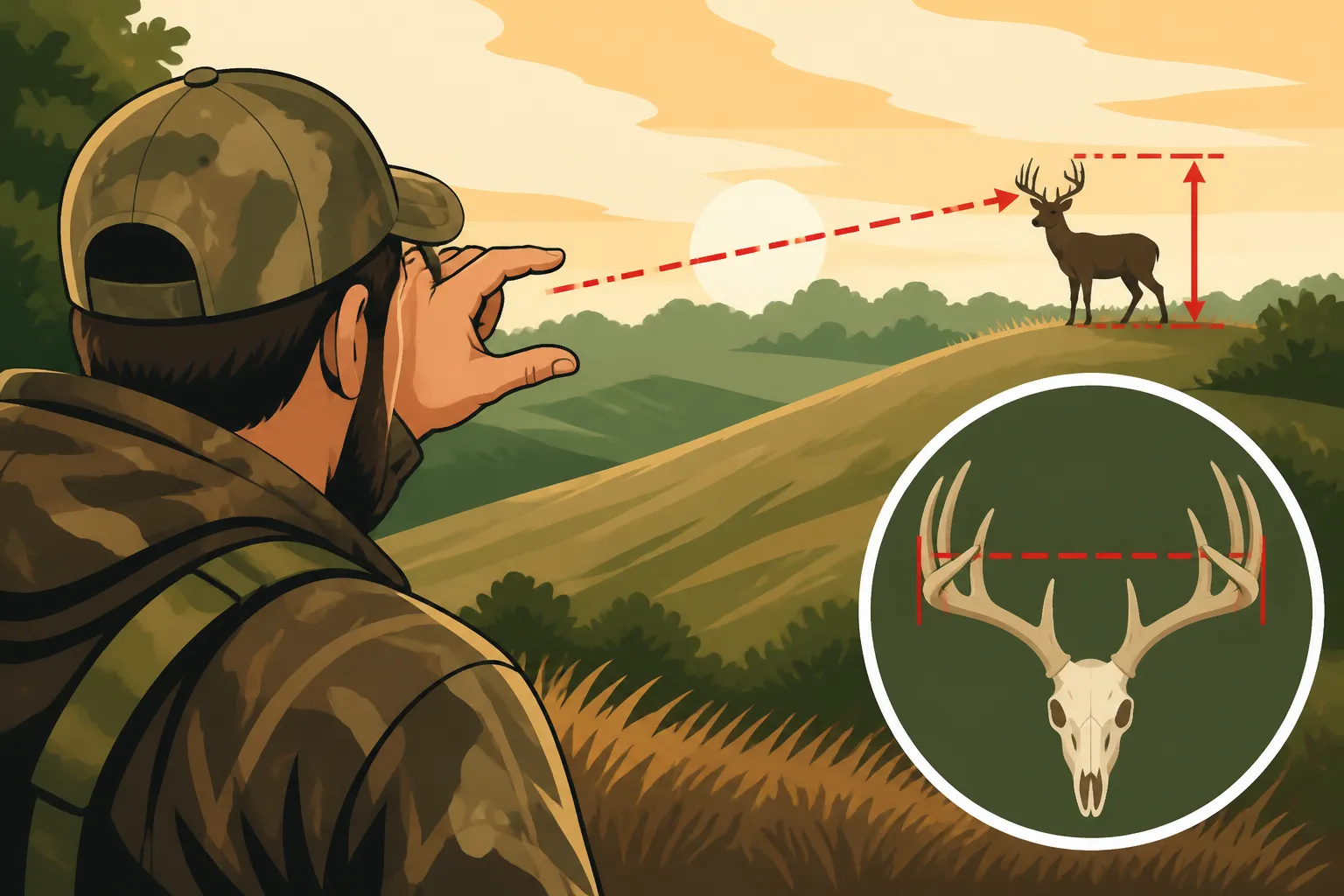
Visualizing 10 inches in the field is much harder than it sounds. If you’ve ever held a tape measure to a deer mount, you know how quickly those inches add up or shrink depending on your perspective. For a 10-inch outside spread, think about the distance between your knuckles if you spread your pointer fingers and thumbs wide apart. Another common reference point is the width of a standard piece of printer paper, which is 8.5 inches. So, a 10-inch spread would be just a little wider than that.
It's crucial to remember that this isn't about guesswork; it's about forming a consistent mental image. When you're in the stand, trying to determine if a buck meets the requirement, you need a quick, reliable comparison in your mind. This visual benchmark is your best friend when those critical moments arise. Many hunters find it helpful to look at photos or videos of deer with known antler measurements during the off-season to build this visual library.
Practical Techniques for Field Judging Spread
When that buck steps out, you're not going to have a tape measure handy. You need quick, reliable tricks you can deploy in seconds. Mastering these visual cues can make all the difference between a legal harvest and a missed opportunity—or worse, an illegal one.
Using the Deer's Ears as a Reference
This is probably the most widely used and effective field judging technique. Most mature whitetail bucks in Mississippi, including those in the Hills Unit, have ears that are approximately 6-7 inches from tip to tip when they are alert and angled forward. While this can vary slightly depending on the individual deer and its exact ear position, it provides a very strong baseline.
For a 10-inch outside spread, you're generally looking for antlers that extend noticeably beyond the tips of the ears. If the main beams barely reach the ear tips, or are inside them, that buck is likely not meeting the 10-inch minimum. If the antlers are well outside the ear tips, encompassing a good deal of air on either side of the head, you're probably looking at a legal buck. Practice this by observing any deer you see, even does, and mentally superimposing a "10-inch line" using their ear spread as a guide. This quick mental calibration will serve you well when you're Hunting the Rut in the Hills Unit and bucks are on the move.
The Head-Width Method
Another useful trick is to use the deer's head width itself as a reference. The width of a mature buck's head, from eye to eye or just behind the eyes, is typically in the 5-6 inch range. This can be a bit harder to gauge precisely than the ear-tip method, especially if the deer isn't facing you directly. However, it can serve as a secondary confirmation.
If the antlers extend well past the widest part of the buck's skull, not just the ears, you're often looking at a legal deer. This method requires a bit more attention to detail because head size can vary more than ear spread. Combine this with the ear-tip method for a double-check. A useful exercise is to estimate the width of the deer's head, then mentally double it. If the antlers are wider than that estimated double-width, you're likely in good shape for the 10-inch rule.
Body Proportions and Angles
Beyond the head and ears, the overall body proportions of the deer can offer subtle clues, though these are less precise for exact spread. Older, more mature bucks tend to have thicker necks, broader chests, and a more developed body overall. While body size doesn't directly correlate to antler spread, a truly mature buck is more likely to carry a legal rack. Conversely, a young, spindly-bodied buck, even if it has a decent spread, might still be skirting the 10-inch minimum.
The angle at which you view the deer also plays a huge role. A buck quartering away from you will make its antlers appear narrower than they actually are, especially if the angle is steep. A buck facing directly away or towards you offers the most accurate perspective on spread. If a deer is broadside, it can be easier to judge relative to the ear tips, but even then, a slight head turn can distort perception. Always try to get as broadside a view as possible or wait for the deer to turn its head directly towards or away from you for the most reliable assessment. This is especially true when you’re attempting to make a quick decision on a deer that just popped out while Still-Hunting Hills Unit Ridges.
Training Your Eye for the Moment of Truth
Field judging isn't an innate talent; it's a skill you develop and hone. The more you practice, the more confident you'll become when a potential shooter steps into your shooting lane.
Off-Season Practice with Known Measurements
The off-season is your secret weapon for developing a keen eye. Grab an old set of antlers, or even just a piece of plywood cut to 10 inches wide. Place it at various distances—50 yards, 100 yards, 150 yards—and look at it through your binoculars, scope, or even just with your naked eye. This helps you build that crucial mental database of what 10 inches looks like at different ranges.
You can also use household items. A standard dinner plate is roughly 10 inches in diameter. Cut out a cardboard silhouette of a deer head and attach a 10-inch width across it. Practice looking at it from various angles and distances. The goal is to make the mental comparison almost automatic, reducing the stress and uncertainty when it really counts during Mississippi Gun Season Opening Day. Even better, if you have a friend who hunts, compare notes on bucks you've seen and what you believe their spreads to be, then confirm if possible.
Utilizing Scouting Tools and Technology
Modern hunting technology has come a long way in helping us prepare. Trail cameras are invaluable for off-season scouting and getting an idea of the deer on your property or public land. When reviewing trail camera photos, pause on pictures of bucks and try to estimate their spread relative to their ears. Many mapping apps, like GoHunt, offer features that let you measure distances on aerial photos, which can be useful for understanding scale in the landscape where you'll be hunting. While GoHunt primarily focuses on Western big game, the principle of using mapping tools to understand terrain and scale is transferable. This can help you anticipate how a deer might look at a given distance in a specific area you've scouted.
When you're out scouting before the season, perhaps when you are Scouting Mississippi Public Land Before Season, bring a small tape measure and measure branches or rocks that are roughly 10 inches wide. Then step back and look at them through your binoculars. The more you familiarize your eyes with actual measurements in a real outdoor setting, the better you’ll become. You can also use trail camera images to review and practice your judging skills. Trail Camera Rules on Mississippi Public Land will guide you on legal placement, ensuring your practice is within regulations.
The Impact of Distance and Lighting
Distance is perhaps the biggest culprit in misjudging antler spread. The farther away a deer is, the smaller it appears, and its antlers will seem narrower than they truly are. A buck that looks like a sure thing at 50 yards might suddenly look questionable at 150 yards. Always err on the side of caution with distance. If you're questioning it at 100 yards, it's probably best to pass or try to get closer for a clearer view.
Lighting conditions also play a significant role. In low light, at dawn or dusk, or under heavy tree cover, antlers can appear as dark silhouettes, making it nearly impossible to discern width or tines. Sunlight filtering through trees can create shadows that distort the appearance of the rack. Overcast days generally offer the most consistent lighting for judging. If the light is poor, and you can't clearly see the antler boundaries and how they relate to the ears, then you simply can't make an accurate judgment. Patience in these situations is key. Wait for better light or for the deer to move into a more open area. Reading Aerial Photos for Hills Unit Deer can help you identify open areas or travel corridors where you might get a better view.
Common Mistakes and How to Avoid Them
Even experienced hunters can fall victim to certain psychological traps or optical illusions when adrenaline is pumping. Being aware of these common pitfalls can significantly improve your accuracy.
Rushing the Shot
This is probably the most common mistake. Buck fever is real, and it makes you want to pull the trigger the second you see antlers. But those few extra seconds, even a slow count to five, can be the difference between a legal harvest and a regretful one. Take a deep breath. Slow down your heart rate. Put your binoculars on the deer (if possible and safe), and consciously run through your mental checklist: "Are the antlers wider than the ears? How far past the ears do they extend? Does the head-width method confirm?"
Don't let the excitement overshadow your responsibility. If you feel rushed, it's often a sign that you haven't made a conclusive judgment. There will always be another deer, another season. Passing on a questionable buck, even if it turns out to be legal, is a far better outcome than taking an illegal one. This patience is especially valuable when considering the long-term health of the deer population, as seen in Mississippi Deer Harvest Records.
Misjudging Angles
We touched on this earlier, but it deserves extra emphasis. A buck walking away from you will always look narrower than it is. Conversely, a buck quartering towards you can sometimes make its antlers appear wider than their actual spread. The ideal scenario is a broadside view, or the buck facing directly at or away from you.
If a buck is at an odd angle, your best bet is to wait. Be patient. Deer rarely stand perfectly still for long. Eventually, it will likely turn its head or body, giving you a clearer, more accurate perspective. You might even try to subtly make a soft grunt call to get its attention, which often causes a deer to stop and look in your direction, giving you that crucial moment for a true assessment of its spread.
The "Ground Shrinkage" Phenomenon
Ah, "ground shrinkage"—the hunter's lament. This is when a buck looks massive through your scope but shrinks considerably once you walk up to it. It’s a very real psychological effect, often caused by adrenaline, poor lighting, or simply wishing that deer was bigger than it truly is. To counteract ground shrinkage, always add a "mental buffer." If you think a buck is just 10 inches, consider passing or getting a better look, because by the time you walk up to it, it might be 9.5 inches.
Instead, look for a buck where you are confident it is clearly over 10 inches. Aim for antlers that extend well past the ears, giving you that margin of safety. This is where all your off-season practice comes into play. The more accurately you can estimate 10 inches, the less susceptible you'll be to ground shrinkage. Remembering to report your harvest according to Mississippi Deer Reporting Requirements can help you reflect on your judgment calls season after season, improving your skills.
Here's a quick guide to visual cues for a 10-inch spread in the Hills Unit:
| Feature to Observe | Visual Cue for 10-Inch Spread (Approx.) | Notes |
|---|---|---|
| Ear Tips | Antlers extend noticeably beyond ear tips | Most reliable; average ear tip-to-tip is 6-7 inches. |
| Head Width | Antlers significantly wider than the skull | Use as a secondary confirmation. |
| Body Angle | Seek broadside or direct frontal/rear view | Avoid quartering angles for accurate judgment. |
| Distance | Appears clearly wider at 100+ yards | Allowance for "ground shrinkage." |
| Confidence | You feel no doubt about the measurement | If in doubt, let it walk or gain a better vantage point. |
Always remember that these rules, and your judgment, are part of the larger framework of Mississippi Deer Season Structure Explained. It’s about being an ethical and responsible hunter, ensuring the health and sustainability of the deer population for years to come. The Hills and Southeast Unit Antler Restriction Rules are there for a reason, and respecting them makes all of us better stewards of Mississippi's wildlife.
Disclaimer
The information provided in this article is for general guidance only and does not constitute legal advice. Hunting regulations in Mississippi can change, and it is the hunter's responsibility to consult the most current Mississippi Department of Wildlife, Fisheries, and Parks (MDWFP) regulations before engaging in any hunting activities. Always verify specific dates, bag limits, and legal requirements directly with the MDWFP.