Tracking a Deer Through Mississippi Leaf Litter
There are few moments in hunting as gut-wrenching as making a shot on a deer, feeling good about it, and then walking up to where it stood only to find sparse sign or, worse, nothing at all on that thick, crunchy Mississippi leaf litter. It’s a frustrating reality for many hunters, where the forest floor seems to conspire against your efforts to recover your game. This guide is all about equipping you with the knowledge and tactics to confidently track a deer through even the most challenging leaf-strewn landscapes found throughout our state.
The Unique Challenges of Mississippi Leaf Litter
Mississippi's diverse ecosystems, from the bottomland hardwoods of the Delta to the pine forests and mixed woods of the Hills and Piney Woods, all present their own unique tracking puzzles. But one constant is the ubiquitous leaf litter, a beautiful yet often maddening layer that makes blood trailing a true test of skill and patience.
Understanding the Forest Floor Dynamics
When you're out there trying to pick up a trail, it's easy to just see a "forest floor." But if you slow down and really observe, you'll notice that the composition of that leaf litter changes dramatically depending on where you are. In the vast bottomland hardwood tracts, especially in areas like the Delta National Forest or Mahannah Wildlife Management Area, you're dealing with immense piles of oak, maple, and sweetgum leaves. These leaves, particularly when dry, create a thick, springy carpet that absorbs blood like a sponge and makes subtle scuffs nearly impossible to see. A deer might leave a tiny drop of blood, and within seconds, it wicks into the dry organic matter, leaving almost no visible trace. When wet, however, this same litter can become matted, sometimes allowing for clearer impressions or blood pooling, but also making it easier for rain to wash away vital sign.
Contrast this with the piney woods of regions like the DeSoto National Forest or areas of the Piney Woods region, where pine needles dominate. While pine needles can be easier to see tracks in if they're deep enough, they also shed very little blood on their surface. A deer bleeding out often has the blood trapped within its fur, only to drip out when it stops or walks over taller vegetation. The varying density of undergrowth also plays a huge role. In some areas, you might have relatively open understory, making it easier to scan. In others, thick privet, briar patches, or cane brakes can swallow a wounded deer whole, and then trying to follow a trail through that dense cover becomes a whole other ball game. You're not just looking for blood; you're looking for disturbed vegetation where something big pushed through.
Visual Obstacles and False Positives
One of the biggest headaches when tracking in heavy leaf litter is the sheer amount of visual noise. Every fallen twig, every disturbed patch of leaves from a squirrel digging for an acorn, every gust of wind scattering debris can look like a sign from your deer. It can be incredibly disheartening to spend minutes meticulously examining what you thought was a blood drop, only to realize it's just a rust-colored leaf or a wet spot. The brain naturally wants to see what it's looking for, leading to these frustrating false positives.
Moreover, the way a deer's blood interacts with leaves is often far from ideal. Instead of a clear, bright red trail, you often find scattered, dark specks that have absorbed into the leaf surface. These tiny, inconsistent drops can be nearly invisible, especially under the dappled light of a forest canopy. A deer might be bleeding profusely internally, but the external sign is minimal if the entry and exit wounds are high or the blood is clotted by fur. This is particularly true if you hit a deer high in the shoulder or back. You might find a single, tiny smear on a leaf, and then nothing for 20 yards. It’s enough to make you second-guess your shot and your tracking ability. Understanding these nuances is crucial for maintaining patience and preventing frustration from derailing your efforts.
Essential Gear and Preparations for Tracking
Successful tracking, especially through challenging terrain like Mississippi’s leaf litter, often comes down to preparation and having the right tools on hand. Don't wait until you've pulled the trigger to think about what you'll need.
Lighting the Way: Flashlights and Headlamps
Let's be honest, almost every deer hunter has, at some point, found themselves tracking into the fading light or well after dark. This is where a quality light source isn't just helpful; it's absolutely non-negotiable. Forget that cheap pocket flashlight you carry for emergencies. You need a powerful, focused beam that can cut through the gloom and, ideally, highlight blood.
Many experienced trackers swear by a good headlamp. Why? Because it keeps your hands free to push aside branches, hold your rifle, or steady yourself as you lean in to examine a tiny spec. Look for headlamps with multiple brightness settings and a long battery life. Even better, some modern flashlights and headlamps come with different color filters. Blue light, in particular, can make dried blood stand out much more vividly against the browns and greens of the forest floor, a trick that can make all the difference when you're on a sparse trail. I always carry at least two primary light sources – a powerful handheld flashlight and a reliable headlamp – plus extra batteries for both. You never want to be caught out in the dark with a dead light, especially when you're actively Blood Trailing After Dark in Mississippi.
Marking the Trail: Tape and GPS
When you're moving slowly, meticulously examining every square inch of the forest floor, it's incredibly easy to lose your last known spot, especially if you lift your head for a moment or detour around an obstacle. This is why marking your last confirmed sign is paramount.
Simple flagging tape, typically bright orange or pink, is your best friend here. Every time you find blood or a clear track, tie a piece of tape to a branch right above it. Make sure you can see the previous piece of tape from your current marker. If you lose the trail, you simply fall back to your last marker and start searching in a wider circle. Some hunters even prefer biodegradable toilet paper, as it's less obtrusive and breaks down over time, though it might not hold up as well in wet conditions. Make sure to remove your markers on your way out if you're on public land, respecting the regulations and leaving no trace.
For a more high-tech approach, a good GPS device or a hunting app on your smartphone, like GoHunt, is invaluable. Every time you confirm blood, drop a waypoint. This creates a digital breadcrumb trail that allows you to see your progress, know your exact location, and easily backtrack if necessary. It’s also incredibly helpful for visualizing the deer’s path, which can help you anticipate where it might be headed – perhaps toward water or thick cover. If you're out on a WMA like Copiah County Wildlife Management Area or Caston Creek Wildlife Management Area, an app that works with cached maps (or one like GoHunt that functions even without cell service) is critical, as reception can be spotty. Remember, always have a fully charged phone or an external battery pack if relying on an app.
Additional Tracking Aids
Beyond lights and markers, a few other items can make your tracking efforts more successful. A good pair of binoculars, even small ones, can help you scan ahead from your last marked spot, looking for the deer itself or more obvious signs like a downed tree or a patch of disturbed leaves indicating movement. Sometimes, seeing the next obvious sign from a distance saves you a lot of crawling on your hands and knees.
While not directly for tracking, consider wearing scent eliminators if you plan to back out and return later. You don't want to leave your human odor all over the trail, potentially pushing the deer further away if it's still alive. And finally, appropriate footwear. You need something quiet that allows you to move slowly and deliberately, but also offers good support and traction for navigating uneven terrain and potential wet areas. You don't want to be making a ton of noise that would spook a bedded deer.
Step-by-Step Tracking Techniques in Leaf Litter
The moment you realize the deer isn't piled up where you shot it, a methodical approach is essential. Panic or rushing will only make things worse, particularly when dealing with tricky Mississippi leaf litter.
The Grid Search and "Cutting" the Trail
Once you've exhausted the immediate vicinity of the shot site and found minimal or no blood, it's time to get systematic. The first step is to establish a clear starting point – the last place you definitively saw blood or sign. Mark it clearly. From there, instead of just walking randomly, try a grid search pattern. Start by moving in a straight line out from your last sign, scanning intently. If you find nothing, take a few steps to the left or right, and then move parallel to your first line. Continue this, slowly expanding your search area. It's tedious, but it maximizes your chances of picking up a faint sign that you might otherwise miss.
Another powerful technique is "cutting" the trail. This is especially useful if you lose a faint trail and can't immediately pick it up in your grid search. From your last confirmed sign, walk in a large arc away from the presumed direction of travel, looking for tracks or blood on the outer edge of where you think the deer might have gone. For example, if you think the deer went straight north, walk 50-75 yards east, then walk north, parallel to the original direction, looking for sign. If you find nothing, walk west, parallel, for a similar distance. This wide arc can pick up a deer that veered slightly, or give you a fresh perspective on the trail. Remember, deer often follow the path of least resistance or head towards thick cover. Knowing how to use features like a Hanging a Stand on a Delta Bottomland Funnel or understanding deer movement along natural barriers can give you an edge in predicting their path.
Interpreting Scrapes, Scuffs, and Other Subtle Signs
Blood is king, but it's not the only sign. In leaf litter, you often have to become a detective, piecing together a story from subtle clues. Look beyond the obvious. A wounded deer will often leave more than just blood. Pay attention to disturbed leaves – are they ruffled or pushed aside in a way that suggests a heavy animal recently moved through? Look for scuff marks where a hoof dragged, especially if the deer is hit in a leg. Broken twigs or branches that wouldn't normally be broken at that height are also prime indicators. A deer that is struggling to move will often break branches that an uninjured deer would simply step over.
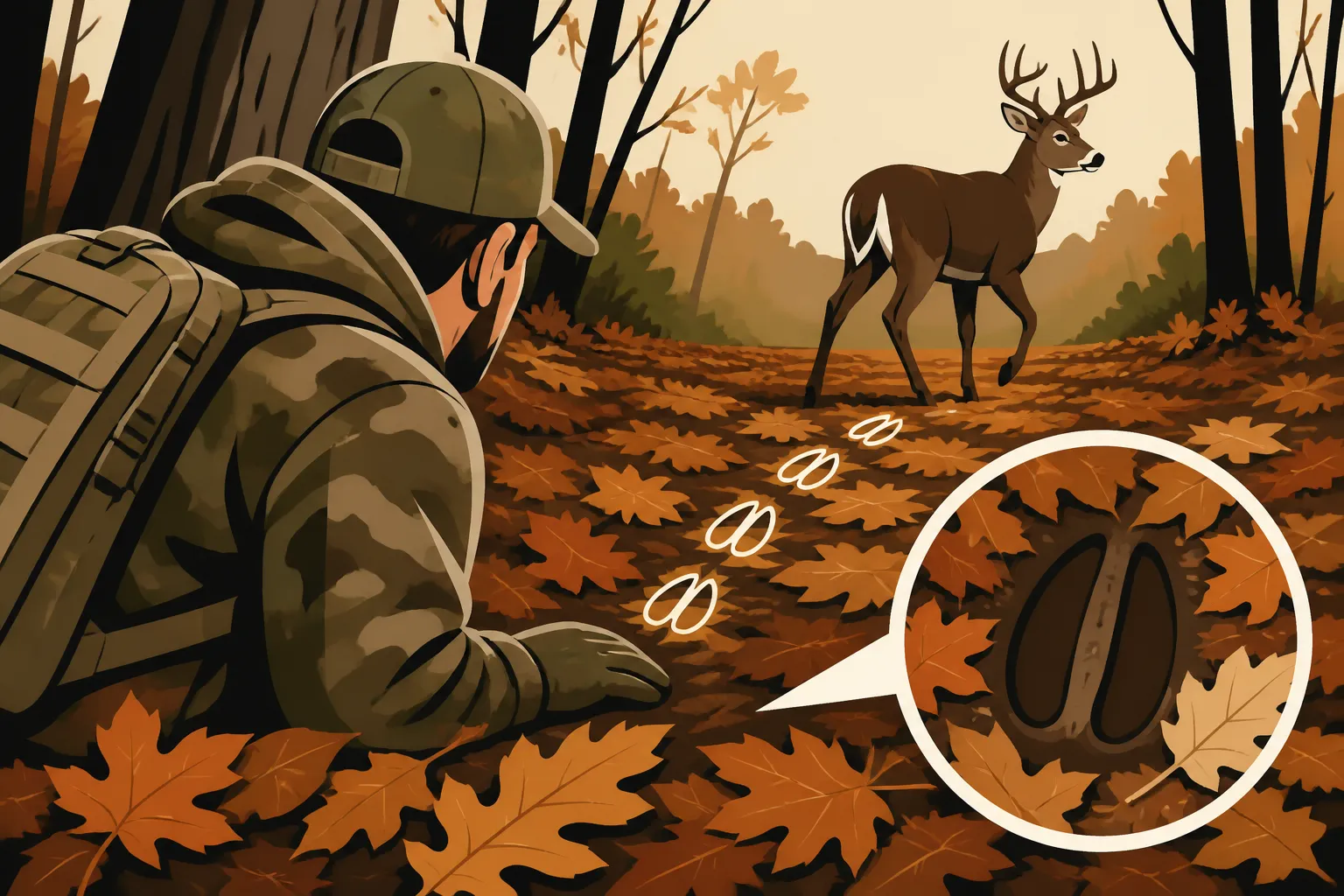
Another critical sign is tracks. While hard, dry leaf litter might not show clear tracks, look for patches of softer ground, muddy areas, or even just a slight depression in deeper leaves. Pay attention to the stride – an injured deer will often have an uneven gait, with one leg leaving a shallower or more disturbed impression. If you find a spot where the deer has stopped for a moment, look for fresh droppings or urine, especially if it's mixed with blood. If you suspect the deer has bedded down, look for an impression in the leaves, often with fresh blood around the edges. When a buck is moving hard during the rut, perhaps heading towards a hot doe, these subtle signs can be harder to spot, but a wounded animal will almost always leave some sort of disturbance.
When to Back Out and Call for Help
Knowing when to back out is just as important as knowing how to track. If the blood trail completely vanishes, or if you're only finding tiny, widely scattered drops, pushing too hard can ruin your chances. If you suspect a gut shot or a less-than-ideal hit, giving the deer time is often the best strategy. A gut-shot deer will often bed down within a few hundred yards and expire if left undisturbed for several hours (4-6 hours minimum, or even overnight). Pressuring it will only push it further, making recovery much harder. The ideal waiting period can also be influenced by conditions. For example, if you're dealing with Field Dressing a Deer in Warm Weather concerns, a longer wait might not be feasible without risking meat spoilage.
If you’ve exhausted your efforts, don’t be afraid to call for help. Many communities in Mississippi have experienced trackers or even certified tracking dog services. Tracking dogs can often pick up a scent trail that human eyes could never detect, even hours or a day later, especially if the ground scent is still viable. Always check local regulations about using tracking dogs – while generally legal for wounded game recovery, specific rules might apply, especially on public land. Remember, the goal is ethical recovery of the animal, not personal glory.
Factors Influencing Your Tracking Success
Beyond your gear and technique, several factors entirely outside your control can dramatically impact your tracking success through Mississippi's challenging leaf litter.
Shot Placement and Immediate Deer Reaction
The type of shot you make fundamentally dictates the kind of blood trail you can expect and the deer’s immediate reaction. A perfectly placed heart or double-lung shot will usually result in a short track, often with good blood, as the deer expires quickly. You might even hear the deer crash within earshot. A high shoulder shot or a spine shot will drop a deer on the spot, or at least severely incapacitate it.
However, things get tricky with other hits. A liver shot might produce dark, reddish-brown blood, often with some digestive material, and the deer might travel a good distance before bedding. Gut shots, as mentioned, are the worst – green or brownish material mixed with blood, often sparse, and the deer can travel for miles if pushed. Muscle hits (leg, ham) will produce bright red blood, but often with little internal damage, meaning the deer might not bleed out quickly and could survive. Even a perfect shot doesn't guarantee a bright red carpet on the ground; often, blood can be matted in the hair until the deer beds down or its body cavity fills up. It’s important to watch the deer's reaction closely after the shot – a kick, a hunch, or a burst of speed can all tell you something valuable about where you hit it. This is why a good follow-up shot is crucial if the deer is still standing.
Environmental Conditions
Mississippi weather is notoriously unpredictable, and it can be your best friend or worst enemy when tracking. Rain is perhaps the biggest adversary. A heavy downpour can wash away a blood trail in minutes, leaving you with nothing but disturbed leaf litter to follow. If rain is forecast, you have a very narrow window to track, and waiting is often not an option. Light drizzle, however, might actually help by wetting the leaves and making blood stand out a bit better, but too much will still erase it.
Dry conditions mean less blood spreading on the surface of leaves, as it wicks directly into the porous material. It also means leaves are loud underfoot, making it harder to move quietly and listen for the deer. Conversely, very wet conditions or recent rain can make leaves lie flat, sometimes revealing clearer tracks, but also making the blood more susceptible to washing away.
Temperature is another huge factor, especially concerning meat spoilage. In Mississippi’s warmer early archery season or during the peak of the Hunting the Rut in the Hills Unit in late fall, temperatures can still be quite high. If you make a marginal shot, you might be forced to make a difficult decision: risk pushing the deer to recover it quickly, or let it lie longer and risk meat spoilage. This is a tough ethical call that every hunter faces. Always consider the temperature when deciding how long to wait.
Understanding the dynamics of wind and thermals, especially in varied terrain like the Loess Bluff Hills or the extensive bottomlands, is also key. A wounded deer will often try to use the wind to its advantage, bedding down where it can smell danger approaching. Knowing how to read these subtle shifts can help you predict where a deer might choose to hide.
Here’s a quick guide to interpreting blood on the trail:
| Blood Color/Consistency | Typical Shot Location | What to Expect | Tracking Difficulty |
|---|---|---|---|
| Bright Red, Foamy/Bubbles | Lung | Deer typically won't go far; crash within 100-150 yards. | Moderate to Easy |
| Bright Red, Mixed with Hair | High Shoulder/Muscle | Deer might live, or bleed out slowly. Sparse trail. | Difficult |
| Dark Red, Watery, No Bubbles | Heart/Artery | Deer drops quickly, heavy blood trail. | Easy |
| Dark Red/Brown, Clotting | Liver/Muscle | Deer travels far, beds down. Consistent but not massive trail. | Moderate to Difficult |
| Dark Red/Brown, With Chunks/Contents | Gut/Stomach | Deer travels very far if pushed. Sparse, inconsistent trail. | Very Difficult |
| Pinkish/Red, Milky, Small Spots | Leg/Flesh Wound | Deer will likely survive, very sparse blood trail. | Extremely Difficult |
Knowing these indicators can help you make an informed decision about how long to wait, how aggressively to track, and whether to call in reinforcements. Whether you're Scouting Mississippi Public Land Before Season or simply using an app like GoHunt to mark your progress, every piece of information helps stack the odds in your favor.
Disclaimer
The information provided in this guide is for informational purposes only and is based on general hunting practices and regulations. Hunting regulations, seasons, and licensing requirements can change frequently. Always consult the latest Mississippi Department of Wildlife, Fisheries, and Parks (MDWFP) official regulations before engaging in any hunting activities. Adherence to all local, state, and federal laws is the hunter's responsibility. Safety should always be your top priority.