Setting Decoys on a Farm Pond
Hunting farm ponds for ducks in Mississippi can be incredibly rewarding, but let's be honest, it also comes with its fair share of head-scratching moments. You've scouted, you've seen the birds using a particular pond, but when you set up, they just seem to circle out of range or flare at the last second. It's frustrating, and often, the key lies in how you're setting your decoys. This guide is all about equipping you with the knowledge to effectively place your spread, turn those wary circles into committed approaches, and ultimately, put more ducks in the bag on Mississippi's often overlooked farm pond hotspots.
Understanding the Farm Pond Dynamics
Before you even think about tossing out your first decoy, you've got to become a detective of sorts. Farm ponds, even small ones, have a lot going on beneath the surface and along their edges. Ignoring these subtle cues is a common mistake and can lead to ducks giving your spread a wide berth.
Reading the Water and Shoreline
Every farm pond, no matter how small, has its own unique character. You need to observe it closely to understand how ducks are naturally using it. Are there shallow edges where dabblers like mallards and wood ducks can tip up to feed on submerged vegetation or invertebrates? Look for subtle depth changes, perhaps a slight drop-off near the dam, or a muddy flat that’s been exposed in drier times. Ducks often prefer certain depths for different activities. They might loaf in a slightly deeper, more protected section, and feed in the shallower margins.
Pay close attention to any existing cover along the shoreline. Overhanging trees, cattails, or a stand of brush provide natural windbreaks and a sense of security for resting ducks. These areas often become natural loafing zones, even without decoys present. If you can replicate that sense of security with your spread, you're already one step ahead. Identifying these natural "sweet spots" is paramount, as your decoy spread should funnel birds into them, or at least mimic activity there. It’s not just about throwing plastic birds out; it's about telling a story that makes real ducks comfortable enough to join.
Wind Direction and Duck Approach
This is probably the single most critical factor that many hunters overlook or underestimate, especially on smaller bodies of water. Ducks, being incredible aviators, almost universally land and take off into the wind. Think of it like an airplane needing a headwind for lift. On a small farm pond, this means the wind dictates precisely where they will attempt to set down. If your decoy spread doesn't account for this, you're essentially asking ducks to land awkwardly, which they simply won't do.
Before you even launch your boat or wade out, check the wind direction. You want to set your decoys so that there's a clear, open "landing strip" directly into the prevailing wind, pointing towards your blind or concealment. The ducks will typically approach from downwind, swing wide, then turn into the wind to commit to the landing zone you've created. If the wind shifts during your hunt, and believe me, it often does in Mississippi, you need to be prepared to adjust your spread. A quick re-alignment of your decoys can turn a frustrating lull into a productive flight. Failure to adapt to changing wind is a surefire way to watch birds sail past, never offering a shot.
Essential Decoy Spreads for Farm Ponds
Once you’ve read the pond and understood the wind, it’s time to deploy your feathery ambassadors. But how you arrange them can make all the difference between a successful hunt and watching ducks fly by. Simplicity and realism are often the winning tickets on smaller waters.
The Classic "J" or "U" Spread
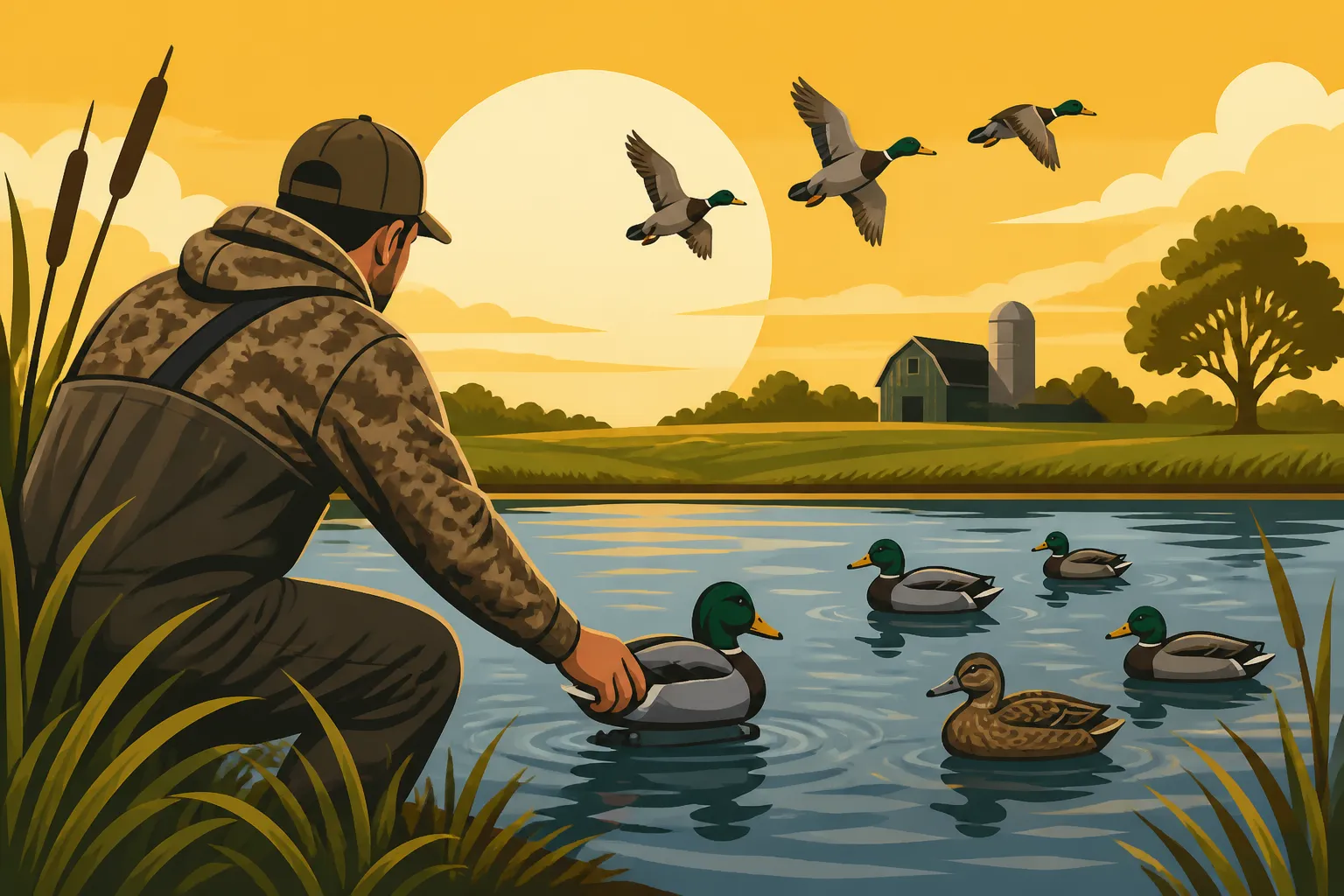
This is a go-to spread for a reason – it works. The idea behind the "J" or "U" spread is to create a natural-looking open pocket, or "kill hole," directly in front of your blind or concealment. The main body of your decoys forms the long leg of the "J" or one side of the "U," extending away from your position, while a smaller group or a few individual decoys forms the shorter curve. Ducks will naturally want to land in that open water, seeking safety among the "feeding" birds.
For farm ponds, it's crucial not to make this spread too large or too sparse. On smaller water, a wide-open "U" can look unnatural. A tighter "J" shape, with the hook facing your blind, usually works better. Keep the decoys relatively close together, mimicking a natural raft of ducks feeding or loafing. This tightness provides a sense of security to incoming birds. The open water should be big enough for ducks to commit to landing, but not so vast that it looks like an empty void. Remember to always orient this open pocket so ducks can land directly into the wind. If the wind shifts, you might need to adjust the curve of your "J" to maintain that critical landing path.
Smaller, More Realistic Spreads
A common mistake hunters make on farm ponds is deploying too many decoys. On a vast open lake, a massive spread might be necessary to grab attention, but on a cozy farm pond, it can look artificial and overwhelming. Smaller ponds typically hold smaller groups of ducks, so a sprawling, unrealistic spread can actually deter wary birds. Instead, focus on quality over quantity and create a scene that genuinely looks like a few contented ducks enjoying a quiet spot.
Consider using just a dozen or two decoys, perhaps even fewer if the pond is tiny. Group them into smaller clusters of 3-5 birds, with a few singles spaced naturally. Mix up your species, but keep it realistic for what you'd find in Mississippi. Mallards are a staple, of course, but don't forget about the ever-present wood ducks, especially if there are trees around. You might even throw in a few pintail or gadwall if you've seen them in the area. A company like GoHunt, known for its focus on smart hunting solutions, might even offer compact, realistic decoy sets specifically designed for smaller water or mobile hunts, making it easier to transport and deploy a lifelike spread without overdoing it. A small, lifelike spread often outperforms a huge, artificial one when targeting smart, pressured birds.
Adding Movement and Realism
Still decoys can work, especially on unpressured birds or during low-light conditions. But let's face it, ducks are constantly moving – tipping, dabbling, preening, or simply paddling. Adding even a subtle hint of motion to your spread can be a game-changer, especially on a calm day when your plastic birds look particularly lifeless. This flicker of activity can draw distant birds' attention and make your setup appear far more inviting.
The simplest form of movement is a jerk string. A few decoys rigged to a string that you can pull from your blind can simulate ducks paddling or feeding, sending ripples across the water. Battery-operated spinning wing decoys, like Mojos, can be incredibly effective, especially from a distance, but use them judiciously on smaller, more pressured ponds. Sometimes, one spinner is enough; too many can make a spread look robotic. Consider using them in conjunction with your main spread, perhaps set slightly apart to mimic a lone drake landing. There are also simple current-activated decoys or even "swimmer" decoys that create realistic ripples. The key is to make it look effortless and natural, not like a carnival attraction. Even a subtle ripple can catch a duck's eye and convince them to take a closer look at your spread.
Concealment and Hunter Placement
You can have the most perfectly set decoy spread, but if the ducks spot you, it's all for naught. Concealment is arguably as important as the decoys themselves, especially on smaller, more intimate farm ponds where birds are often closer and more wary.
Maximizing Natural Cover
The best blind is often no blind at all, but rather skillful use of existing natural cover. On a farm pond, this might mean tucking yourself into a thick line of cattails, positioning yourself behind a downed tree, or huddling within a dense patch of riparian brush. The goal is to blend seamlessly into the environment, breaking up your human outline entirely. Ducks have incredible eyesight, and they can pick out a silhouette or an unnatural shape from a surprising distance.
Before setting up your blind, take a few minutes to survey the pond from the perspective of an incoming duck. Lie down, stand up, move around – how visible are you from different angles? Position yourself with the sun at your back if possible, so that incoming birds have to look into the glare. Always put your concealment on the downwind side of your landing zone, ensuring ducks are focused on approaching the decoys rather than looking directly at you. Overdressing your blind with too much material can also make it look unnatural and out of place. Use just enough to disappear, allowing the natural surroundings to do most of the work for you.
Portable Blind Options for Limited Cover
Sometimes, a farm pond just doesn't offer enough natural cover to disappear completely. Maybe it's a freshly mowed bank, or a pond surrounded by open pasture. In these situations, portable blind options become your best friend. The key is to keep them low-profile, easy to set up, and well-camouflaged. You don't want a towering fortress that screams "hunter!" to every passing bird.
Simple A-frame blinds that can be quickly erected and brushed in with local vegetation are excellent choices. Layout blinds, typically used in open fields for geese, can also be adapted for pond edges if you can effectively brush them in with grass or mud. Even a simple ghillie blanket draped over yourself while sitting against a large tree or a slight rise can provide enough breakup to fool ducks. The critical factor is to ensure your portable blind blends with the existing vegetation. Carry a few zip ties or bungee cords to secure natural brush to your blind. And remember, the less you move in the blind, the better. Ducks are much more likely to spot movement than a static, camouflaged shape.
Adapting to Duck Behavior and Pond Conditions
No two hunts are ever exactly alike. What worked last week might not work today, and what works on one pond might fail spectacularly on another. Being able to adapt to the specific conditions and the behavior of the ducks you're hunting is what separates consistently successful hunters from those who just get lucky.
Scouting Before the Hunt
This cannot be overstated: effective scouting is the cornerstone of successful farm pond hunting. You can have the best gear and the most elaborate decoy spread, but if the ducks aren't using that particular pond, or if they're only using it at specific times, you're just wasting your time. Drive around, use binoculars from a distance, or sneak into position well before daylight. Look for fresh droppings, tell-tale "puddle rings" from feeding dabblers, or actual birds on the water.
Pay attention to when they use the pond. Is it a morning spot, an afternoon loafing spot, or an evening fly-in for the night? Also, observe their flight paths. Do they typically approach from a certain direction, perhaps following a creek or a treeline? This information will tell you exactly where to set up your blind and orient your decoys. Tools from companies like GoHunt, which often integrate mapping features or satellite imagery, can be invaluable for identifying potential ponds and access points, though ground scouting is always king for real-time intel. Without diligent scouting, you're essentially hunting blind, hoping for dumb luck.
Adjusting Spreads for Wary Birds
You've set your spread, you're hidden, and birds are working it… but they're flaring at 50 yards. This is a classic sign of wary, pressured birds, a common occurrence on many accessible Mississippi farm ponds. Don't be stubborn; it's time to adapt. Often, the solution is counter-intuitive: less is more. Try reducing the number of decoys in your spread. Sometimes, a handful of hyper-realistic decoys is more effective than a dozen mediocre ones.
Another tactic is to increase the spacing between your decoys. Wary birds sometimes perceive a tight cluster as a trap, or simply don't like to land amidst too many other birds. Giving them a bit more room in the kill hole can make them feel safer. You might also try moving your kill hole slightly closer to your concealment, or conversely, further away if they're flaring at a very close distance. Sometimes, simply removing any spinning wing decoys if you're using them can make a huge difference, as pressured birds can become "spinner shy." Remember, ducks that have been shot at before are incredibly sensitive to anything that seems off. Constantly evaluate their reactions and be willing to make significant changes to your setup until you find what they're comfortable with.
Weather and Time of Day Considerations
The weather and the time of day play a massive role in how ducks behave and how effective your decoy spread will be. A clear, calm, bluebird day can be tough. Ducks can see everything, and without wind to create ripples or move decoys, your spread might look static and uninviting. On such days, incorporating movement, like a jerk string or a single, well-placed spinning wing decoy, becomes even more critical.
Conversely, windy, overcast, or even rainy days can be a duck hunter's dream. The low light provides natural concealment, and the wind adds motion to your decoys and breaks up your outline. Ducks also tend to fly lower and more aggressively in adverse weather. During a cold front, birds might pour into a pond seeking refuge and food. Your decoy spread should still be realistic, but you might find ducks are less discerning. Remember that duck migration timing through Mississippi is heavily influenced by cold fronts, often bringing in fresh birds. Early morning shoots usually see birds heading from roosts to feed, while late afternoon can bring them back for loafing or evening feeding. Adapting your setup to these daily patterns and the prevailing weather will increase your odds of success.
| Decoy Spread Type | Description | Pros | Cons | Ideal Conditions |
|---|---|---|---|---|
| "J" or "U" Spread | Decoys form a J or U shape, creating an open landing zone (kill hole). | Clearly defines a landing area; very effective for funneling birds. | Can look unnatural if too large for the pond; requires wind consideration. | Moderate wind, active ducks, average-sized farm ponds. |
| Small Realistic Cluster | 6-12 decoys in 2-3 tight groups, mimicking feeding/loafing birds. | Highly natural appearance; less intimidating for wary birds; easy to move. | May not grab attention from very distant birds; less defined landing zone. | Calm days, pressured birds, small ponds with limited space. |
| Movement Heavy Spread | Uses jerk strings, spinning wing decoys, or swimmers with static decoys. | Excellent for attracting attention; adds realism on calm days. | Can look artificial if overdone; spinning wing decoys can flare wary birds. | Calm days, low wind, clear skies, trying to attract distant birds. |
| Mixed Species Spread | Mallards, Wood Ducks, Pintails, etc., grouped naturally. | More realistic for Mississippi ponds; appeals to a wider range of birds. | Requires species-specific decoys; proper mixing is key for realism. | Ponds with diverse duck populations; any wind condition. |
Disclaimer
Hunting is an activity with inherent risks. Always prioritize safety, understand and follow all local, state, and federal hunting regulations, and ensure you have the appropriate licenses and permits. The information provided here is for educational purposes and should not replace professional guidance or personal judgment. Be mindful of property boundaries and obtain proper permission before hunting on private land.