Night Hunting Hogs With Lights on Private Land
The relentless march of feral hogs across Mississippi farmlands and timber country is a headache no landowner wants. These destructive creatures aren't just an occasional nuisance; they decimate crops, tear up valuable habitat, and reproduce at an alarming rate. Traditional daytime hunting methods, while effective to a degree, often miss the larger picture because hogs are incredibly adept at becoming nocturnal under pressure. That's why understanding the ins and outs of night hunting with lights on private land is absolutely crucial for any serious hog management strategy. This guide will walk you through the regulations, gear, and tactics to help you reclaim your property from these relentless pests under the cover of darkness.
Understanding Mississippi's Feral Hog Regulations for Night Hunting
Before you even think about loading up your truck for a night hunt, it’s paramount to understand the specific regulations that govern feral hog hunting, especially after sundown, here in Mississippi. While the state generally takes an aggressive stance on hog eradication due to the immense damage they cause, there are still rules in place that ensure safe and legal hunting practices. Misunderstanding these regulations could lead to fines, confiscation of equipment, or even loss of hunting privileges, which nobody wants when they're just trying to protect their land.
Private Land, Public Land, and Night Restrictions
One of the most significant distinctions you need to grasp is the difference in regulations between private and public lands when it comes to night hunting feral hogs. On private land, the Mississippi Department of Wildlife, Fisheries, and Parks (MDWFP) allows for year-round hunting of feral hogs, day or night. This flexibility is a direct response to the ecological and agricultural damage these animals inflict, granting landowners and those with permission greater freedom to manage populations. You can often see the evidence of their destructive rooting firsthand across countless acres, making these liberal rules a necessity. This means if you own the land or have explicit permission from the landowner, you generally have the green light to pursue hogs after dark.
However, the rules are drastically different if you venture onto public lands, such as Wildlife Management Areas (WMAs), National Forests, or other state-owned properties. On these lands, night hunting for feral hogs is almost universally prohibited. Public lands often have specific hunting seasons and hours, and night hunting for any species, including hogs, is typically restricted to preserve game species, manage hunter pressure, and ensure safety. Always double-check the specific regulations for any WMA or public land you intend to hunt. Even in areas bordering private land, it's vital to ensure you are legally on private property before engaging in night hunting activities. The goal is hog removal, but it must be done within legal parameters. For a more comprehensive overview, you can check the article on Mississippi Feral Hog Regulations.
Legal Lighting Equipment and Restrictions
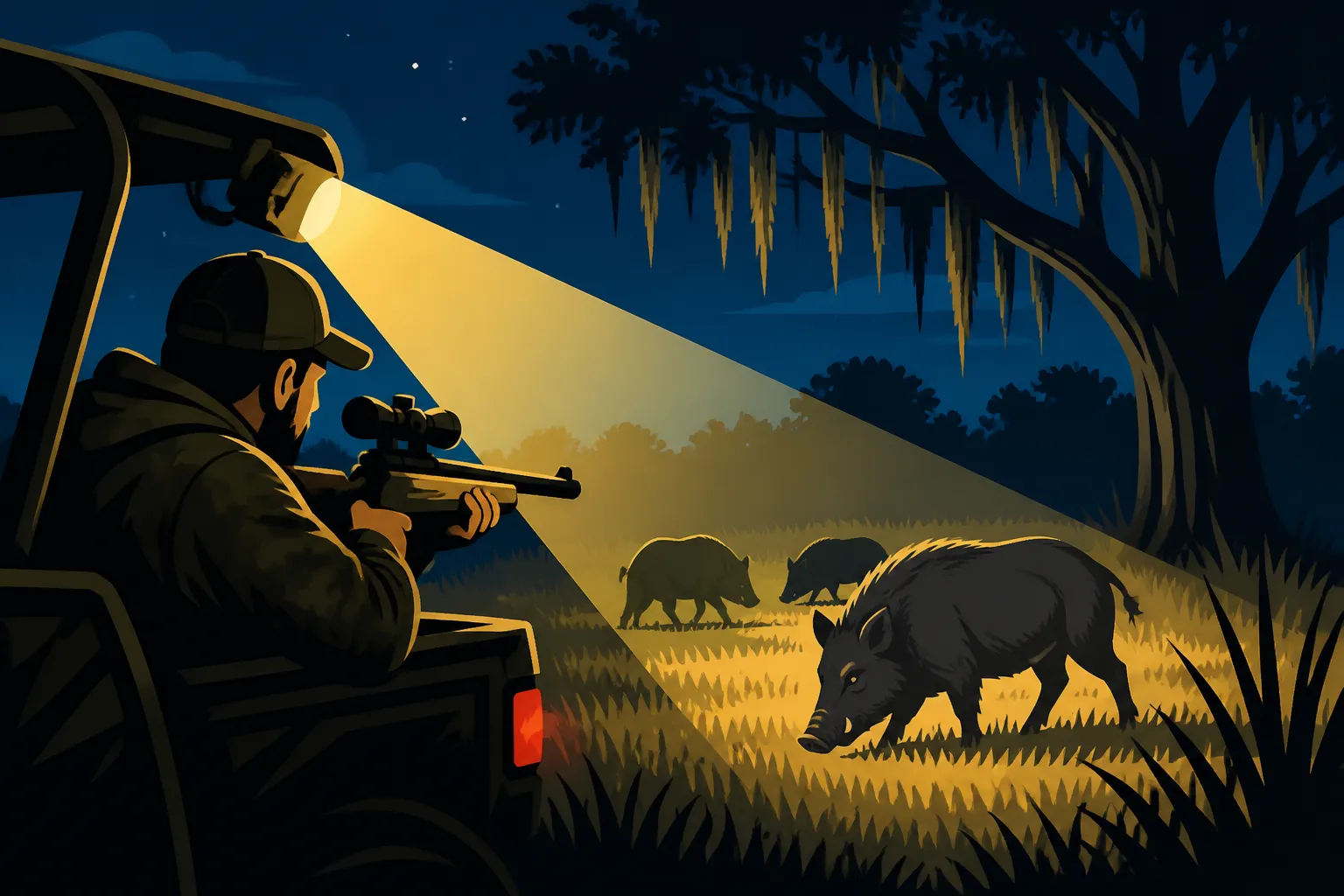
When it comes to illuminating the night for feral hogs, Mississippi offers some clear guidelines on what kind of lighting equipment is permissible. On private land, hunters are allowed to use artificial lights, including spotlights, headlamps, weapon-mounted lights, and even vehicle headlights. This broad allowance is a testament to the state's aggressive management stance. The key here is the private land aspect; these lighting tools are generally restricted or entirely prohibited on public hunting grounds. The specific rules regarding Night Hog Hunting Light Rules in Mississippi confirm this flexibility.
The type of light color can also be a factor in your success. While white light is most common and offers the clearest visibility, many experienced night hunters prefer red or green lights. Hogs, like many nocturnal animals, tend to be less reactive to red and green light spectrums compared to bright white light. This can allow you to spot them without immediately sending them scattering. Red lights are often preferred for their minimal impact on human night vision, while green lights tend to offer better contrast for identifying targets at a distance. Modern weapon-mounted lights, some from brands like GoHunt, often come with interchangeable filters or adjustable color settings, giving you the versatility to adapt to different scenarios and hog reactions. Experimenting with different colors can be really enlightening (pun intended) to see what works best in your specific hunting area and with your particular hog population.
Required Permits and Permissions
Even though feral hogs are considered a nuisance species and there's no bag limit or closed season on private land in Mississippi, you still need to adhere to basic legal requirements. First and foremost, you must possess a valid Mississippi hunting license. This isn't just for deer or turkey; it covers all legal hunting activities in the state, including hog removal. There isn't a separate "hog permit" in Mississippi, but your general hunting license is your foundational document. For non-residents, this might involve a different set of licenses, so be sure to check the MDWFP website or consult a local agent.
Beyond your personal license, the most critical "permit" for night hunting on private land is explicit permission from the landowner. Verbal permission is legally sufficient in Mississippi, but it’s always a good idea to get it in writing. A simple, dated note stating you have permission to hunt feral hogs, day or night, on their specific property can save a lot of headaches if a game warden or curious neighbor has questions. This also helps clarify access routes and boundaries, which are especially important when hunting in the dark. Always remember, without this permission, you are trespassing, and the consequences can be severe. The article, Do Feral Hogs Need Landowner Permission?, details this crucial step further. Respect for private property is paramount, and a good relationship with landowners ensures continued access for hog control efforts.
Why Night Hunting is So Effective for Feral Hogs
If you've spent any amount of time trying to manage hog populations during daylight hours, you've likely encountered their frustrating ability to vanish. They're incredibly intelligent and adaptable. This is precisely why shifting your efforts to after-dark operations can dramatically increase your success rate and impact on the local population. Night hunting taps into their natural instincts and behavioral patterns in a way that daytime pursuits simply can't match, making it a critical component of any serious hog management strategy.
Hogs' Nocturnal Nature and Behavior Patterns
Feral hogs are not inherently nocturnal, but they quickly become so when faced with hunting pressure. In areas where they are heavily pursued during the day, they learn to move, feed, and breed under the cover of darkness. This behavioral shift is a survival mechanism, and it's incredibly effective for them. They'll spend daylight hours bedded down in the thickest cover they can find – dense briar patches, swamps, or deep timber – only to emerge en masse once the sun dips below the horizon. This is particularly true in agricultural areas where they feed on crops, as fields offer little cover during the day.
When you're out at night, you're not just hunting; you're often catching them at their most active and vulnerable. They might be rooting up a freshly planted field, traveling along a well-used game trail, or watering at a secluded pond. Their senses are adapted for low light conditions, but a sudden beam of red or green light can often surprise them, giving you precious seconds for a clean shot. Understanding this nocturnal switch is key to why night hunting is not just an alternative, but often the primary strategy for effective hog control in heavily hunted areas across Feral Hogs Across Mississippi.
Cooler Temperatures and Hog Activity
Another significant factor contributing to the effectiveness of night hunting, especially in Mississippi's often sweltering climate, is the simple fact that nights are cooler. Hogs, particularly larger boars and sows, generate a lot of body heat and prefer to avoid the high temperatures and direct sunlight that can cause them to overheat. During the spring, summer, and early fall, daytime temperatures in Mississippi can easily soar into the 90s, making hogs much less active during those hours. They conserve energy, moving only when absolutely necessary, often retreating to cool mud wallows or dense, shady cover.
As soon as the sun sets and the temperatures drop, you'll notice a marked increase in their activity. They'll travel further, feed more aggressively, and be less cautious simply because the environmental conditions are more comfortable for them. This means that hunters targeting hogs at night are often observing a more natural, undisturbed pattern of movement and feeding. This is particularly noticeable during the warmest months when a daytime hunt might yield nothing but tracks, while a nighttime vigil could reveal entire sounders actively foraging. The temperature correlation is a major reason why night hunting yields such high success rates, providing a wider window of opportunity to encounter hogs at their most vulnerable.
Targeting Larger Sounders Under Cover of Dark
One of the most appealing aspects of night hunting feral hogs is the increased likelihood of encountering and effectively targeting entire sounders. During the day, particularly on properties experiencing heavy pressure, hogs tend to be more fragmented. They might move in smaller groups or even individually, making it harder to put a significant dent in the population. However, at night, when they feel more secure and the cover of darkness offers a perceived safety, sounders often consolidate. You're more likely to see multiple sows with their piglets, and even large boars, feeding together in open areas.
This behavior allows for more efficient culling. If you can approach a sounder unnoticed in the dark, using appropriate lighting, you have the potential to take down several animals in one encounter. This is a critical advantage when you're trying to reduce the sheer numbers of How Many Feral Hogs Mississippi Has that are rapidly reproducing. The ability to thin out an entire family group, including multiple breeding sows, has a much greater impact on long-term population control than taking individual hogs sporadically during the day. When you're managing a problem, dealing with a group is always more impactful than picking off stragglers, and night hunting provides that opportunity more readily.
Essential Gear for Successful Night Hog Hunting with Lights
Night hunting feral hogs isn't just about showing up after dark; it requires a specific set of tools to be safe, ethical, and successful. The right gear can make the difference between a frustrating, fruitless outing and a productive night of hog eradication. From how you illuminate your target to what you use to bring it down, every piece of equipment plays a crucial role in your overall strategy. Investing in quality, purpose-built gear is essential for anyone serious about effective night hunting.
Choosing the Right Lights: Red, Green, White
When venturing out to hunt hogs at night, your choice of illumination is paramount. You've got several options, each with its own set of advantages and disadvantages. The most common colors are white, red, and green, and often, the best approach is to have access to a couple of these.
- White Light: This is your standard flashlight beam. It offers the brightest, clearest illumination, making target identification easy and extending your effective visibility range. The downside, however, is that hogs are often more spooked by a sudden blast of bright white light. It can cause them to bolt immediately, especially if they are heavily pressured. If you're going to use white light, try to illuminate the area gradually or sweep the light over them quickly from a distance to gauge their reaction before a steady beam. Many weapon-mounted lights from brands like Streamlight or Olight offer incredible candela and lumen output, making target identification crystal clear, but discretion is key.
- Red Light: Many night hunters swear by red lights. The theory is that hogs (and many other nocturnal animals) don't perceive red light as well as other colors, making them less likely to be alarmed. This allows for a more subtle approach, giving you more time to get a steady aim. Red light also helps preserve your natural night vision, which is a huge plus for scanning unlit areas. However, red light doesn't offer the same clarity or range as white light, and distinguishing details on a hog can be harder, particularly at longer distances or in dense cover.
- Green Light: Green light falls somewhere in between red and white. It offers better visibility and contrast than red light, making it easier to see outlines and differentiate between a hog and its surroundings. Many hunters find that green light offers a good balance, providing enough illumination for clear target acquisition without being as jarring to hogs as white light. Like red light, it's generally less alarming to hogs than white light.
Ultimately, having a light system that can switch between colors or having separate lights for different purposes is a wise choice. A weapon-mounted light might be dedicated to a specific color (like green or red) for targeting, while a powerful handheld white light can be used for tracking after the shot or confirming an area is clear.
| Light Color | Advantages | Disadvantages | Best Use Case |
|---|---|---|---|
| White | Brightest, clearest vision, long range | Most likely to spook hogs, ruins night vision | Post-shot tracking, confirming areas, long-range ID |
| Red | Least likely to spook hogs, preserves night vision | Low clarity, poor contrast, shorter range | Close-range stalking, initial spotting, maintaining stealth |
| Green | Good clarity & contrast, less spooking than white | Can still alert hogs if too sudden | General night hunting, target acquisition, balancing stealth & vision |
Optics and Thermal Imaging Integration
While lights are fundamental, modern technology has brought optics to a whole new level for night hunting, particularly with the advent of thermal and night vision devices. These tools can dramatically enhance your ability to detect and identify hogs in complete darkness, far beyond what even the best spotlight can achieve.
- Night Vision: Traditional night vision amplifies ambient light (starlight, moonlight) to create a visible image. It's excellent for seeing in very low light conditions and can offer clear images, especially if you have some natural light sources. Gen 2 and Gen 3 night vision devices, whether monoculars, binoculars, or rifle scopes, can provide incredible detail. The downside is that they require some ambient light to work and can be washed out by bright artificial lights or direct light sources.
- Thermal Imaging: This is arguably the most revolutionary tool for hog hunting. Thermal imagers detect heat signatures, not light. This means they work equally well in absolute darkness, fog, or even light brush that would obscure visible light. Hogs, being warm-blooded, stand out like a beacon against the cooler background, making detection incredibly easy. You can spot hogs bedded down in thick cover, or moving through dense foliage, long before you could with traditional methods. Brands like Pulsar and ATN offer high-quality thermal scopes and monoculars that are incredibly effective. The primary drawbacks are the cost, which can be substantial, and the fact that thermal imagery doesn't provide the same level of detail as night vision or visible light, meaning positive identification of species can sometimes be a challenge at extreme distances, though for hogs, their distinct shape usually makes it clear.
Many serious hog hunters combine these technologies. They might use a thermal monocular for initial scanning and detection, then switch to a weapon-mounted red or green light for positive identification and the shot. Or, they might use a thermal scope on their rifle, allowing for detection and targeting all through one device. The key is to leverage these technologies to overcome the limitations of human vision in the dark, giving you an unparalleled advantage over these elusive animals. You can even use these tools for Scouting Mississippi Public Land Before Season to understand hog movement patterns.
Firearm Selection and Ammunition Considerations
The choice of firearm and ammunition for night hunting hogs is just as crucial as your lighting and optics. You need a setup that is reliable, accurate, and powerful enough to dispatch these tough animals efficiently and humanely.
- Rifle Selection: Many hunters prefer AR-style platforms for night hunting. Their modularity allows for easy attachment of lights, thermal/night vision optics, and suppressors (where legal, which they are for hunting in Mississippi). Common calibers include .223/5.56, 6.5 Grendel, .300 Blackout, and .308 Winchester. The .223/5.56 is perfectly adequate for hogs, especially with good shot placement, but heavier calibers like .308 or 6.5 Grendel offer more kinetic energy for larger hogs or less-than-ideal angles. Bolt-action rifles in calibers like .270 or .30-06 are also highly effective, though less conducive to rapid follow-up shots on a running sounder.
- Ammunition: When selecting ammunition, focus on bullets designed for maximum energy transfer and penetration. Soft point, ballistic tip, or bonded bullets are generally good choices. Avoid thin-jacketed varmint rounds that might fragment too quickly on a hog's tough hide and bone structure. For example, Hornady's SST or Winchester Power-Point are popular choices. Remember, a hog's vitals are positioned a bit differently than a deer's, so understanding Shot Placement on a Feral Hog is critical for a quick, ethical kill, especially in the dark.
- Shotguns and Handguns: While less common for dedicated night hunting with lights, shotguns loaded with slugs can be effective at close ranges, particularly in dense cover. Handguns in powerful calibers like .357 Magnum, .44 Magnum, or 10mm can also be used, though they are often reserved for backup or extremely close encounters.
- Suppressors: If legal in your area, a suppressor is an invaluable addition to a night hunting setup. It reduces muzzle blast and recoil, making follow-up shots quicker and less disorienting, both for the hunter and potentially for other hogs in a sounder. This can allow you to take multiple animals before the rest scatter. Many brands offer suppressors that are robust enough for hunting applications and can be easily mounted on most hunting rifles.
Always zero your chosen firearm and ammunition under conditions that simulate your night hunting environment as closely as possible. Dimming the range lights or shooting at dusk can help you get accustomed to your sights and optics in lower light, ensuring accuracy when it counts.
Strategic Approaches to Night Hunting Hogs on Private Land
Effective night hunting for feral hogs isn't just about having the right gear; it's about smart strategy. Hogs are clever and resilient, and to consistently put them down, you need to understand their patterns, anticipate their movements, and set yourself up for success. This involves careful planning, precise execution, and a good understanding of the local terrain and how hogs interact with it after dark.
Scouting and Baiting Strategies for Nocturnal Activity
Even though you're hunting at night, the groundwork for success begins long before sunset. Scouting during the day is absolutely essential to identify prime locations where hogs are likely to travel, feed, or water after dark. Look for fresh rooting, tracks, scat, and rubbed trees. Pay close attention to field edges, creek bottoms, travel corridors between thick cover and food sources, and wallows. Use tools like the GoHunt app on your phone to mark these hot spots with GPS waypoints, which will be invaluable when you're navigating in the dark.
Baiting is also a highly effective strategy for concentrating hogs and drawing them into a predictable location for a night hunt. Corn is a classic and highly effective bait choice. You can simply broadcast it, pile it, or use gravity feeders. Fermented corn or sour mash can be even more attractive due to its strong odor. Once you've established a bait site, consistency is key. Keep it fresh, and hogs will quickly learn to visit it regularly, often under the cover of darkness. Set up trail cameras with infrared flash (so as not to spook them) to monitor activity. These cameras will tell you exactly when hogs are visiting, how many, and which direction they're coming from. This intelligence is gold for planning your ambush. For more tips on attracting hogs, check out Building and Freshening a Hog Bait Site. Remember, baiting on private land for hogs is perfectly legal in Mississippi.
Stand Placement and Approach Tactics
Once you've identified active areas and established bait sites, careful stand placement is critical. For night hunting, a ground blind or a low-profile elevated stand is often preferred. You want to be comfortable, quiet, and have an unobstructed view of your bait site or travel corridor. Ensure your stand offers a safe shooting lane with a clear backstop beyond your target. Consider setting up 50-100 yards from your primary bait site to allow for optimal light spread and target identification.
Your approach to the stand is just as important as the stand itself. Hogs have excellent hearing and a phenomenal sense of smell. Plan your entry and exit routes carefully to minimize disturbance. Approach from downwind, well before hogs are expected to arrive, and take your time. Use natural terrain features or existing paths to mask your movement. Avoid making noise, and try to keep any artificial lights (like a dim headlamp for navigation) pointed downwards or away from the hunting area until you're settled. Once in your stand, remain absolutely still and quiet. Even subtle movements or sounds can alert hogs, sending them scattering into the night. Patience is your greatest ally.
Utilizing Wind and Thermals in Darkness
Just because it's dark doesn't mean the basic principles of scent control and understanding air currents go out the window. In fact, they become even more crucial because hogs rely heavily on their sense of smell in low-light conditions. Always hunt with the wind in your favor, positioning yourself downwind of where you expect the hogs to appear. A slight breeze can carry your scent hundreds of yards, alerting hogs long before they are in sight.
Thermals also play a significant role, particularly in hilly or undulating terrain. As the ground cools after sunset, air often flows downhill into valleys and low-lying areas. In the morning, as the ground warms, air rises. Understanding these thermal currents is vital. If you're hunting a ridge or a creek bottom, the thermals will dictate how your scent is carried. Early evening, thermals may still be rising for a short period before reversing and falling as the night progresses. Plan your hunt to coincide with favorable thermal patterns, especially if you're not using a ground blind that can help contain some of your scent. Continuously monitoring wind direction with a simple wind checker is a must, even in the dark, as unexpected shifts can spoil an otherwise perfect setup. GoHunt often integrates wind and weather data into their mapping layers, which can be invaluable for predicting these subtle changes.
Safety First: Night Hunting Best Practices
Night hunting introduces unique challenges and significantly heightened safety considerations compared to daytime hunts. Reduced visibility, altered perception, and the presence of firearms mean that every step must be taken with extreme caution and deliberate thought. Prioritizing safety isn't just a suggestion; it's a non-negotiable requirement to ensure everyone involved has a successful and incident-free experience.
Communication and Visibility with Hunting Partners
If you're hunting with a partner or as part of a group, clear and constant communication is absolutely paramount during a night hunt. Before you even step foot in the woods, establish a detailed plan: who will be where, what are the shooting lanes, and what are the signals for various situations (e.g., "hog spotted," "safe to shoot," "all clear").
Use two-way radios with earpieces to communicate quietly and effectively without alarming game. Avoid shouting or loud talking, which can spook hogs and make it harder to hear. Define clear zones of fire for each hunter to prevent crossfire incidents. In the darkness, it's incredibly easy to become disoriented, or for a hog to run in an unexpected direction, leading to a dangerous situation if hunters aren't aware of each other's precise locations. Consider wearing reflective armbands or vests when moving to and from stands, especially if there's any chance of other hunters in the vicinity. The goal is to always know where your partners are, and for them to know where you are, at all times. This shared awareness is your best defense against accidents.
Target Identification in Low Light
This is perhaps the most critical safety aspect of night hunting. In the dark, even with the aid of lights, night vision, or thermal optics, positive target identification can be challenging. You must be 100% certain of your target before you pull the trigger. Feral hogs can resemble other animals in certain lighting or through less detailed optics. You're hunting on private land, but there might be legal game, domestic animals, or even other people in the vicinity.
Never point your weapon at anything you haven't positively identified as a feral hog and confirmed is in a safe firing lane. Use your lights and optics to clearly discern the animal's shape, size, and movements. If there's any doubt, do not shoot. This applies equally to thermal imaging; while excellent for detection, thermal often lacks the detail for absolute identification. Always follow up with a visible light source (red or green, often weapon-mounted) to confirm it’s indeed a hog, and not, for example, a deer, which might be out of season or otherwise protected. The momentary flash of light to confirm is a small price to pay for preventing a tragic mistake. Remember, once that bullet leaves the barrel, there's no taking it back.
Post-Shot Protocol and Recovery in Darkness
The moment of truth—the shot—is only part of the equation. Successfully recovering a hog in the darkness presents its own unique set of challenges. A wounded hog can be dangerous, and tracking a blood trail at night is significantly harder than during the day.
After taking a shot, observe the hog's reaction carefully. Did it drop immediately? Did it run? If it ran, note the direction and any sounds it made. Wait a minimum of 15-30 minutes before initiating a track, allowing the hog to expire or stiffen up. When you do begin tracking, use a powerful white light, ideally with a wide beam, to search for blood. Blood can look different under artificial light, so move slowly and methodically. Mark the last spot you saw the hog or blood with a reflective marker, and continue doing so every few yards. This prevents you from getting lost or losing the trail if the blood sign becomes sparse.
If the trail goes cold, don't push it too hard. It's often better to back out and return at first light to continue the search. Trying to push a potentially wounded hog in the dark can make it harder to find and increase the risk of a dangerous encounter. Always approach a downed hog with extreme caution, especially if it's still moving. Use your light to verify it's deceased before approaching closely. Remember the basics of Handling a Hog After the Shot, even more so in the dark. A careful, systematic approach to recovery ensures both your safety and that of your hunting partners, while also ensuring you don't lose the animal you've ethically harvested.
Disclaimer
Please note that hunting regulations, seasons, and licensing requirements are subject to change by the Mississippi Department of Wildlife, Fisheries, and Parks (MDWFP). Always consult the latest official MDWFP regulations before planning any hunting trip. The information provided in this guide is for informational purposes only and should not be considered legal advice. It is the responsibility of each individual hunter to know and abide by all applicable hunting laws and regulations.