Working a Creek Bottom for Late-Season Deer
Late season deer hunting in Mississippi can feel like a completely different ballgame than the early weeks. The leaves are down, the deer have been pressured for months, and they've gone from carefree browsing to cautious, almost entirely nocturnal movements. It’s enough to make even the most seasoned hunter question their strategies. But don't throw in the towel just yet! If you're struggling to connect with whitetails when the temperatures drop and the pressure mounts, it's time to shift your focus to the unsung heroes of the late season: creek bottoms. These natural sanctuaries offer everything a wary deer needs to survive and thrive during the toughest parts of the season. This guide will walk you through exactly how to unlock their potential, giving you a real shot at a late-season deer.
Understanding Why Creek Bottoms Are Late-Season Sanctuaries
When the landscape outside the creek bottoms becomes barren and open, these areas transform into critical refuges for deer. They're not just random low spots; they're complex ecosystems that provide security, sustenance, and shelter that deer can't find anywhere else during the late season.
The Allure of Cover and Thermal Regulation
Think about it: when the rest of the woods are stripped bare, making every movement a gamble, creek bottoms retain a surprising amount of dense cover. This isn't just a few sparse trees; we're talking about thick stands of briars, honeysuckle, downed timber, and dense undergrowth that create an almost impenetrable fortress. Deer can disappear into these tangles, feeling invisible and safe from predators, including us hunters. This security is paramount when they've been bumped and harassed for weeks on end.
Beyond just hiding, these thickets also play a crucial role in thermal regulation. On those bitterly cold Mississippi mornings, the dense canopy and lower elevation in a creek bottom can actually be a few degrees warmer, shielding deer from biting winds. Conversely, if we get an unexpected warm spell, the shaded, moist environment of a creek bottom offers a cooler retreat. This dual benefit—both security and comfort—makes creek bottoms an irresistible draw for deer looking to conserve energy and avoid detection. It’s where they can truly relax, even if it’s just for a few hours in the middle of the day.
Reliable Food and Water Sources
Food and water become scarcer as the season wears on, but creek bottoms often hold out longer than higher, drier ground. While the prime acorn crop might be long gone, you can often find persistent mast crops like overcup acorns or water oak acorns that hang on later into winter, especially in the damper soils. Beyond acorns, these areas frequently support a variety of browse that remains palatable and accessible. Think about greenbrier, honeysuckle, or even certain privet varieties that provide much-needed nutrients when other vegetation has browned out.
And then there's the water itself. Even during dry spells, a creek bottom almost always has at least a trickle of water, or at minimum, moist ground. This constant access to hydration is vital, especially when deer are mostly feeding on drier browse or residual agricultural crops. A deer isn't going to stray far from its basic needs, and in the late season, those needs are consistently met within the confines of a healthy creek bottom. This combination of persistent food and reliable water creates a strong magnet for deer when resources are dwindling elsewhere, making them prime targets for hunters who understand this dynamic. For more on this, check out our guide on Late-Season Food Sources for Mississippi Whitetails.
Natural Travel Corridors
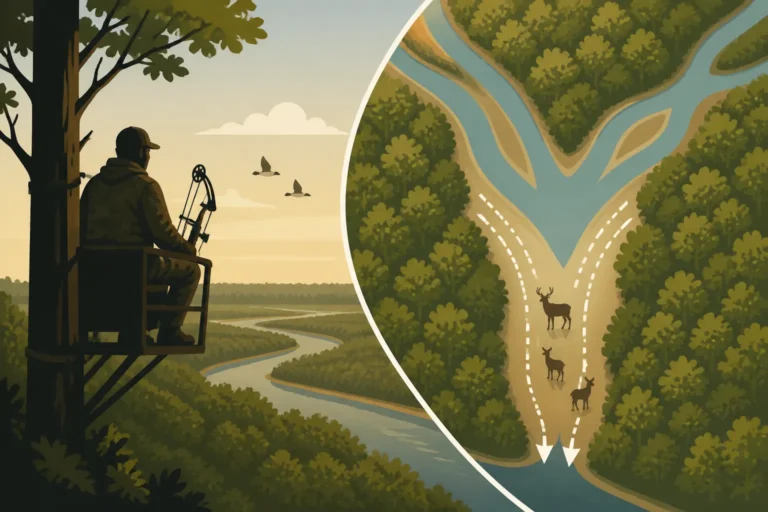
Deer, like most animals, are inherently lazy. They prefer the path of least resistance, especially when they're trying to move stealthily. Creek bottoms naturally create these pathways. The contours of the land, the banks of the creek, and the breaks in the thick cover form distinct travel corridors. These can be actual trails along the water's edge, or subtle funnels created by the vegetation itself.
Deer will use these corridors to travel between bedding areas, feeding locations, and water sources without exposing themselves in open timber or fields. They become superhighways of deer movement, particularly during low-light hours. Identifying these natural funnels and pinch points along the creek is paramount. A narrow bend in the creek, a crossing where the banks are low, or a section where a tributary feeds in can all concentrate deer movement, making your ambush much more effective. Even if the deer are largely nocturnal, these corridors provide a clear, defined area where they will eventually pass.
Scouting and Interpreting Creek Bottom Sign
Effective late-season hunting in creek bottoms isn't about blind luck; it's about meticulous scouting, even if that means walking in cold during the season. You need to become a detective, piecing together the subtle clues deer leave behind to understand their patterns and pinpoint the best ambush spots.
Identifying Key Funnels and Crossings
As mentioned, deer use creek bottoms as natural highways. Your job is to find the choke points on those highways. Look for places where the creek itself narrows, where the banks are less steep, or where a downed log creates an easy bridge across the water. These are prime crossing locations. Also, pay close attention to where any small draws or ditches feed into the main creek bottom. These are often natural funnels that converge deer movement, especially if they lead from a known bedding area to a food source.
Digital scouting tools can be invaluable here. Before you even step foot in the woods, tools like GoHunt allow you to zoom in on aerial imagery and topographic maps to identify these features. You can trace the creek, look for pinch points where timber narrows between the water and a field edge, or identify a hard bend in the creek that acts as a natural funnel. Mark these spots on your GPS or mapping app, then verify them on the ground. You might find a well-worn trail leading up to a low crossing, or fresh tracks where deer are consistently entering and exiting a thicket through a specific bottleneck. For more on interpreting land features, take a look at our guide on Reading a Ridge for Hills Unit Deer, the same principles of understanding terrain apply here.
Locating Bedding Areas within the Thickets
Finding where deer bed in these thick, often swampy creek bottoms can be challenging, but it’s critical. Deer will bed in the densest, nastiest cover they can find within the creek system. This could be a patch of incredibly thick briars on a slight rise, a hidden island of high ground in a marshy area, or an accumulation of blown-down trees that offer maximum concealment. They want to be able to smell danger downwind, see danger from at least one direction, and escape quickly if necessary.
When scouting, look for well-used trails leading into these extra-thick spots. You might not be able to push your way through them, and you probably shouldn't, as it could blow deer out. Instead, look for sign around the edges: fresh rubs, scrapes (yes, even late season, especially if the rut is still sputtering or a secondary rut is on), and heavy tracks. The best time to scout for bedding areas is on a warm, windy day when deer are less likely to be in them, or after the season has closed. Use your GoHunt app to mark these zones. If you can identify the primary bedding, you can then focus on intercepting deer as they leave these safe havens to feed or water.
Pinpointing Remaining Food Sources
Even when most of the landscape looks desolate, creek bottoms can hold hidden food treasures. Walk the edges of the creek, especially focusing on species like overcup oaks, water oaks, or willow oaks that drop acorns later. Scrutinize the understory for greenbrier, honeysuckle, or any other browse that is still lush and palatable. Don't forget about any agricultural fields that might border the creek bottom. A deer will utilize the creek bottom for cover and then sneak out into a cut corn or soybean field under the cover of darkness. The transition zone where the thick creek bottom meets an open field or a patch of late-season browse is often an excellent place to set up.
Always check for fresh droppings and browse lines to confirm what deer are actually eating. Just because a food source could be there doesn't mean deer are prioritizing it. Their preference can shift quickly. If you find a specific food source being hammered, you've found a major piece of the puzzle. Combining this knowledge with where they're bedding and how they're traveling will allow you to pinpoint the perfect stand location. To dive deeper into finding game sign, our guide on Finding Sign in Big Delta Timber offers transferable insights for creek bottoms.
Effective Strategies for Hunting Mississippi Creek Bottoms
Once you've done your homework and understand the lay of the land within the creek bottom, it's time to put a plan into action. Hunting these areas successfully requires a mindful approach, from how you position yourself to how you interact with the environment.
Smart Stand Placement and Access Routes
This is where the rubber meets the road. In a creek bottom, your stand placement is everything. You need to be where the deer are, but more importantly, you need to get there and back without them knowing you were ever there. Look for strategic locations that intersect multiple travel corridors, are near a bedding area, or overlook a key food source or crossing. Often, these spots will be on a slight rise along the creek bank, or on the edge of an extra-thick pocket of cover that funnels deer past your position.
Consider using a mobile setup—a lightweight tree stand or saddle—that allows you to adapt quickly based on fresh sign or changing wind. If the cover is too thick for a tree stand, a well-brushed-in ground blind can be incredibly effective, especially when positioned carefully along a dense game trail. Your access and exit routes are just as important as the stand itself. Plan a path that uses existing ditches, thick cover, or the creek itself (if shallow enough) to mask your approach. Avoid walking directly through known bedding areas or across open ground. The goal is to be a ghost in the woods. Our article on Using a Ground Blind on Mississippi Public Land might give you some ideas for those situations where a tree stand just isn't feasible.
Playing the Wind and Thermals
In creek bottoms, the wind can be notoriously tricky. The topography, dense cover, and often damp conditions can create swirling eddies and unpredictable thermal currents. What might be a consistent wind direction at ridge top can be a chaotic mess in a low-lying creek bottom. However, understanding general thermal principles is key: air rises as it warms and falls as it cools. In the mornings, cold air will typically drain down into the creek bottom, and as the sun warms the land, it will begin to rise out. The opposite happens in the evening.
Always set up with the prevailing wind in mind, but be acutely aware that it might shift or swirl. Have multiple stand options for different wind directions. On frosty mornings, expect thermals to pull your scent down into the creek. In the evenings, as the sun sets, expect them to carry your scent upwards and out. A small, portable wind checker is an absolute must-have in these environments. Frequently test the air currents to ensure your scent cone isn't drifting into areas where deer are likely to approach. A single puff of air in the wrong direction can ruin your hunt.
Employing Calling and Decoys Sparingly
Late-season deer, especially bucks, are generally much warier and less responsive to calling than during the peak rut. However, that doesn't mean you should leave your calls at home entirely. Soft, subtle calls can sometimes coax a curious deer a few extra yards or stop a moving deer for a shot. A light grunt, a quiet doe bleat, or even a fawn bleat might elicit a response, especially if the deer are still feeling some residual rutting activity or if there are still fawns around.
The key word here is "sparingly." Overcalling will almost certainly spook a late-season deer. Use calls to reinforce the idea that other deer are in the area, not to aggressively challenge or attract. Decoys are often less practical in the super-thick cover of a creek bottom, but if you have a more open bottleneck or crossing, a single doe or buck decoy (especially a non-dominant buck) might work if visibility allows. Just remember that late-season deer have seen it all, so realism and subtlety are your best friends. For more on calling strategies, you might find useful tips in our article on Grunt Calls in Mature Mississippi Timber, as many of the principles apply universally.
Overcoming Obstacles and Maximizing Your Chances
Hunting creek bottoms late in the season is a commitment. It's often harder, wetter, and colder work than hunting open timber. But for those willing to put in the effort, the rewards can be significant.
Dealing with Water and Impassable Terrain
Creek bottoms, by definition, involve water. And in Mississippi, that can often mean standing water, mucky conditions, or even minor flooding after heavy rains. You absolutely need to be prepared for wet feet, or worse. Waterproof boots, waders, and appropriate rain gear are non-negotiable. Don't underestimate how cold wet feet can get, and how quickly it can ruin a hunt. Sometimes, crossing the creek is the only way to access a prime spot or retrieve a downed animal. Be mindful of currents and depth, and always prioritize safety.
The terrain itself can be a tangled mess of briars, downed timber, and dense vegetation. This makes silent travel a huge challenge. Pick your path carefully, moving slowly and deliberately to avoid snapping branches or rustling leaves. Consider trimming a discrete path to your stand before the season, if allowed and practical, to ensure a quiet approach. Remember, it's not about speed; it's about stealth. If you find a deer in a slough, getting it out requires planning. Our guide on Recovering a Deer From a Delta Slough offers some valuable tips for navigating these tricky water situations.
| Feature | Importance in Late Season Creek Bottoms | Scouting Notes |
|---|---|---|
| Dense Cover | Provides critical security and thermal regulation. Deer prioritize it to hide from pressure. | Look for thick briar patches, downed trees, honeysuckle tangles, high ground islands. |
| Water Source | Essential for all deer activity; consistent presence in creek bottoms. | Mark areas with consistent flow, moist soil, or shallow crossings. |
| Food Sources | Late-holding acorns (overcup, water oak), greenbrier, honeysuckle, adjacent crop fields. | Check for fresh droppings, browse lines, and feeding sign. |
| Funnels/Pinch Points | Concentrate deer movement, making ambush points more effective. | Identify creek bends, narrow timber strips, tributary junctions, low crossings. |
| Bedding Areas | The thickest, nastiest spots within the bottom where deer feel safest. | Look for heavily used trails entering impenetrable thickets; don't bust them out. |
| Elevated Ground | Small rises or islands offer slightly better visibility and drier conditions for bedding or stand placement. | Use topo maps and aerials to find subtle elevation changes within the flat bottom. |
| Access/Exit | Crucial for quiet entry/exit to avoid spooking wary deer. | Plan routes using natural screening, ditches, or water; avoid open areas. |
Adapting to Increased Hunting Pressure
Late-season public lands, even creek bottoms, can still see pressure. While many hunters might give up after the rut, others will be keying in on these same spots. The trick is to go deeper, slower, and smarter than the average hunter. Don't just hunt the obvious entry points; walk a little further, get a little wetter, and push into areas that others might deem too difficult. This is where your GoHunt app again becomes your best friend, allowing you to identify obscure access points or sections of the creek bottom that are harder to reach and therefore less pressured.
Hunting during the middle of the week, when pressure is typically lighter, can also be beneficial. If you're encountering too many hunters, consider shifting your focus to the mid-day hours. While conventional wisdom says deer are nocturnal late season, a slight lull in human activity can sometimes spur a wary deer to move during daylight, especially between bedding and feeding. The more you understand how Hunting Pressure on Mississippi Public Land impacts deer movement, the better you can adapt. Look for spots where other hunters aren't willing to go – that's often where the deer will be.
The Importance of Patience and Persistence
Let's be honest: late-season hunting is a grind. The cold, the wet, the sheer lack of visible deer activity can be demoralizing. But this is precisely where patience and persistence pay off. You might sit for hours, seeing nothing but squirrels and songbirds. You might even question if there are any deer left in the county! However, the deer are there; they're just incredibly good at hiding.
Your mental fortitude will be tested, but sticking with it, hunting those crucial creek bottoms on cold, miserable days, will often lead to success when others have given up. One hour, one minute, one second can be all it takes for that elusive late-season buck to make a mistake. Be ready, stay warm, and trust your scouting. Remember, these deer have survived months of pressure; they aren't easy. But with a well-thought-out plan focused on the sanctuaries of Mississippi's creek bottoms, you dramatically increase your odds of ending your season with a success story.
Disclaimer
Hunting is an inherently dangerous activity. Always prioritize safety, follow all local, state, and federal hunting regulations, and obtain proper licenses and permits before heading afield. The information provided in this guide is for informational purposes only and does not substitute for personal research, training, or professional guidance. Stay safe and hunt responsibly.