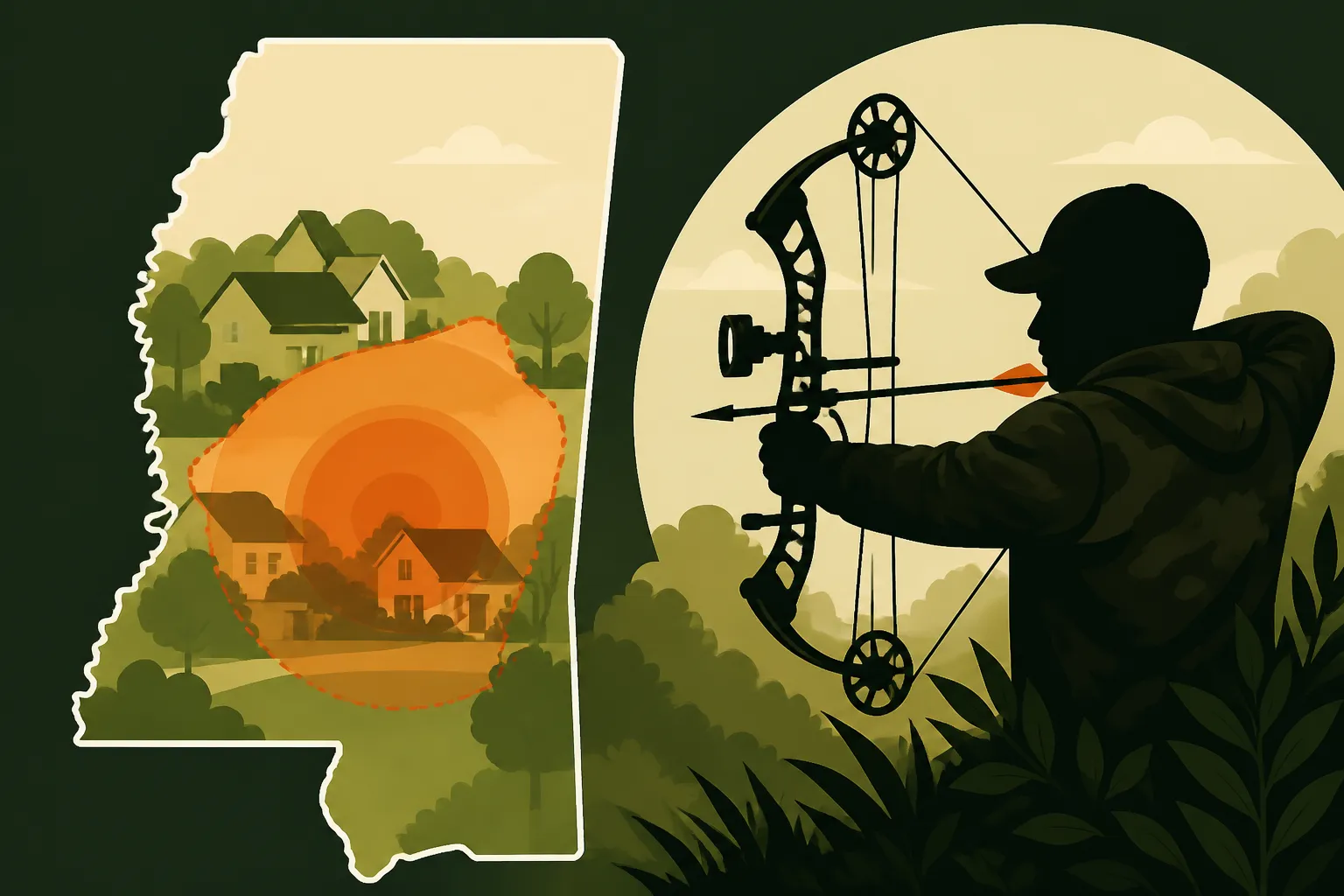
Mississippi Suburban Archery-Only Zones
Finding good hunting land in Mississippi can feel like a real challenge, especially when you live in or near a bustling town. You're constantly facing development, shrinking natural spaces, and the reality that a prime hunting spot from your youth might now be a subdivision. But what if I told you there’s an increasingly popular and effective way to manage deer populations and enjoy some incredible hunting opportunities right in the fringes of our more populated areas? This guide is all about navigating Mississippi’s suburban archery-only zones, helping you understand the rules, find access, and ethically pursue whitetails where you might least expect them.
Understanding Mississippi's Suburban Archery-Only Zones
It's a common scenario: you drive through a subdivision and see more deer than you do on your rural lease. They're nibbling on azaleas, crossing busy roads, and generally making themselves at home, sometimes to the detriment of both the deer and the residents. This is precisely where the concept of suburban archery-only zones comes into play, offering a vital solution to a growing problem.
What Are Archery-Only Zones?
Simply put, suburban archery-only zones are specific areas, often within or bordering urban and suburban landscapes, where hunting is permitted exclusively with archery equipment. The idea here isn't just to create more hunting opportunities, though that's a welcome byproduct for us hunters. The primary driver is wildlife management. Deer populations in many suburban areas across Mississippi have boomed, largely due to an abundance of food (your carefully cultivated landscaping!), a lack of natural predators, and a safe haven from traditional hunting pressure.
These unchecked deer numbers lead to a host of issues: an increase in deer-vehicle collisions, significant damage to residential and commercial landscaping, and potential health risks if deer herds become over-dense and more susceptible to diseases like Chronic Wasting Disease (CWD). By allowing archery hunting in these controlled environments, wildlife agencies and local municipalities can help bring deer numbers back into balance safely and efficiently, minimizing the impact on human residents and property. It's a surgical approach to wildlife management in areas where traditional firearm hunting would be impractical and unsafe.
Why These Zones Are Necessary in Mississippi
Mississippi, like many other states, has seen significant population shifts and development in recent decades. The sprawling growth of cities like Jackson, Hattiesburg, and Tupelo means that what was once prime hunting habitat is now residential or commercial property. Yet, the deer don't just disappear; they adapt. They learn to live among us, becoming quite comfortable with human presence, often leading to overpopulation in these urban pockets.
The Mississippi Department of Wildlife, Fisheries, and Parks (MDWFP) recognizes that these deer populations need to be managed, but traditional gun seasons simply aren't feasible in densely populated areas. Imagine a high-powered rifle being discharged near schools or neighborhoods—it's a non-starter for safety reasons alone. Archery hunting, with its shorter effective range and less intrusive nature, offers a practical alternative. It allows for targeted removal of deer in areas where they've become a nuisance or pose a risk. This targeted approach helps mitigate concerns over crop damage in fringe agricultural areas, reduces the number of costly and dangerous deer-vehicle collisions, and contributes to the overall health of the statewide deer herd by preventing localized overbrowsing and potential disease outbreaks. The goal is to sustain healthy deer numbers while ensuring public safety and reducing negative human-wildlife interactions, which is a delicate balance to strike.
Navigating Regulations and Requirements for Suburban Archery
Hunting in Mississippi's suburban archery-only zones isn't just about grabbing your bow and heading out. There are specific rules, permits, and, most importantly, safety considerations that are paramount when you're hunting in close proximity to homes and people. It’s a different ballgame than hunting deep in the Delta National Forest.
Special Rules and Permits
First and foremost, you'll still need your basic Mississippi hunting license, typically a Resident Sportsman's License or an All-Game License for residents, or the appropriate nonresident license. But beyond the state requirements, many suburban archery-only zones are established through local city or county ordinances. This means that while the state sets the general framework for archery hunting (which you can learn more about in resources like "Mississippi Archery Season Dates by Unit"), individual municipalities might have additional, more restrictive rules specific to their designated archery zones.
These local rules can dictate everything from the specific boundaries of the zone, to the legal hunting hours, to even the type of broadheads you're allowed to use. For instance, some areas might only permit mechanical broadheads that are designed for maximum energy transfer and quick, clean kills to minimize tracking distances. It's crucial to thoroughly research the specific regulations for the particular town or county you plan to hunt in. This might involve checking the MDWFP website for special regulations, contacting the local police or sheriff's department, or even reviewing city council minutes. When it comes to equipment, understanding rules like those covered in "Crossbow Rules During Mississippi Archery Season" is vital, as crossbow regulations can sometimes vary from traditional vertical bows. Many seasoned hunters even use mapping and information platforms like GoHunt to help cross-reference state regulations with known local ordinances, providing an extra layer of confidence before heading afield.
Safety Considerations and Property Access
Safety, above all else, must be your top priority when hunting in a suburban environment. Unlike large tracts of secluded timber, you're often dealing with smaller parcels of land, neighboring homes, roads, and potentially curious onlookers. Every shot must have a safe and clear backdrop, meaning you absolutely must know what's beyond your target. This often limits shot angles and requires extreme discipline to ensure your arrow will not travel beyond your intended target or land on someone else's property. Always err on the side of caution; if there's any doubt about a safe shot, don't take it.
Equally critical is gaining proper access to the land you intend to hunt. Even if an area is designated as an "archery-only zone" by a municipality, it's still private property, and you must obtain permission from the landowner. This isn't just good manners; it's the law. Many hunters find success by knocking on doors, introducing themselves, explaining their intentions (wildlife management, not just "trophy hunting"), and offering to share venison. You'd be surprised how many homeowners are struggling with deer issues and would welcome a responsible hunter. It's often best to get this permission in writing, clarifying the exact boundaries you can hunt and any specific rules the landowner has. For more details on this, you can check out resources like "Do You Need Written Permission in Mississippi?" and "Getting Private Land Permission in Mississippi". A mapping tool like GoHunt can be invaluable here, allowing you to identify property lines and landowner names quickly, making the process of asking for permission much smoother and more professional.
Practical Strategies for Hunting Suburban Archery Zones
Hunting in suburban archery zones requires a shift in mindset and tactics compared to traditional big woods hunting. It's often about precision, discretion, and understanding deer behavior in a human-dominated landscape. These aren't necessarily trophy hunting expeditions, but rather strategic management efforts that can still yield rewarding experiences and put venison in the freezer.
Scouting and Stand Placement
Effective scouting in a suburban archery zone is less about covering vast tracts and more about pinpointing overlooked pockets and micro-habitats. Deer in these areas become masters of concealment, often bedding down in small creek bottoms, thick fencerows, abandoned lots, or dense ornamental shrubs in backyards that offer visual cover. Focus your scouting efforts on identifying these safe havens and the travel corridors deer use between them and their food sources. These food sources aren't just natural browse; they're often garden plants, fruit trees, and even spilled birdseed. Look for pinch points where deer are funneled, such as narrow strips of timber between subdivisions or along drainage ditches. Using aerial imagery from platforms like GoHunt can be incredibly helpful for identifying these small, overlooked areas and mapping out potential access points and stand locations while being mindful of property lines.
When it comes to stand placement, subtlety is key. Ground blinds are often excellent choices because they can be brushed into existing cover discreetly and offer excellent concealment in close quarters. If using a tree stand, prioritize trees that offer dense cover, even if they aren't the tallest. The goal is to blend in completely and minimize your profile. Consider the prevailing wind direction, not just for scent control (which is always crucial), but also for how it might carry sound. Think about potential backdrops for your shot, ensuring any arrow that passes through a deer has a safe landing zone well before it reaches a road or house. Remember, you're not just hunting deer; you're also managing the perception of hunting, so being as invisible and non-intrusive as possible is paramount. For general principles of setting up, some advice from "Using a Ground Blind on Mississippi Public Land" can be adapted, even though the context is different.
Ethical Considerations and Public Perception
Hunting in a suburban setting places a higher emphasis on ethical conduct and managing public perception than almost any other hunting scenario. You are an ambassador for all hunters, and your actions reflect directly on the hunting community. This means prioritizing a clean, swift kill above all else. Pass up any shot that isn't absolutely perfect and guaranteed to dispatch the animal quickly. Tracking a wounded deer through someone's backyard or across multiple properties is an absolute nightmare scenario and can quickly turn public opinion against these valuable management programs.
Discretion during game recovery is also critical. If possible, plan to retrieve your deer at night or during times of low pedestrian traffic. Have a plan for how you'll get the deer out quickly and respectfully, perhaps with a deer cart or extra help. Field dressing should ideally be done off-site, or at least out of public view. For tips on handling game, you might find some useful information in "Field Dressing a Deer in Warm Weather". Be prepared to engage respectfully with curious or concerned non-hunters. Explain why you're hunting (deer management, reducing collisions, feeding your family), answer their questions calmly, and always maintain a polite, professional demeanor. Participating in programs that donate venison to local food banks can also be a fantastic way to showcase the positive impacts of hunting and build goodwill within the community. Adhering to high ethical standards and being a good neighbor ensures these unique hunting opportunities continue to thrive. Don't forget, fulfilling your Mississippi Hunter Education Requirements provides a solid foundation for responsible hunting practices, no matter the environment.
Here's a quick comparison of some key aspects between traditional rural hunting and suburban archery-only hunting:
| Feature | Traditional Rural Hunting | Suburban Archery-Only Hunting |
|---|---|---|
| Location | Large forests, farms, remote public lands | Residential areas, parks, private land near towns |
| Primary Goal | Recreation, meat, trophy, wildlife management | Wildlife management (nuisance control), recreation, meat |
| Weapon | Rifles, shotguns, muzzleloaders, archery | Strictly archery equipment (bows, crossbows) |
| Access | Public land, large private leases, family land | Small private parcels, often through direct landowner permission |
| Safety Concerns | Other hunters, livestock, distant structures | Homes, roads, people, pets, property lines |
| Public Perception | Generally accepted, less scrutiny | Highly scrutinized, requires careful ambassadorial behavior |
| Scouting Focus | Large-scale habitat, food plots, travel corridors | Micro-habitats, overlooked pockets, ornamental food sources |
| Stand Placement | Dominant scrapes, rub lines, funnels, food sources | Discreet, concealed, safe backstops, property line awareness |
| Game Recovery | Can be extensive, less immediate pressure | Needs to be swift, discreet, planned |
Disclaimer
Hunting is an inherently dangerous activity. This article is for informational purposes only and does not supersede local, state, or federal hunting laws and regulations. Always consult the latest Mississippi Department of Wildlife, Fisheries, and Parks (MDWFP) regulations and any relevant local ordinances before engaging in any hunting activities. It is your responsibility to ensure you are properly licensed, understand all rules, and hunt safely and ethically.