Mississippi Songbird Nest Predation by Hogs
It’s a truly disheartening moment when you’re out enjoying Mississippi’s beautiful wild places, perhaps listening for the distinct calls of a Painted Bunting or the busy chattering of a Carolina Wren, and instead you find a torn-up bird nest, its contents scattered. For many of us who cherish our state’s diverse wildlife, the unseen threat of feral hogs to our precious songbird populations is a quiet but deeply troubling concern. This guide will delve into how these invasive animals disrupt the delicate balance of our ecosystems by preying on songbird nests and offer insights into managing this complex problem.
The Unseen Threat: How Feral Hogs Devour Songbird Nests and Habitat
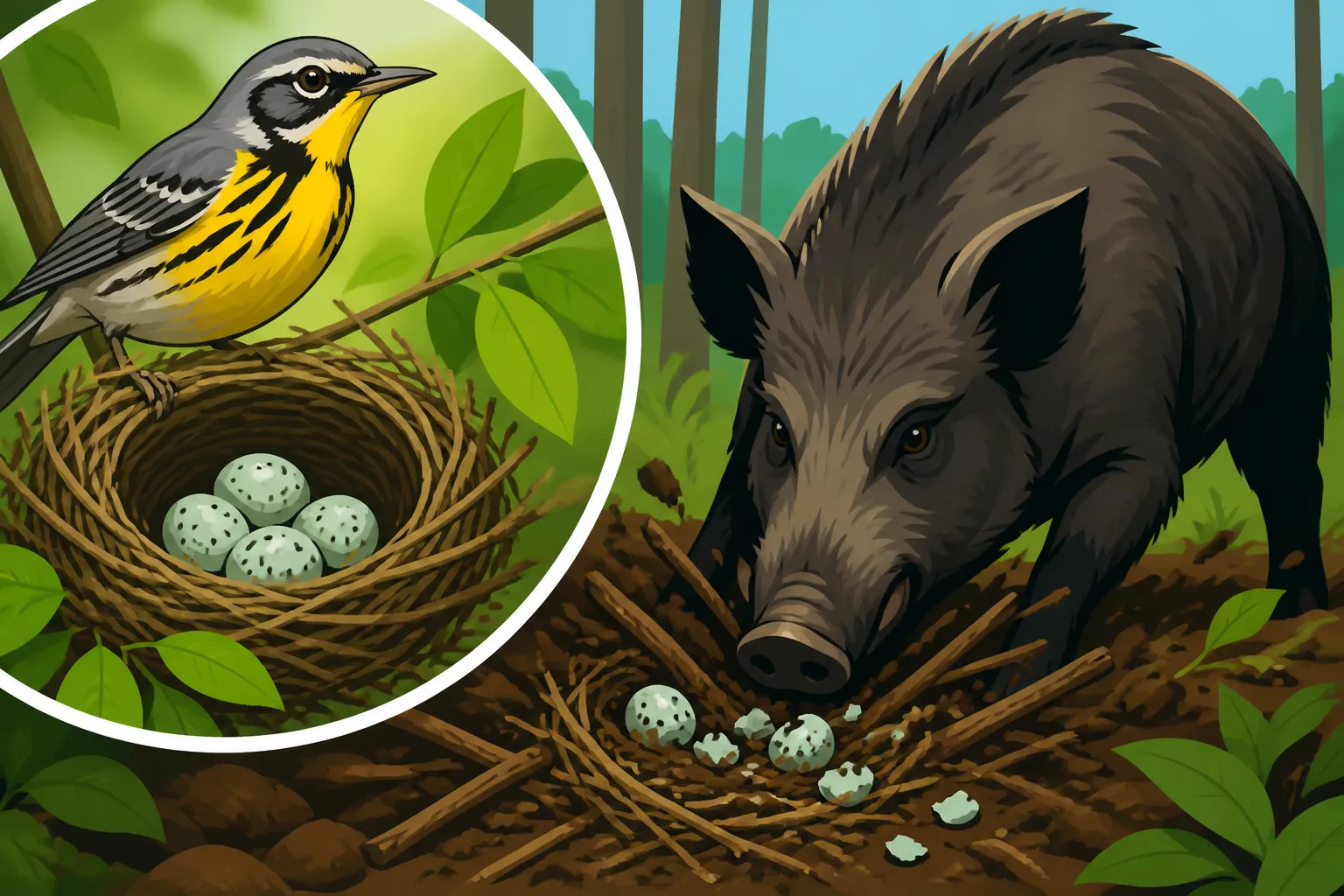
When we talk about the damage feral hogs inflict, our minds often jump to ruined agricultural fields or torn-up food plots. And rightly so, as their destructive rooting habits cause immense economic hardship. However, the impact of these animals goes far beyond crop destruction; it extends deeply into the natural ecosystem, posing a significant threat to ground-nesting and low-nesting songbirds. Imagine a delicate nest, painstakingly built by a pair of warblers, hidden in a low thicket. It represents weeks of effort and the future of a family. A rooting hog, driven by an insatiable hunger, can obliterate it in mere seconds, consuming eggs and helpless nestlings without a second thought.
Their omnivorous diet means little is safe. While acorns, roots, and insects are primary food sources, protein is always on the menu. A hog will readily consume eggs, chicks, and even adult birds if given the opportunity. This isn't just opportunistic scavenging; it's an active form of predation that directly impacts the reproductive success of many avian species. What makes this particularly insidious is that many of our beloved Mississippi songbirds, like the Ovenbird or various sparrows, nest close to the ground, making their nests incredibly vulnerable to a hog's powerful snout and keen sense of smell. It’s a silent assault on the next generation of birds, often going unnoticed by human eyes until it’s too late.
Direct Predation: The Snout of Destruction
Feral hogs are truly generalist predators, and their diet reflects that. When they are constantly rooting through the undergrowth for tubers, grubs, and fungi, they inevitably uncover anything else hidden there. A ground nest, for example, is simply another calorie source waiting to be discovered. Unlike a specialized predator, a hog isn't necessarily hunting for nests, but it consumes them with brutal efficiency when encountered. This "bycatch" predation is devastating because it’s so widespread. Where you have hogs, you have them constantly churning up potential nesting sites.
Consider the common Yellow-breasted Chat, a bird that often nests in dense, low shrubs. Its nest might be just a few feet off the ground, built with care to avoid detection by common predators like snakes or raccoons. But a hog’s sense of smell is legendary, and if it roots near that shrub, the scent of eggs or young birds is a clear signal. The entire clutch can be wiped out in moments. This kind of widespread, indiscriminate destruction can lead to significant declines in local songbird populations over time, especially in areas with high hog densities. It's a contributing factor that often gets overshadowed by their more visible damage, but its ecological consequences are profound.
Habitat Degradation: Beyond the Nest
Beyond direct predation, feral hogs are ecological engineers of destruction, and their impact on habitat is equally, if not more, damaging in the long run. Their constant rooting disturbs vast areas of soil, turning delicate forest floors and marsh edges into lunar landscapes. This action destroys the very understory vegetation that many songbirds rely on for nesting material, cover from predators, and foraging sites. Imagine a patch of native grasses and wildflowers, crucial for nesting Indigo Buntings or field sparrows. After a sounder of hogs has moved through, it's nothing but churned-up earth, leaving no suitable place for a nest.
Furthermore, hogs compete with native wildlife for critical food resources. They devour acorns, berries, and fungi that would otherwise sustain deer, turkeys, squirrels, and a host of other species, including many migratory birds. This resource depletion can force songbirds to expend more energy finding food, potentially reducing their overall health and reproductive output. The altered plant communities resulting from hog disturbance can also favor invasive plant species that are less beneficial for native wildlife. It’s a cascading effect: fewer native plants mean less food and cover, which in turn means fewer birds. For landowners and managers utilizing mapping tools like GoHunt, understanding where hog activity is concentrated can help identify areas of severe habitat degradation that need immediate attention.
Why Mississippi Hogs Pose a Unique Threat to Our Feathered Friends
Mississippi's diverse ecosystems, from the bottomland hardwoods of the Delta to the pine savannas of the Piney Woods, provide critical habitat for a vast array of songbird species. Unfortunately, these same rich habitats also provide ideal conditions for feral hogs to thrive and expand their range. The mild climate, abundant food sources, and often dense cover allow hog populations to proliferate rapidly, unchecked by natural predators. This combination of factors means that the impact of hog predation on songbirds here can be particularly severe, exacerbated by the sheer number of hogs in many regions. Feral Hogs Across Mississippi are a problem throughout the state, and their numbers are significant.
One of the most challenging aspects of feral hogs is their incredible reproductive capacity. A sow can breed as early as six months old and produce multiple litters per year, with each litter potentially containing a dozen piglets. This exponential growth makes control extremely difficult. Even if a local population of hogs is reduced, they can quickly rebound or be replaced by individuals moving in from adjacent areas. This constant pressure means that songbird populations, which might only produce one or two clutches per year, are fighting an uphill battle against an ever-present threat. Understanding How Many Feral Hogs Mississippi Has helps illustrate the scale of this ecological challenge.
High Numbers, Wide Range: An Overwhelming Presence
The sheer density of feral hogs in many parts of Mississippi creates an overwhelming problem for songbirds. When hog numbers are low, their impact might be localized or less frequent. However, when you have high concentrations of hogs moving through an area daily, the probability of nests being discovered and destroyed skyrockets. This isn’t just an issue for species that nest on the ground; hogs will also disturb low-hanging nests in shrubs and small trees. Their wide-ranging foraging patterns mean they can access nearly every corner of a property, leaving few places truly safe for nesting birds.
Think about a typical patch of Mississippi woodland or a field edge. Hogs traverse these areas, often following deer trails or creating their own, constantly sniffing and rooting. A warbler's nest in a honeysuckle tangle, or a sparrow's nest at the base of a clump of sedge, becomes just another potential meal. This widespread and consistent disturbance means that even if a nest isn't directly eaten, the constant presence of hogs can cause parent birds to abandon clutches due to stress, noise, and disruption. The sheer volume of hogs, coupled with their relentless foraging, puts intense pressure on already vulnerable bird populations.
Habitat Overlap: The Delta's Double Whammy
In regions like the Mississippi Delta, the overlap between prime songbird nesting habitat and high feral hog populations creates a particularly challenging scenario. The Delta’s bottomland hardwoods, river cane thickets, and dense shrubby areas are vital breeding grounds for numerous migratory and resident songbird species. These are also the exact types of dense cover and fertile ground that feral hogs absolutely thrive in. The rich soil provides excellent rooting opportunities, and the thick vegetation offers perfect concealment and farrowing sites.
This means that areas offering the best potential for songbird nesting success are often the very places most heavily impacted by hogs. A particularly devastating example is the destruction of moist-soil units or shallow wetlands, which are crucial for many marsh-nesting birds, but also highly attractive to hogs seeking mud for wallowing and soft ground for rooting. When Hunting Delta Unit Bottomland Deer, you often see the tell-tale signs of hog activity – rooted up areas, wallows, and rubs – which indicate just how pervasive their presence is in these critical ecosystems. It’s a double whammy for songbirds, as their best homes become the most dangerous places to raise a family.
Detecting the Damage: Signs of Hog Predation
For dedicated hunters, landowners, and bird enthusiasts, understanding how to identify hog predation is crucial. It’s not always obvious, as a hog leaves a different kind of calling card than a coyote or a raccoon. Learning to differentiate hog damage from other predators can inform your management strategies and help you protect vulnerable areas. This means looking for a combination of environmental disturbance and specific evidence at the nest site. A well-placed trail camera could also show Night Hunting Hogs With Lights on Private Land or other nocturnal activities.
Often, the first clue isn't even at the nest itself, but the general area. If you find extensive rooting, wallows, or hog tracks nearby, any depredated nests in that vicinity are likely victims of the pigs. Unlike a bird of prey that might leave scattered feathers or a snake that leaves no trace, a hog's destructive nature will usually be evident in the surrounding landscape. Understanding these signs can make all the difference in implementing effective control measures, whether that’s trapping or increased hunting pressure.
The Scene of the Crime: What a Depredated Nest Looks Like
When a feral hog depredates a nest, the scene is often one of thorough destruction. Unlike a raccoon that might meticulously pick apart eggs, or a snake that swallows them whole, a hog tends to be less delicate. You’ll typically find the nest itself completely torn apart, often ripped from its anchoring branches or flattened into the ground. Eggs will be crushed, not delicately opened, and often mixed with soil and leaf litter from the rooting activity. If nestlings were present, there might be very few remains, as a hog will consume them entirely.
What you won't usually find are neat shell fragments or small teeth marks often left by rodents or small carnivores. Instead, look for broad, powerful marks indicative of a large snout and strong jaws. The ground directly around the nest will likely be churned up, with obvious rooting marks, deep hoof prints, and perhaps even hog droppings nearby. It’s a messy, decisive act of destruction that leaves little doubt as to the culprit. If you’re checking a new favorite nesting spot with the GoHunt app, and notice significant ground disturbance, that should raise an immediate red flag.
Here’s a quick comparison of common nest predator signs:
| Predator Type | Typical Nest Damage | Egg Shell Appearance | Surrounding Area Clues |
|---|---|---|---|
| Feral Hog | Completely torn apart, flattened, ripped from anchor | Crushed, mixed with soil/debris | Extensive rooting, large tracks, wallows, rubs |
| Raccoon | Nest often left intact but disturbed; eggs removed | Typically neatly opened, possibly carried away | Smaller tracks (hand-like), climbing signs if elevated |
| Snake | No disturbance to nest structure; eggs simply gone | No shell fragments (swallowed whole) | No distinct tracks, possible slither marks in soft soil |
| Coyote/Fox | Nest often pulled out, scattered, possibly disturbed | Crushed, chewed, scattered widely | Canine tracks, scat, possible dig marks |
| Bird (Crow/Jay) | Eggs punctured or carried away; nest usually intact | Punctured holes, pieces pecked at | Bird tracks if on ground, often no ground disturbance |
| Opossum | Nest disheveled, eggs broken and eaten | Irregularly broken, may be messy | Small, hand-like tracks; nocturnal activity |
Tracking the Culprits: Identifying Hog Activity
Beyond the immediate nest site, learning to identify general hog activity in an area is paramount to understanding and mitigating predation. Hogs leave a lot of evidence of their presence, and with practice, you can almost map their movements just by reading the landscape. The most obvious signs are rooting patterns: large swaths of turned-up earth where they’ve been searching for food. These areas can range from small, localized patches to acres of completely disturbed ground. Look for these alongside creek bottoms, under acorn-producing trees, or in moist, soft soils.
Another clear indicator is hog tracks. They have cloven hooves, similar to deer, but their tracks are typically rounder and wider, with the dewclaws often registering in the mud, especially on larger hogs. Wallows are also a dead giveaway: muddy depressions where hogs have rolled to cool down and remove parasites. These are often found near water sources or in low, damp areas. Finally, keep an eye out for rubs on trees, especially small saplings, where hogs have scratched themselves. If you’re seeing these signs regularly in an area known for nesting songbirds, it’s a strong indication that your avian residents are at significant risk. Utilizing mapping tools can help track these patterns over time.
Taking Action: Strategies to Protect Songbird Nests from Hogs
Protecting songbird nests from feral hogs in Mississippi is an ongoing challenge, but it's not a hopeless one. It requires a multi-faceted approach, often involving a combination of direct removal efforts, habitat management, and community awareness. There's no single silver bullet, but by integrating various strategies, landowners and conservationists can significantly reduce the impact of these destructive animals and provide a safer environment for our native birds. Mississippi Feral Hog Regulations allow for year-round hunting and trapping on private land, which gives us some powerful tools.
The most effective strategies often involve sustained, concerted efforts rather than one-off attempts. Because hogs reproduce so rapidly and can quickly re-colonize an area, consistent pressure is key. This might mean organizing regular trapping efforts, coordinating with local hunters, or implementing fencing in very specific, high-value conservation areas. Ultimately, the goal is to reduce hog numbers to a level where their impact on nesting songbirds is minimized, allowing these populations a better chance to thrive.
Trapping and Removal: Reducing the Source
The most direct and often most effective method for protecting songbird nests from hogs is to reduce the hog population through trapping and removal. Trapping Mississippi Feral Hogs is a year-round activity on private lands, and it’s arguably the most efficient way to remove large numbers of animals. Modern hog traps, often large panels with remote-triggered gates, can capture entire sounders at once. This drastically cuts down on the number of mouths preying on nests and destroying habitat. Baiting these traps with corn or other attractants draws hogs in, allowing for efficient removal.
For landowners or hunting clubs, establishing a consistent trapping program, perhaps through a dedicated team or a contracted trapper, can make a huge difference. It’s not a "set it and forget it" solution; traps need to be monitored frequently, and bait replenished. However, the results are undeniable. By removing the primary source of predation, you give ground-nesting and low-nesting songbirds a fighting chance to successfully fledge their young. This active management is a critical component of any comprehensive plan to protect avian populations from feral hog impacts. Hunting Mississippi's Year-Round Feral Hogs is also a tool, especially for opportunistic removal.
Habitat Management for Resilience
While removing hogs is paramount, managing habitat to make it more resilient to hog damage and less attractive to hogs can also play a crucial role. This involves promoting healthy native plant communities that offer better nesting and foraging opportunities for songbirds, and strategically protecting sensitive areas. For example, focusing on restoring dense native undergrowth in areas where songbirds prefer to nest can provide more robust cover, making nests slightly harder for hogs to discover. This might involve planting native shrubs, conducting prescribed burns to stimulate new growth, or removing invasive species that offer poor nesting cover.
Additionally, consider fencing off particularly sensitive areas, such as small, critical nesting habitats or specialized wetlands, if feasible. While large-scale fencing is often impractical and expensive, targeted exclusion fencing around a known prime nesting zone could offer localized protection. Tools like GoHunt can assist in identifying these crucial areas for targeted habitat work. Furthermore, ensuring a diverse and abundant food supply for native wildlife, which hogs compete with, can help overall ecosystem health. By strengthening the habitat, you’re not just protecting individual nests; you're building a more robust environment where songbirds can better cope with environmental pressures.
Community Involvement and Awareness
Finally, protecting Mississippi's songbirds from feral hogs isn't just a job for individual landowners; it's a community-wide effort. Raising awareness about the specific threat hogs pose to bird nests and broader ecosystem health can galvanize more people to take action. This might involve sharing information within local hunting clubs, conservation groups, or neighborhood associations. Educating people on the signs of hog activity and the methods for control can lead to a more widespread, coordinated response. For example, knowing Why Mississippi's Gun Opener Draws the Biggest Crowds might inspire hunters to also consider hog removal during deer season.
Encouraging responsible hunting and trapping practices is also key. Hunters who understand the ecological damage hogs cause may be more motivated to participate in year-round hog removal efforts rather than just incidental encounters. Collaborating with organizations like the MDWFP, which often provides resources and guidance on hog management, can amplify local efforts. By fostering a shared understanding and a collective sense of responsibility, we can create a stronger front against feral hogs, ultimately leading to a healthier environment for all of Mississippi’s wildlife, including our cherished songbirds.
Disclaimer
This article is for general informational purposes only and does not constitute professional advice. Laws, prices and regulations vary by location and change over time. Consult a qualified professional for guidance on your specific situation.