What Mississippi Trespass Law Requires
There's nothing quite like the feeling of stepping into the woods, rifle or bow in hand, knowing you're about to connect with nature on a primal level. But that peace of mind can quickly vanish if you're constantly worried about where property lines truly lie, or if you're even legally allowed to be where you are. Navigating land ownership, access, and the often-confusing rules around private property can be one of the biggest headaches for Mississippi hunters. This guide is here to clear the air, breaking down exactly what Mississippi's trespass law requires of you, so you can hunt with confidence and respect for landowners.
Understanding "Posted" and Permission in Mississippi
The concept of private property is fundamental to hunting in Mississippi. While we're blessed with some fantastic public hunting opportunities, a huge portion of the state's prime hunting ground is privately owned. And let's be honest, those property lines can sometimes feel like invisible tripwires, just waiting to spring a legal trap on an unsuspecting hunter. Knowing the rules isn't just about avoiding a fine; it's about being a responsible, ethical hunter and maintaining positive relationships with the folks who own the land.
What Constitutes Posted Land?
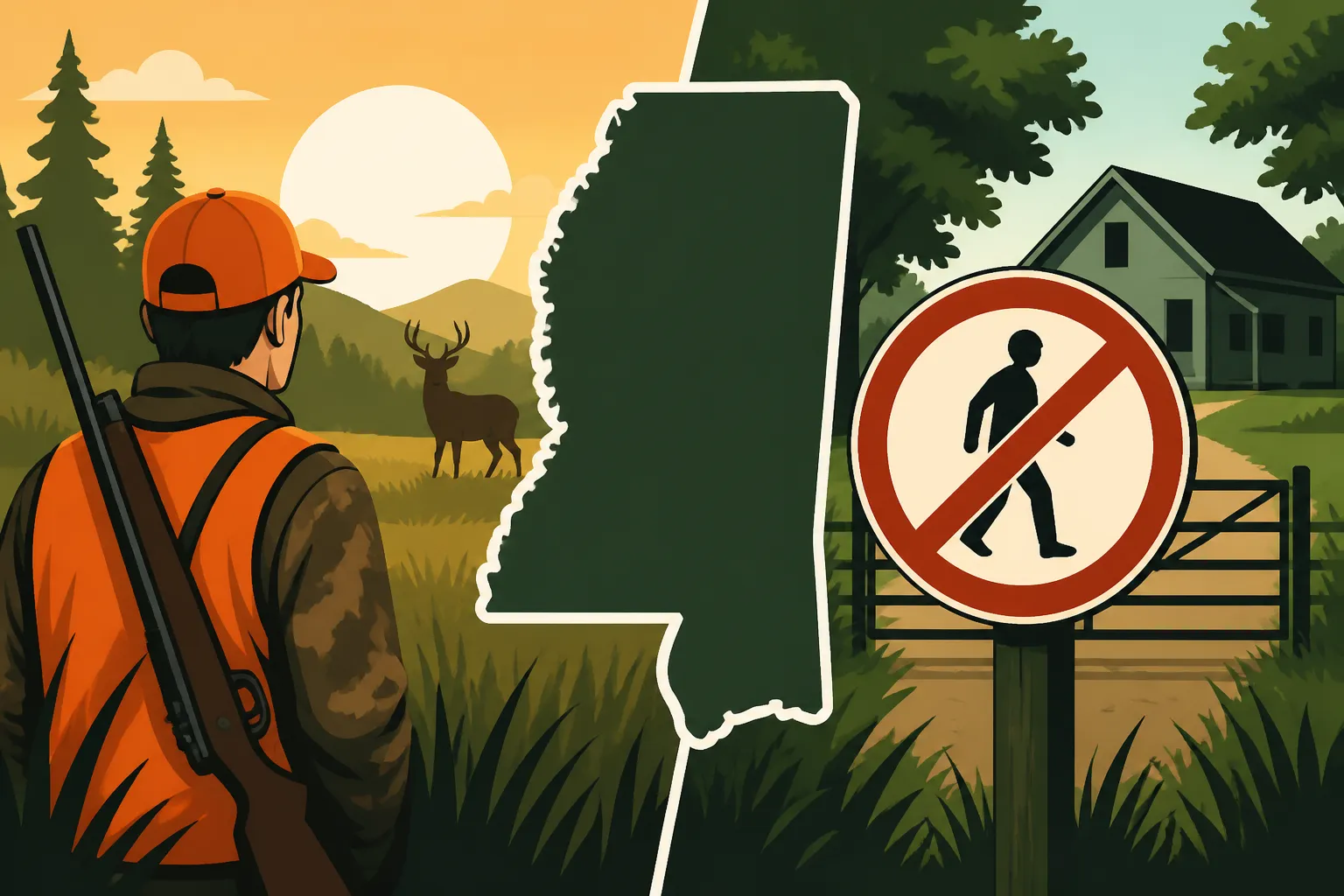
Many hunters mistakenly believe that if there isn't a "No Trespassing" sign every fifty feet, the land is open for business. That's a dangerous assumption, and it's simply not how Mississippi law works. Land does not have to be specifically "posted" with signs for you to be trespassing. The default in Mississippi, just like in most places, is that all private land is off-limits unless you have explicit permission from the owner.
However, the law does have provisions for what constitutes formally "posted" land, which can sometimes impact the severity of a trespass charge or act as undeniable notice. While specifics can vary, generally, if a landowner wants to enhance their ability to prosecute trespassers, they might clearly mark their boundaries. This could involve painting trees or posts with a distinctive color at regular intervals, or erecting specific "No Trespassing" signs that meet certain size and visibility requirements. But again, let me stress, even if a property isn't marked this way, it's still private, and you still need permission. Don't fall into the trap of thinking an unmarked fence line or a quiet woods means open season. It's on you to know whose land you're on. For more detailed information on formal marking, it's worth reviewing Mississippi Posted Land Rules.
The Importance of Express Permission
This is where the rubber meets the road: you must have permission. "Express permission" means it's clearly stated, not just implied. You can't just assume that because a gate was open, or because you've seen other hunters there, that you have a green light. That's a recipe for trouble.
How do you get this permission? Ideally, it's a direct conversation. Knock on the door, call them on the phone, or send a respectful message. Explain your intentions clearly. Are you hunting deer? Turkeys? Just scouting? Be upfront. While verbal permission is legally valid, it can be hard to prove if there's ever a dispute. That's why many seasoned hunters, myself included, highly recommend getting it in writing. A simple text message exchange confirming your permission can often suffice, but a signed note or email is even better. It clearly outlines who has permission, for what activity, and for how long. This protects both you and the landowner. Imagine you're out there, having a great hunt, and suddenly a game warden or another landowner approaches. Being able to pull out a text or a signed note that says, "Yes, [Your Name] has my permission to hunt my property at [Address] on [Date(s)] for [Species]" is invaluable peace of mind. Without it, you could face uncomfortable questions or even charges. Do You Need Written Permission in Mississippi? delves deeper into the benefits of a written agreement.
Common Scenarios and Misunderstandings
Even the most well-intentioned hunter can find themselves in a tricky situation. Mississippi's varied landscape, from dense Delta bottomlands to rolling Hills Unit ridges, often means property lines are anything but clear-cut. Understanding common points of confusion before you're in the thick of it can save you a lot of grief.
Retrieving Game Across a Property Line
This is perhaps the most emotionally charged and legally ambiguous situation a hunter can face: you make a good shot, but your deer or turkey crosses onto neighboring private land before expiring. Your heart sinks. You know the animal is there, but you also know you might be stepping onto someone else's property.
Mississippi law generally allows you to track wounded game onto private land without prior permission. This means you can follow the blood trail or sign. However, the critical distinction is that you cannot retrieve the animal without first obtaining permission from the landowner. If you find the animal on their land, your next step is not to drag it out. Your next step is to immediately contact the landowner. Explain the situation calmly and respectfully, and ask for permission to retrieve your game. Most landowners, if approached with courtesy and respect, will understand and grant permission. They're often hunters themselves and appreciate the effort to recover an animal.
What if you can't reach the landowner? This is where it gets tough. Legally, you're still not allowed to remove the animal without their consent. In such cases, your best bet is to contact the Mississippi Department of Wildlife, Fisheries, and Parks (MDWFP) regional office or a local game warden. They may be able to assist in contacting the landowner or advise you on the proper legal course of action, which sometimes means leaving the animal if permission cannot be obtained. It's a tough pill to swallow, but it's crucial for avoiding a trespass charge. Don't risk a violation for a deer. For a deeper dive into this, see Retrieving Game From Private Land in Mississippi.
Unmarked Boundaries and "Accidental" Trespass
Mississippi's woods aren't always neatly surveyed with clear boundary markers every 50 yards. Creeks, old fencelines, changes in timber type, or even just subtle shifts in topography can be your only clues in some areas. It's incredibly easy, especially when focused on the hunt, to inadvertently drift across an unmarked property line.
While it might be "accidental," ignorance of the law or property lines is rarely an excuse. The responsibility falls squarely on the hunter to know where they are. This is where modern technology becomes an absolute game-changer. I can't stress enough the value of GPS mapping apps like onX Hunt or GoHunt. These apps overlay property lines, landowner names, and public land boundaries directly onto your satellite maps. Before I even step foot on new ground, I spend time with these apps, marking potential hotspots, identifying access points, and, most importantly, scrutinizing every single property line. Even on familiar ground, I keep it open on my phone (downloaded for offline use, because cell service can be spotty!).
If you do find yourself on someone else's property by accident, the best course of action is to immediately pack up your gear, cease hunting, and quietly exit the property the way you came, making as little impact as possible. If confronted, be honest, apologetic, and cooperative. Law enforcement often has discretion, and a genuine, respectful mistake is usually handled differently than blatant disregard. Learning Finding Mississippi Property Lines is a crucial skill for every hunter.
Public Land Adjacent to Private Land
Many of us rely on Mississippi's public lands, whether it's a National Forest or one of our fantastic Wildlife Management Areas. These lands often share long borders with private property, creating specific challenges. It's easy to focus on your hunting spot and forget that a hundred yards past that tree line, the rules change drastically.
When hunting public land, it's paramount to know precisely where the public boundary ends. Just because a deer steps onto private land doesn't mean you can follow it or shoot it. In Mississippi, it is illegal to shoot across a property line onto private land, even if your stand is on public property. This is a safety issue as much as a legal one; you have no idea what might be on the other side. Always be aware of your surroundings, your shooting lanes, and, critically, where those public lines are drawn. Use those mapping apps to continually confirm your location. When Public Hunting Land in Mississippi abuts private holdings, extra diligence is key to staying legal and safe.
Consequences of Trespass and Preventing Issues
No one wants their hunting season to end with a court date or a revoked license. Understanding the potential repercussions of trespassing, and, more importantly, proactively preventing it, is vital for any responsible hunter in Mississippi. It's not just about avoiding punishment; it's about upholding the integrity of our sport.
Legal Penalties for Trespassing Hunters
Mississippi takes trespassing seriously, especially when it involves hunting. The penalties can range depending on the specifics of the situation, but generally, you're looking at fines, and potentially, the loss of your hunting privileges. For a first offense of simple trespass, you might face a monetary fine. However, if that trespass involves hunting, or if it's a repeat offense, the penalties can escalate significantly. You could be facing higher fines, court costs, and, critically, the suspension or revocation of your hunting license. This means you could be legally barred from hunting in Mississippi for a period of time, which for most of us, is a devastating consequence. In some aggravated cases, especially involving damage to property or refusal to leave, it could even lead to jail time.
Game wardens and local law enforcement have a job to do, and protecting private property rights is a big part of it. They tend to be less lenient when hunters show blatant disregard for boundaries or are disrespectful to landowners. The goal here isn't to scare you, but to impress upon you the importance of knowing and respecting the law. Staying within the bounds of your permission or public land is non-negotiable. For a comprehensive look at what you could face, check out Mississippi Wildlife Violation Penalties.
Building Relationships with Landowners
One of the best ways to prevent trespass issues, and potentially gain access to fantastic hunting grounds, is to cultivate good relationships with landowners. It might sound old-fashioned, but a little neighborly goodwill goes a long way. Many landowners are incredibly generous, but they've also likely had bad experiences with disrespectful hunters in the past.
When you approach a landowner, come prepared, polite, and with a clear request. Introduce yourself, state your purpose, and ask if they'd consider granting you permission. Don't just show up in hunting gear expecting a "yes." Be willing to offer something in return: help mend fences, check on livestock, or assist with nuisance animal control, like Trapping Mississippi Feral Hogs if they have a problem. Even offering to share some of your harvest can be a great gesture. It's about building trust and demonstrating that you're a responsible, respectful individual.
Remember, a landowner's property is their livelihood, their sanctuary, or both. Treat it with the utmost respect. Leave no trash, close all gates, and report anything suspicious you see on their property. Being a good steward not only earns you favors but helps improve the overall image of hunters in the community. You can find more tips on this delicate art in Asking a Mississippi Farmer for Permission.
Tools and Strategies for Staying Legal
So, how do we put all this into practice and ensure we're always on the right side of Mississippi's trespass law? It comes down to preparation, awareness, and using the right tools.
First and foremost, invest in and learn to use a reputable mapping application like onX Hunt or GoHunt. These apps are invaluable for showing you property lines in real time, often with landowner information. Before you head out, download the maps for your specific area so they work even if you lose cell service. This is critical in many parts of Mississippi where service can be spotty. Regularly check your position on the map, especially when moving through dense cover or near known boundaries. For more on using technology in the field, explore onX Layers for Mississippi Land Status and Using the MDWFP App Without Cell Service.
Beyond technology, good old-fashioned scouting is essential. Get out there before the season opens (with permission if on private land!) and walk those boundary lines. Look for natural markers, survey pins, painted trees, or fence lines. Take mental notes, or even mark them on your mapping app. Understanding the topography and identifying those "pinch points" or areas where you might inadvertently cross a line can make all the difference. Scouting Mississippi Public Land Before Season is not just for finding game, it's for staying legal.
Finally, always carry your written permission with you if you're hunting private land. A simple laminated card, a printed email, or even a text message thread easily accessible on your phone can save you a lot of grief. Being prepared to show proof of permission instantly demonstrates your responsibility and respect for the law.
Staying legal when hunting in Mississippi doesn't have to be a source of anxiety. By understanding the law, respecting landowners, and utilizing the tools available to us, we can all enjoy our time in the field with confidence and contribute to a positive perception of hunters across the state.
| Land Status | Permission Required? | Recommended Proof | Penalty for Trespass (Hunting) |
|---|---|---|---|
| Posted Private | Yes, express | Written/Text | Fines, potential hunting privilege suspension/revocation, jail |
| Unposted Private | Yes, express | Written/Text | Fines, potential hunting privilege suspension/revocation |
| Public Land | No, general access | N/A | N/A (unless entering restricted areas or violating WMA rules) |
| Tracking Wounded Game onto Private | No, for tracking only | N/A | Trespass if game is retrieved without permission |
| Retrieving Wounded Game from Private | Yes, express | Written/Verbal approval | Fines, potential hunting privilege suspension/revocation, jail |
Disclaimer
This article is for general informational purposes only and does not constitute professional advice. Laws, prices and regulations vary by location and change over time. Consult a qualified professional for guidance on your specific situation.