Mississippi Annual Deer Harvest
When you're dedicated to hunting deer in Mississippi, it's easy to get caught up in the immediate thrill of the season—the cold mornings, the quiet woods, the sudden appearance of a majestic whitetail. But sometimes, you might find yourself wondering how your own experiences fit into the bigger picture. Are deer numbers up or down? How did other hunters fare in your favorite county, or across the state? Understanding the annual deer harvest isn't just a dry statistical exercise; it's a window into the health of our deer herd, the effectiveness of management strategies, and ultimately, what you might expect when you hit the woods. This guide will help you decipher Mississippi's annual deer harvest data, offering insights into what these numbers truly mean for the passionate hunter.
Understanding Mississippi's Deer Harvest Numbers
For those of us who spend countless hours scouting, hanging stands, and enduring the elements, the Mississippi deer season is more than just a pastime—it's a way of life. When the Mississippi Department of Wildlife, Fisheries, and Parks (MDWFP) releases its annual deer harvest report, it's not just a collection of dry figures; it's a narrative about our state's whitetail population, influenced by everything from weather patterns to hunter behavior. These numbers give us a snapshot of the herd's vitality and help us understand the bigger ecosystem we're a part of.
What Goes Into the Annual Harvest Report
The MDWFP’s annual harvest report is a monumental undertaking, piecing together information from thousands of individual hunting experiences across the state. It’s not just a simple count; it’s a comprehensive look at how many deer were harvested, their sex, and often their age, and where they were taken. The primary way this data is collected is through mandatory hunter reporting. Every deer harvested in Mississippi must be reported to the MDWFP, typically through their user-friendly mobile app or website. This immediate reporting is crucial, as it allows biologists to gather real-time data throughout the season, rather than relying on estimates or post-season surveys that might be less accurate.
Think about it: every time you take a deer and use the MDWFP app to check it in, you're directly contributing to this vital dataset. This process ensures that biologists have a solid foundation of information to analyze. They look at overall harvest totals, breaking them down by deer management unit, county, and even by weapon type. They differentiate between antlered bucks, antlerless deer, and even youth harvests. This level of detail helps paint a clear picture of localized population dynamics and hunter success, which can then be compared year over year to identify trends. Without this active participation from hunters, the quality and accuracy of the harvest report would suffer, making effective management much more challenging.
Why the Numbers Matter to Hunters
Beyond the biological implications, these annual harvest numbers hold significant weight for the everyday hunter. They are, in essence, a report card for the deer herd and the management strategies in place. A consistent harvest of mature bucks and a healthy balance of antlerless deer often indicates a thriving population. Conversely, a noticeable dip in harvest or a shift in the age structure of bucks being taken could signal potential issues, like habitat degradation or increased pressure. For example, if you see that the overall Mississippi Deer Population Estimate is holding steady or growing, that’s generally good news for your future hunting prospects.
These reports also provide valuable context for individual hunter success. Did you have a tough season? The harvest report might show that severe weather depressed deer movement across the board, making everyone's season a little harder. Or perhaps you're considering hunting a new area; looking at past Mississippi Deer Harvest Records for specific counties can give you an idea of the historical success rates and deer density in that region. It’s about understanding the environment you're hunting in, seeing how broader trends might influence your personal experiences, and gaining confidence that the MDWFP is making data-driven decisions to sustain our hunting heritage. It helps us validate our own observations and strategize for future seasons, whether that involves different tactics or exploring new public lands.
Trends and Factors Influencing Mississippi's Deer Harvest
Mississippi's deer harvest is rarely static; it fluctuates from year to year, influenced by a complex interplay of natural and human factors. Understanding these dynamics can help hunters predict potential outcomes for the upcoming season or make sense of past results. It's like trying to read the future of the deer woods—you have to consider all the variables at play.
Weather's Impact on Harvest Success
Weather might be the single biggest uncontrollable factor affecting deer harvest each year. Think about it: a mild winter means less stress on the deer herd, potentially leading to better fawn survival and overall healthier animals. On the flip side, extreme weather events can be detrimental. A prolonged drought can severely impact food sources, forcing deer to travel farther for sustenance, making them more vulnerable or, conversely, making them harder to pattern. Heavy rainfall can flood bottomlands, pushing deer to higher ground and changing their movement patterns dramatically.
But it’s not just the extremes. Even subtle shifts can have a profound impact on hunter success. A series of warm, humid days during the peak of gun season can make deer movement lethargic, leading to fewer sightings and lower harvest numbers. Conversely, a sharp cold front after a period of mild weather can kick deer activity into high gear, often resulting in increased harvest. Hunters know this instinctively; we’re constantly checking the forecast. A good, crisp, cold snap during the rut, for instance, can lead to incredible hunting opportunities, pushing bucks to cruise more openly, making them more susceptible to calls and encounters.
Habitat Changes and Their Role
The landscape of Mississippi is constantly evolving, and these changes directly influence where deer live, what they eat, and how accessible they are to hunters. Large-scale habitat alterations, such as timber clear-cuts, can drastically shift deer populations. Initially, a fresh clear-cut provides abundant browse and cover for a few years, drawing deer into these areas. As the timber grows back, that prime browse eventually fades, and deer may disperse to more mature timber stands or areas with diverse forage.
Agriculture also plays a massive role, especially in regions like the Delta. Shifts in crop rotations, the timing of harvests, or even changes in which crops are planted can affect deer nutrition and their daytime bedding and feeding patterns. Imagine trying to find deer in a standing cornfield versus a recently cut bean field. The available cover and food sources are entirely different. Even more subtle changes, like a landowner managing for specific types of mast trees, or creating wildlife openings on private land, can create localized hotspots for deer activity. These habitat changes are often long-term trends, but they have a cumulative effect on the overall Deer Density by Mississippi Unit and thus, the annual harvest potential.
Hunter Effort and Participation
It might seem obvious, but the number of hunters in the woods and how much time they spend there directly impacts the total annual harvest. If hunter participation increases, even with a stable deer population, the harvest numbers are likely to rise. Conversely, a decrease in hunter numbers or fewer days spent afield could lead to lower harvest figures, even if the deer herd itself is healthy. Economic factors, changing demographics, and even the cost and availability of licenses can all influence hunter effort.
Furthermore, hunter skill and tactics evolve. More hunters are using tools like trail cameras, onX maps (or similar mapping apps like GoHunt), and advanced scouting techniques to become more efficient. Access to knowledge about Hunting the Mississippi Rut by Unit or effective Rattling and Grunting in Mississippi strategies means hunters are often better prepared than ever before. While hunting pressure on public land is a real concern, especially during prime times like Why Mississippi's Gun Opener Draws the Biggest Crowds, increased hunter knowledge and persistence can lead to a more consistent overall harvest, even if individual success rates might vary. The MDWFP also offers invaluable resources and educational programs, such as Mississippi Hunter Education Requirements, which contribute to a more skilled and ethical hunting population, indirectly supporting sustainable harvest practices.
Regional Differences in Mississippi Deer Harvest
Mississippi isn't a monolithic deer hunting landscape; it's a diverse state with distinct geographical regions, each presenting unique challenges and opportunities for deer and hunters alike. The annual deer harvest numbers reflect these regional differences, showcasing how habitat, land use, and specific regulations shape hunting success.
Delta Unit Harvest Specifics
The Mississippi Delta, with its rich agricultural lands and vast bottomland hardwood forests, is legendary for producing some of the state's largest bucks. Consequently, harvest numbers here are often scrutinized with great interest. The harvest in the Delta Unit is heavily influenced by the sheer abundance of high-quality forage provided by agricultural crops like corn, soybeans, and rice. This nutrient-rich diet allows deer to express their full genetic potential, leading to larger body sizes and impressive antlers. However, the open nature of many Delta fields also means deer patterns are often tied to standing cover, dense sloughs, and remote timber blocks.
The Delta Unit also operates under specific antler restrictions, such as the Delta Unit Twelve-Inch Spread Rule Explained, which mandates that bucks must have at least a 12-inch outside spread or a main beam length of 15 inches to be legal. This regulation is designed to protect younger bucks and allow them to mature, leading to a higher proportion of older-aged bucks in the harvest compared to units with less restrictive rules. While this might mean hunters pass on more deer, it contributes to the Delta's reputation for growing Why the Delta Grows Big Bucks, and ultimately, to a harvest that reflects a strong population of mature deer. The harvest often peaks when crops are cut, exposing deer and forcing them into remaining cover, or during the late season when deer are concentrated on specific food sources.
Hills Unit Harvest Insights
Moving east from the Delta, you enter Mississippi's Hills Unit, a diverse landscape characterized by mixed pine and hardwood forests, rolling topography, and a greater prevalence of smaller, privately owned tracts of land. The deer harvest here often looks quite different from the Delta. While trophy bucks are certainly taken in the Hills, the overall deer density might be higher in some areas, but the average body and antler size might be slightly smaller due to varying soil quality and less agricultural influence.
Hunting pressure can be intense on some private land tracts, but also more spread out across vast timber company lands and national forests. The Hills Unit often has a different set of antler restrictions, such as the Hills Unit Ten-Inch Spread Rule Explained, which is typically a 10-inch outside spread or a 13-inch main beam length. This allows for the harvest of slightly younger bucks, which aligns with the local management goals and habitat capabilities. Hunters in the Hills often focus on food plots, natural mast crops like acorns, and timber edges. The harvest here often shows a consistent take of both bucks and does, reflecting a management strategy focused on balancing the herd with the available habitat, rather than strictly on trophy potential.
North Central and Southeast Unit Trends
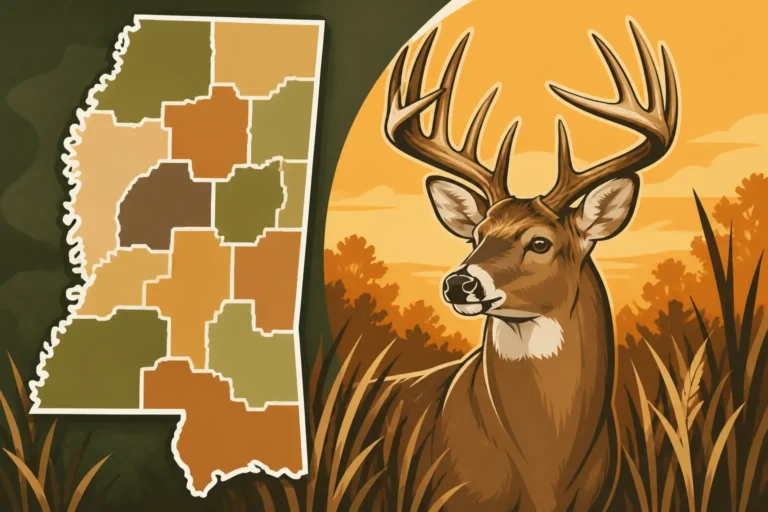
Beyond the Delta and Hills, Mississippi has two other distinct deer management units: the North Central and the Southeast. Each has its own ecological characteristics and harvest trends. The North Central Unit, for instance, shares some characteristics with the Hills, with a mix of agriculture and timber, but often sees specific patterns related to large reservoirs and adjacent public lands. Its harvest can be influenced by timber management practices and the presence of larger tracts of unbroken timber.
The Southeast Unit, extending down towards the Gulf Coast, features longleaf pine forests, swampy lowlands, and coastal plain habitats. Deer densities can vary significantly, and the harvest here might reflect a different set of challenges and opportunities, such as adapting to more dense, thick cover and hunting different types of food sources. This unit also benefits from unique season structures, such as the Hunting the Extended Southeast Unit Archery Window, which can influence overall archery harvest numbers. The harvest in these units underscores the MDWFP's approach to tailored management, recognizing that a "one-size-fits-all" approach simply won't work for Mississippi's varied deer populations. Each unit contributes to the overall Mississippi Deer Season Structure Explained in its own unique way.
Interpreting Harvest Data for Your Next Hunt
Understanding the annual deer harvest numbers isn't just for biologists or land managers; it's a powerful tool that you, as a hunter, can use to refine your strategies, scout more effectively, and ultimately, increase your chances of success. It's about taking the state's story and applying it to your own chapter in the deer woods.
Using Data to Inform Scouting and Strategy
Imagine pouring over maps, marking potential stand locations, and trying to predict deer movement. Now, imagine adding real, hard data to that process. Harvest data, especially at the county level or even more granular if available for specific WMAs, can be incredibly insightful. If you notice a particular county consistently reports a high buck harvest, especially mature bucks, that might indicate a healthy population and effective management that's allowing deer to reach older age classes. This isn't a guarantee of success, but it does suggest a greater potential.
For instance, if you're planning on Scouting Mississippi Public Land Before Season, checking historical harvest data for that WMA could reveal patterns. Has the antlerless harvest been high? That might mean the MDWFP is actively trying to reduce overall deer numbers to balance the herd with the habitat. Has the buck harvest been consistent? It might suggest a stable population. While mapping apps like GoHunt offer incredible detail on property lines, topo maps, and satellite imagery, pairing that visual information with harvest statistics can give you a deeper understanding of what to expect on the ground. You might identify specific areas within a unit that consistently outperform others, guiding your initial scouting efforts and helping you focus your valuable time where deer are more prevalent or where older bucks are being harvested.
The Role of Antler Restrictions in Harvest Quality
Antler restrictions are a hot topic among hunters, and the harvest data clearly illustrates their impact. In units like the Delta, where specific rules like the 12-inch outside spread are in place, the harvest data will typically show a lower number of 1.5 and 2.5-year-old bucks, and a higher proportion of 3.5-year-old and older bucks. This is the intended effect: to allow younger bucks to survive, mature, and contribute to the breeding pool, ultimately improving the genetic quality and average antler size of the herd.
For hunters, this means the quality of bucks harvested—not just the quantity—is greatly influenced by these regulations. If you're hunting in a unit with tight antler restrictions, understanding the harvest data helps confirm that the population is indeed shifting towards older age classes. This might mean you see fewer legal bucks, but the ones you do see are more likely to be mature, formidable animals. Conversely, if you're in a unit with less restrictive rules, the harvest might show a broader range of buck ages, which aligns with a different management philosophy. Knowing these nuances, informed by the harvest reports, helps you set realistic expectations for your hunt and appreciate the specific kind of deer population you're pursuing in any of Mississippi's Four Deer Management Units. It's all about playing by the rules and understanding how those rules shape the game.
| Mississippi Deer Management Units | Key Characteristics | Typical Antler Restrictions (Bucks) | Primary Harvest Focus |
|---|---|---|---|
| Delta Unit | Rich agriculture, bottomland hardwoods, high soil fertility | 12" spread or 15" main beam | Older age class bucks, high quality |
| Hills Unit | Mixed pine/hardwood, rolling topography, diverse habitat | 10" spread or 13" main beam | Balanced buck/doe harvest, herd health |
| North Central Unit | Mix of agriculture & timber, near reservoirs | Varies, often similar to Hills | Consistent buck & doe harvest |
| Southeast Unit | Pine forests, coastal plain, dense cover | Varies, often similar to Hills | Herd management, sustainable harvest |
Disclaimer
This article is for general informational purposes only and does not constitute professional advice. Laws, prices and regulations vary by location and change over time. Consult a qualified professional for guidance on your specific situation.