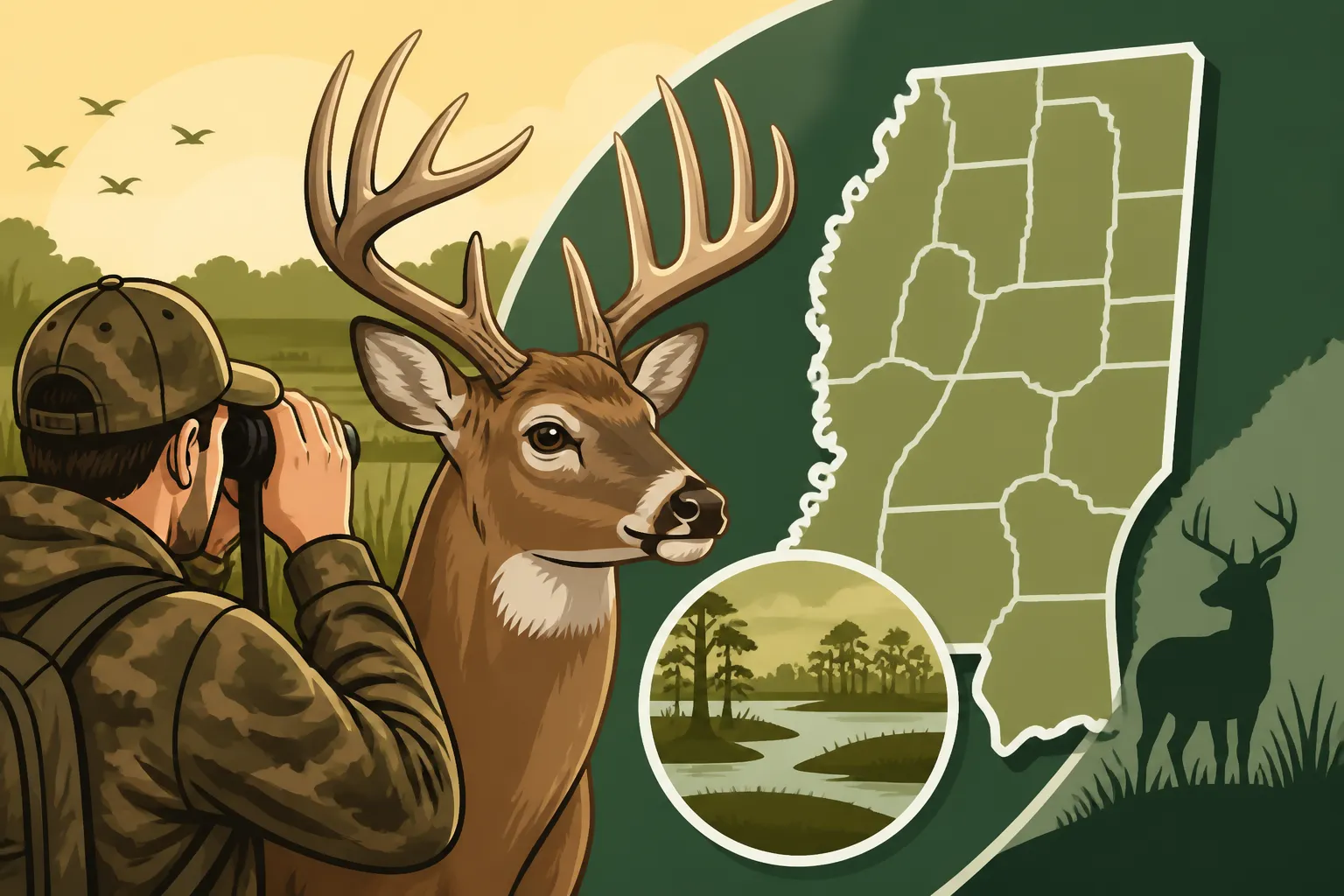
Judging a Legal Buck Under Delta Unit Restrictions
Hunting deer in Mississippi's Delta Unit can be both incredibly rewarding and, let's be honest, a little nerve-wracking when it comes to judging a buck. We've all been there: a beautiful buck steps out, your heart starts pounding, and suddenly that 12-inch spread or four-points-on-one-side rule feels like an impossible calculation under pressure. This guide is here to walk you through exactly what those Delta Unit antler restrictions mean and, more importantly, how to confidently make the right call in the field so you can harvest a legal buck without a second thought.
Understanding Mississippi's Delta Unit Regulations
The Mississippi Department of Wildlife, Fisheries, and Parks (MDWFP) has implemented specific antler restrictions in certain deer management units to promote an older age structure in the buck population and improve herd health. The Delta Unit, known for its rich soils and potential for growing large-bodied, big-antlered deer, has some of the most stringent regulations. It's not just about letting little ones walk; it's a strategic move to ensure genetic potential and a healthier deer herd for generations to come.
The "Twelve-Inch Spread" Rule Explained
This is often the first hurdle for many hunters in the Delta. The rule states that a legal buck must have an inside spread of at least 12 inches. Now, 12 inches might not sound like much when you're looking at a tape measure in your hand, but when that buck is 75 yards away, moving through thick cover, or silhouetted against a fading sky, it can be incredibly deceptive. The "inside spread" is critical; it's the widest point between the main beams, measured from the inside edge of one beam to the inside edge of the other. It doesn't include the tines or any abnormal points extending outwards.
Many hunters mistakenly eye the tips of the antlers or the overall width of the rack. However, if a buck has narrow main beams that only spread, say, 10 inches apart at their widest, but has long tines that make the overall appearance seem much wider, it's still an illegal buck under this rule. This restriction encourages hunters to pass on younger bucks with narrow racks, giving them another year or two to mature and potentially develop that wider spread. It's a key component of Mississippi's strategy to produce quality deer, especially in the nutrient-rich Delta. For a deeper dive into the specific measurement, check out our guide on Delta Unit Twelve-Inch Spread Rule Explained.
The "Four Points on One Side" Rule Explained
This rule is the alternative to the 12-inch spread. If a buck doesn't meet the 12-inch inside spread requirement, it can still be a legal harvest if it has at least four points on one main beam. And just like with spread, there are specifics here. A "point" is generally defined as any projection off the main beam that is at least one inch long, as measured from the base of the projection to its tip, and longer than it is wide at its base. This definition is crucial because sometimes small bumps or non-typical growths might appear to be points but don't meet the length requirement.
When counting, you're looking for at least four distinct, legal points on one side, typically off the main beam. This includes the brow tines, G2s, G3s, and so on. Abnormal points, like kickers or drop tines, do count towards this total if they meet the 1-inch length criteria. So, a buck with a narrow spread but, say, a brow tine, a G2, a G3, and a G4 on its left beam would be legal, even if its spread didn't hit 12 inches. This rule provides a bit more flexibility, allowing hunters to harvest bucks that might be genetically predisposed to narrower, taller racks or those with unique antler configurations.
Why the Delta Unit Has Stricter Rules
The Delta Unit isn't just another part of Mississippi; it's a unique ecosystem. Characterized by fertile, alluvial soils, this region historically grew some of the state's largest deer. The land, often flat and dominated by bottomland hardwoods and vast agricultural fields, provides abundant forage and excellent habitat. The stricter antler restrictions are a management tool designed to take advantage of this natural potential. By protecting younger bucks, the MDWFP aims to:
- Increase Buck Age Structure: More bucks survive to older age classes, leading to larger body sizes and potentially bigger antlers. This creates a more natural deer population where bucks have a chance to reach their prime.
- Improve Genetic Potential: While antler size is influenced by nutrition and age, genetics play a role too. Allowing bucks with good genetics to breed for more seasons can contribute to a healthier, more robust herd overall.
- Enhance the Hunting Experience: For many hunters, seeing and harvesting a mature buck is the ultimate goal. These regulations increase the likelihood of encountering older, larger bucks in the Delta, making for a more challenging and rewarding hunt. Understanding Why the Delta Grows Big Bucks helps put these regulations into perspective. The MDWFP's long-term management goals for this region are clearly laid out in the broader Mississippi Deer Season Structure Explained.
Visual Cues for Estimating Antler Spread
Getting a reliable estimate of antler spread in the field is often the trickiest part, especially when "buck fever" starts to set in. But with practice and a few key visual tricks, you can train your eye to make quick, accurate judgments.
Ear-Tip to Ear-Tip Measurement
This is perhaps the most universally accepted and reliable field-judging technique. For most mature white-tailed deer, the distance from the tip of one ear to the tip of the other, when the ears are in a relaxed, forward position, is approximately 14-16 inches. This isn't a hard and fast rule, as ear size can vary slightly, but it provides an excellent baseline.
If a buck's antlers extend noticeably outside the tips of its ears, it's a pretty safe bet that it meets the 12-inch inside spread requirement. If the antlers barely reach the ear tips, or appear to fall inside them, you're likely looking at a buck with less than a 12-inch spread, and you should probably let it walk unless it clearly meets the four-points-on-one-side rule. Spend time observing deer, even does and young bucks, to calibrate your eye to this ear-to-ear reference. It's a skill that improves with experience.
Body Size and Proportion
A buck's overall body size can also offer clues about its age and, by extension, its antler development. Younger bucks, typically 1.5 to 2.5 years old, tend to have slender bodies, long legs, and a lean neck that blends smoothly into their shoulders. Their antlers, while potentially tall, are often narrower. As bucks mature, their bodies fill out significantly. A 3.5-year-old buck will have a thicker neck that often appears "swelled" during the rut, a deeper chest, and a more developed, blocky appearance.
A wider antler spread is generally more common on these older, more mature-bodied bucks. If you see a buck that looks like a tank – thick-necked, deep-chested, and heavy-bodied – it's more likely to have a legal spread. Conversely, a buck with a sleek, youthful appearance is less likely to meet the spread requirement, though exceptions certainly exist. Always try to assess the buck's body first; it gives you a better idea of its age, which is a major factor in antler development. Many hunters use the popular GoHunt app to record their trail camera photos year-round, which helps them track individual buck development and learn to identify mature deer by their body characteristics.
Head Angle and Perspective Challenges
This is where many hunters get tripped up. A buck's head angle can dramatically alter how its antlers appear. If a buck is looking directly at you, its antlers can appear much narrower than they actually are due to foreshortening. Conversely, if it's quartering away or looking slightly down, the spread might appear wider. The angle of the terrain can also play tricks; a buck standing on a slight incline or decline can skew your perception.
The best practice is to wait for the buck to turn broadside or slightly quartering away, allowing you to get a clearer, unobstructed view of its rack against the backdrop of its body or the surrounding environment. Be patient. Rushing a shot on a buck whose head angle is deceptive is a surefire way to make an illegal harvest. Always prioritize a clear, ethical shot, but also a clear, legal assessment.
Counting Points Accurately on the Hoof
Once you've made a preliminary assessment of the spread, or if the spread looks questionable, your next step is to accurately count points. This requires precision, especially with the 1-inch rule.
Defining a "Point"
As mentioned earlier, for MDWFP regulations, a point must be at least one inch long, measured from its base to its tip, and it must be longer than it is wide at its base. This "longer than wide at the base" rule is crucial. Sometimes, a buck might have a small knob or burr that looks like a budding point but is too wide at its base relative to its length. That would not count.
Always look for clearly defined, distinct projections. If you're unsure, especially on smaller bumps, it's safer to err on the side of caution. Remember, you're looking for four legal points on one side. This can sometimes be challenging on bucks with heavily palmated antlers or those with many small, irregular growths.
Main Beam Points vs. Abnormal Points
For the purpose of the "four points on one side" rule, both typical main beam points (like G2s, G3s, etc., that grow upwards and generally follow the main beam's curve) and abnormal points (like kickers, stickers, or drop tines that grow in unusual directions) can count, provided they meet the 1-inch length and base-width criteria.
So, if a buck has a main beam with a brow tine, a G2, and then a strong kicker off the G2 that meets the point definition, that's three points. If it then has a G3, that would make it four points on that side. The key is that they are points off the main beam, not necessarily strictly "typical" points. This is an important distinction, as some other state regulations may differ. When looking for a buck with a legal rack, remember that you're just looking for the count, regardless of how they are formed.
Quick Counting Techniques in the Field
When a buck presents itself, you often have only a few precious seconds. Here are some techniques to count points quickly and accurately:
- Systematic Scan: Start at the base of one main beam, counting the brow tine (G1), then move up to the G2, G3, and so on, working your way towards the tip. Don't jump around. Once you've counted the typical points, look for any strong abnormal points along that beam.
- Focus on One Side: If you're relying on the "four points on one side" rule, quickly assess one side first. If it clearly has four, you're good. If it's borderline, then quickly scan the other side for a clearer or more definitive count.
- Use Your Optics: Binoculars are your best friend here. Don't rely solely on your naked eye, especially if the buck is more than 50 yards out or in dappled light. Use your binos to clearly identify each projection and confirm its length relative to its base. It's an investment that pays dividends in legal, ethical hunting. Apps like GoHunt also allow you to mark potential locations of older bucks when Scouting Mississippi Public Land Before Season, helping you know what to look for when you're there in person.
Field Scenarios and Decision-Making Under Pressure
The true test of understanding these rules comes when you're actually in the field, heart pounding, and a buck steps out. Making a quick, confident, and correct decision is paramount.
The "Split-Second" Decision
Sometimes, a buck will appear suddenly, offer only a brief window, and then vanish back into the timber. These are the moments that test your preparation. In such situations, you need to rely on your trained eye and quick assessment.
If a buck flashes by, and you only get a glimpse, and you have any doubt about its legality, the best decision is always to pass. You can't un-pull a trigger. It's far better to wonder "what if" about a legal buck than to face the consequences of harvesting an illegal one. This is especially true on public lands or WMAs like those found within Mississippi Wildlife Management Areas, where enforcement is strict.
Practice visualizing legal bucks before the season. Look at photos, watch videos, and even sketch out what a 12-inch spread or a four-point side looks like to you. The more you "see" it beforehand, the better you'll be at recognizing it under pressure.
When to Pass a Borderline Buck
It's tempting to shoot a buck that looks "close enough." However, passing on a buck that's on the edge of legality is not only a wise move to avoid fines and potential license suspension, but it's also a demonstration of sound conservation ethics. A borderline buck likely needs another year to develop.
Think of it this way: if you're standing in your stand, and a buck walks out that might be 12 inches wide, or might have four points on one side, but you're not absolutely sure, that's your cue to wait. There will always be another buck, and the satisfaction of a clean, legal harvest far outweighs the momentary thrill of a questionable one. This approach aligns with the overall goals of Mississippi Deer Bag Limit Rules and responsible wildlife management.
The Role of Optics and Technology
Good optics are non-negotiable for judging deer. A quality pair of binoculars (10×42 or 12×50 are popular choices) will give you the clarity and magnification needed to count points and estimate spread accurately, even in low light. Binoculars allow you to scrutinize details you'd miss with the naked eye.
Beyond traditional optics, modern technology also offers tools. Rangefinders with angle compensation are excellent for getting precise distances, which helps in judging scale. Hunting apps, like GoHunt, can provide detailed maps of your specific hunting area, showing property lines, topography, and even public land boundaries. While they can't judge a buck for you, they can aid in your overall scouting and understanding of the terrain. Some apps even allow you to mark locations where you've seen legal bucks in the past, helping you return to productive spots. This is especially useful in areas where cell service might be spotty, which is why resources like Using the MDWFP App Without Cell Service are so valuable.
Common Mistakes and How to Avoid Them
Even experienced hunters can make mistakes when judging bucks, particularly in the heat of the moment. Being aware of these common pitfalls can help you avoid them.
Misjudging Distance and Antler Size
This is probably the most frequent error. The farther away a buck is, the smaller its antlers will appear. A buck that looks like a monster at 50 yards might only be decent at 100, and a truly impressive buck at 150 yards will look like a deer-of-a-lifetime at 75. Conversely, a small buck up close can appear bigger than it is.
To combat this, use your rangefinder constantly. Get in the habit of ranging landmarks around your stand or blind. Know the exact distances to specific trees, rocks, or openings. When a buck appears, you can quickly estimate its distance, which helps calibrate your eye to its true size. Without a rangefinder, estimating distance is incredibly difficult, especially in open fields or unfamiliar terrain. Many hunters use their onX Layers for Mississippi Land Status to mark these distances on their maps for future reference.
Confusing Main Beam Length with Spread
Another common visual trick is mistaking long main beams for a wide spread. A buck might have impressive, sweeping main beams that extend far forward, giving the illusion of a massive rack. However, the actual inside spread between those beams might be quite narrow. The rack can look tall and impressive, but still fall short of the 12-inch requirement.
Always mentally draw a line straight up from the inside of each main beam and compare that distance. Focus specifically on the space between the beams, not the overall dimensions of the entire antler structure. This takes conscious effort and practice to overcome your brain's natural tendency to be impressed by overall antler mass and length.
Shooting First, Counting Later
This is the cardinal sin of antler restriction hunting and, unfortunately, it happens all too often. The excitement of a buck appearing can override rational thought, leading a hunter to shoot before confirming legality. The consequences can be severe: hefty fines, loss of the harvested deer, and potential suspension of hunting privileges.
The solution is discipline. Before you even shoulder your rifle or draw your bow, force yourself through a mental checklist:
- Is it a buck? (Yes, obviously)
- Can I clearly see its antlers?
- Does it have at least a 12-inch inside spread (using the ear-tip reference)?
- If not, does it clearly have at least four points on one main beam (counting each point carefully)?
- Is it a clean, ethical shot opportunity?
Only when you can confidently answer yes to one of the antler criteria and the shot opportunity should you proceed. If in doubt, do not shoot. It's that simple. Remember, Mississippi Deer Reporting Requirements track all harvested deer, and game wardens are very adept at identifying illegal harvests.
Beyond Antler Restrictions: Ethical Considerations
While adhering to antler restrictions is a legal requirement, it also ties into the broader ethical responsibilities we have as hunters.
Respecting the Resource and Regulations
Antler restrictions, like all hunting regulations, are put in place for a reason: to manage wildlife populations sustainably and ensure healthy herds for the future. By following these rules, you're not just avoiding a ticket; you're actively participating in responsible wildlife conservation. The MDWFP continuously monitors deer populations and adjusts regulations based on scientific data, such as those discussed in Mississippi's Chronic Wasting Disease Zones and their impact on herd management.
The Delta Unit's stricter rules reflect a specific management objective for that region. Respecting those objectives shows respect for the resource itself, the wildlife biologists who dedicate their careers to managing it, and your fellow hunters who share the passion. It’s part of the fabric of White-Tailed Deer Across Mississippi management.
Mentoring New Hunters
For seasoned hunters, there's a vital role in passing on not just hunting skills, but also the ethical framework that governs our sport. When you take a new hunter, especially a young one, into the Delta Unit, emphasize the importance of antler judgment. Teach them the ear-tip rule, how to count points, and the discipline of waiting for a clear, legal buck.
Talk through hypothetical scenarios. Show them photos of legal and illegal bucks. Explain why these rules exist – about herd health, age structure, and the future of hunting. This isn't just about avoiding a mistake; it's about instilling a deep respect for wildlife and the rules that protect it. Teaching proper judgment and ethics is as important as teaching gun safety, and it's a cornerstone of Mississippi Hunter Education Requirements. It’s a shared responsibility that ensures the continuation of Mississippi’s rich hunting heritage for generations to come.
| Characteristic | 1.5-Year-Old Buck (Likely Illegal) | 2.5-Year-Old Buck (Borderline/Legal) | 3.5+ Year-Old Buck (Likely Legal) |
|---|---|---|---|
| Body Shape | Lean, long legs, slender neck | Filling out, neck thickening | Thick, deep chest, heavy muscle, swollen neck (rut) |
| Head/Neck | Long, skinny neck, distinct jawline | Neck blending more into shoulders | Short, thick neck, indistinct jawline |
| Antler Spread | Often inside ear tips, narrow | May just reach ear tips, borderline | Clearly outside ear tips (14"+) |
| Points (One Side) | 1-3 points common | 3-4 points, possibly atypical | 4+ points, strong typical form |
| Behavior | Often nervous, hurried movement | More deliberate, cautious | Confident, dominant |
| Decision | PASS unless 4 pts clearly met | CAUTION, assess carefully | SHOOT (if shot is ethical) |
Disclaimer
Hunting involves inherent risks, and wildlife regulations are subject to change. Always consult the official Mississippi Department of Wildlife, Fisheries, and Parks (MDWFP) regulations guide for the current hunting season before heading into the field. This guide is for informational purposes only and does not supersede state law.