Mississippi Whitetail Color Phase Rarities
Have you ever been out in the Mississippi timber, maybe hunting a Delta bottomland funnel, and suddenly spotted a whitetail that seemed to defy all the typical descriptions? Not just a big antlered buck, but one with patches of stark white, or even completely black fur? It's a truly captivating experience, often leaving hunters wondering if their eyes are playing tricks on them. This guide will dive deep into those fascinating, rare color phases of Mississippi whitetails, exploring what causes them, how to identify them, and what these unique deer mean for us hunters in the Magnolia State.
Understanding the Standard Mississippi Whitetail Coat
Before we delve into the rare, let's establish a baseline for what a typical Mississippi whitetail looks like. Most of us are familiar with the classic brown and tan, but even this "normal" coloration has its nuances throughout the year.
The Classic "Mississippi Tan" and Seasonal Changes
When we think of a Mississippi whitetail, we generally picture a deer with a rich, reddish-brown coat in the spring and summer. This summer coat is relatively thin and sleek, perfectly adapted for shedding heat during our sweltering months. As the days shorten and temperatures begin to dip around September and October, deer undergo a significant change. Their summer coats are replaced by a thicker, denser winter coat that's typically a much duller grayish-brown. This thicker hair provides crucial insulation against the chill, even if our Mississippi winters are milder than those further north. The white belly, throat patch, and underside of the tail remain consistent year-round, serving as warning signals when a deer flags its tail. This standard coloration offers fantastic natural camouflage within our varied landscapes, from the dark, flooded timbers of the Delta to the open piney woods of the Southeast Unit.
Factors Influencing Typical Coat Color
While the seasonal shift is predictable, there can be subtle variations in a deer's coat color influenced by several factors. Age, for instance, can play a role. Older bucks might sometimes appear to have a slightly grizzled or faded look, especially around the face. Diet and overall health also contribute. A well-nourished deer in prime habitat might exhibit a more vibrant coat than one struggling in a lean year, perhaps after Hunting After a Poor Acorn Year. Even the specific habitat can influence how a deer's coat appears. A deer constantly moving through dark, shaded bottomland hardwoods might seem a shade darker than one primarily inhabiting sun-drenched pine plantations. These are all subtle variations within the spectrum of "normal" whitetail coloration, a far cry from the striking genetic anomalies we're about to explore.
Piebald Deer: The Spotted Enigma of the Woods
Among the most commonly reported rare color phases is the piebald deer. If you've ever seen one, you know they're unforgettable. These aren't just deer with a few white spots; they're truly unique individuals.
Characteristics and Common Features of Piebald Deer
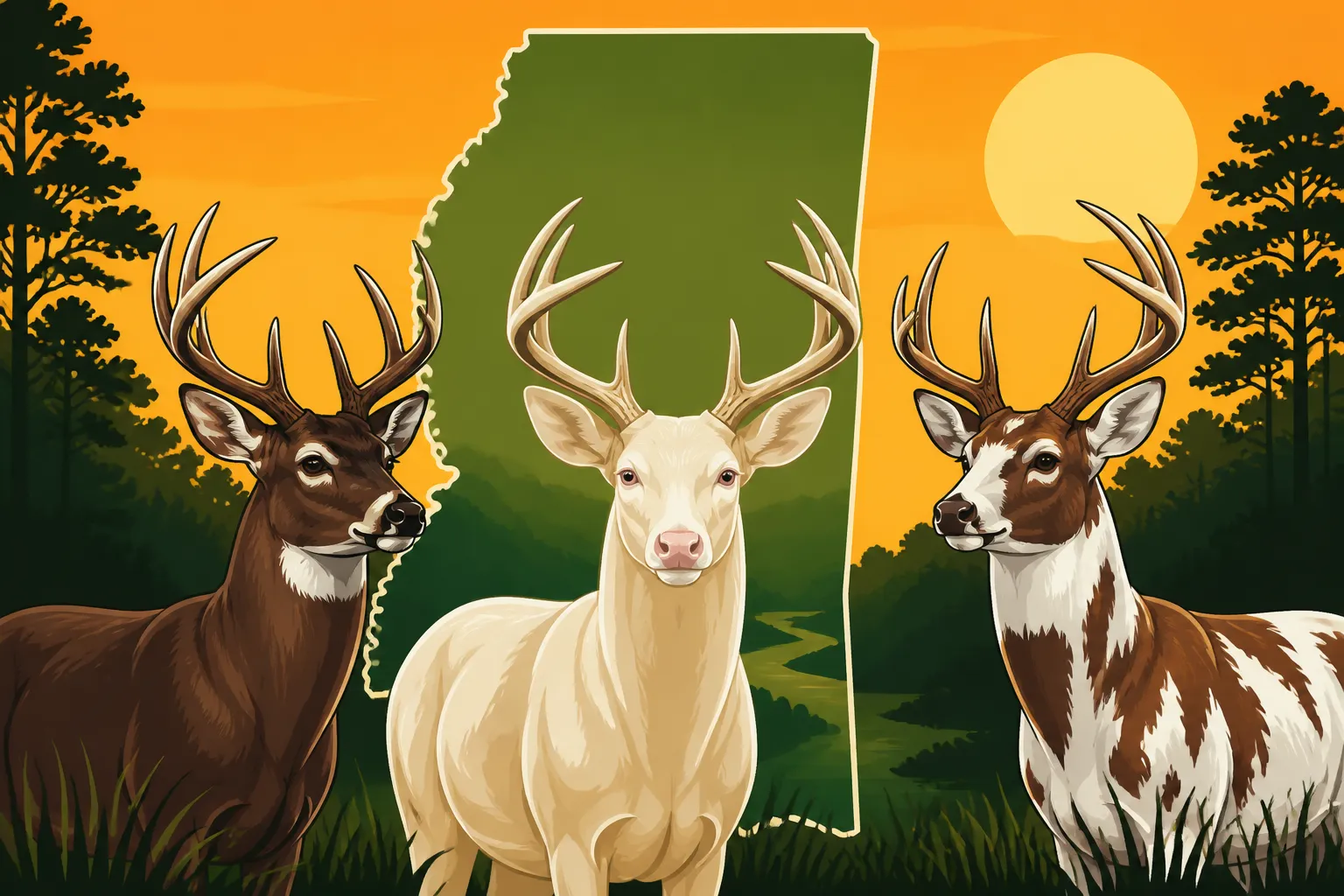
A piebald deer is characterized by irregular patches of white fur mixed with its normal brown coloration. Think of it like a paint-splattered canvas, but in reverse. The white patches can vary greatly in size and location, from small splotches to large areas covering a significant portion of the deer's body. What makes piebald deer even more distinctive are the other physical anomalies that often accompany this genetic trait. Many piebalds exhibit a short, bowing nose, a condition sometimes referred to as "Roman nose." Their legs might be noticeably shorter than average, and their hooves can be deformed, sometimes growing in unusual, curled shapes. You might also notice a curvature of the spine, giving them a hunched appearance. These skeletal deformities can severely impact a deer's mobility and overall quality of life, making them more vulnerable in the wild.
I've talked to hunters in the Delta who swore they saw a deer that looked like a Holstein cow walking through the woods – that's often a piebald. It's truly a sight that makes you double-take.
Prevalence and Genetic Basis
The piebald condition is caused by a recessive gene, meaning a deer must inherit a copy of the gene from both parents to express the trait. This is why piebald deer are relatively rare, estimated to occur in less than 2% of the whitetail population, though local populations might have higher concentrations if the gene is more prevalent in a particular area. When a buck and doe both carry the recessive gene, there's a 25% chance their fawn will be piebald. Even a seemingly normal-looking deer could be a carrier of the piebald gene, silently passing it on to future generations. This genetic quirk is why they continue to pop up even when unseen for generations.
Impact on the Deer's Health and Survival
Unfortunately, the aesthetic uniqueness of a piebald deer often comes at a cost to its health and survival. The skeletal deformities mentioned earlier can make it difficult for these deer to run from predators, navigate rough terrain, or even forage efficiently. Their white patches, while striking to us, can also compromise their natural camouflage, making them stand out against the landscape, particularly during the crucial hunting seasons. A hunter using a scouting app like GoHunt to analyze thermal images wouldn't necessarily see a piebald differently, but visually, they can be much easier to pick out. This increased visibility makes them more susceptible to predation, from coyotes to the increasing number of Feral Hogs Across Mississippi, and to hunters alike. The combination of physical disadvantages and reduced camouflage means that many piebald deer don't live to old age, making sightings of mature piebald bucks even rarer.
Albino Deer: The Ghost of the Forest
Even rarer and perhaps more ethereal than the piebald is the true albino whitetail, a deer that appears as if it's been bleached pure white by the sun.
Defining Features of Albino Whitetails
A true albino deer is instantly recognizable by its pure, unpigmented white fur, which lacks any brown or gray shading whatsoever. But the most definitive characteristic that distinguishes an albino from other white deer (like some extreme piebalds) is the color of its eyes, nose, and hooves. Albino deer have distinctive pink or red eyes, a result of the lack of melanin allowing blood vessels to show through. Their noses and hooves will also be pink or pale, lacking the dark pigment seen in typical deer. This complete absence of pigment makes them truly stand out in any environment. Imagine Tracking a Deer Through Mississippi Leaf Litter and seeing a pure white streak against the forest floor – it would be an unforgettable moment.
Genetic Cause and Rarity
Albinism, like piebaldism, is caused by a recessive gene. In this case, the gene prevents the body from producing melanin, the pigment responsible for skin, hair, and eye color. Because it's a recessive trait, both parents must carry the gene for albinism for an offspring to be born albino. This makes albinism incredibly rare, with estimates suggesting it occurs in only about 1 in 20,000 to 1 in 100,000 deer. Given the extremely low odds, spotting a true albino in the wild is a once-in-a-lifetime event for most hunters.
Survival Challenges for Albino Deer
While beautiful, the pure white coat and lack of pigment present significant survival challenges for an albino deer. The most obvious is the complete lack of natural camouflage. In the green foliage of summer or the muted browns of fall and winter, a pure white deer stands out dramatically, making it an easy target for predators. Beyond camouflage, albino deer often suffer from poor eyesight. Melanin plays a role in eye development, and its absence can lead to vision problems, including light sensitivity. This impaired vision can make it harder for them to detect predators, navigate obstacles, and find food, especially in low light conditions. Overheating can also be an issue; without melanin to protect their skin, they are more susceptible to sunburn. These combined factors mean that albino deer face an even tougher battle for survival than their piebald cousins, often succumbing to predation or environmental stressors at a young age.
Melanistic Deer: The Shadow Phantom
On the opposite end of the spectrum from the ghostly albino is the melanistic deer, a creature of shadow and mystery. While extremely rare in Mississippi, these deer do exist and are truly striking.
The Distinctive Look of Melanistic Whitetails
Melanism is characterized by an excessive amount of dark pigment, resulting in a deer with an unusually dark or even black coat. Unlike a regular deer's dark winter coat, a melanistic whitetail's fur is uniformly dark, often appearing glossy black. Their eyes, nose, and hooves, however, remain typically dark, unlike the red or pink seen in albinos. The sheer depth of color is what sets them apart. Imagine trying to spot one of these against the backdrop of a dark creek bottom or a dense thicket – they blend in almost too well.
Rarity and Geographical Hotspots
Melanistic whitetails are incredibly rare across most of their range, even more so than albinos or piebalds in many areas. However, there are some known hotspots, most notably in specific regions of Texas, where the trait appears to be more concentrated. While much less common, sightings in Mississippi, particularly in areas with dense, dark cover, are not unheard of. The genetic basis for melanism can be complex, involving either dominant or recessive genes, and sometimes it's linked to specific environmental factors that favor darker pigmentation in certain areas. For a Mississippi hunter, stumbling upon a true melanistic deer would be an extraordinary event, even more unique than many trophy bucks.
Survival Advantages and Disadvantages
For melanistic deer, the survival implications are a mixed bag. In environments with dark, dense cover, like the deep swamps and thick bottomlands often found in Hunting Delta Unit Bottomland Deer, a darker coat could actually provide a camouflage advantage, making them harder to spot in shadows. Some theories also suggest that darker coats might offer some protection against certain skin parasites or even absorb heat more efficiently in colder climates, though this might be a disadvantage in Mississippi's sweltering summers. However, just like their lighter-colored counterparts, they stand out in other environments, like open fields or snow-covered landscapes (though snow is rare here). Because of their extreme rarity, studying the precise long-term survival impacts of melanism in Mississippi's whitetail population is challenging, but each sighting offers valuable insight into the diverse genetic makeup of our deer herds.
The Genetics Behind These Unique Deer
It's easy to marvel at these deer and just chalk it up to a "freak of nature," but there's a fascinating scientific explanation rooted in genetics. Understanding this helps us appreciate the complexity of wildlife.
Recessive Genes and Trait Expression
At the heart of piebaldism and albinism are recessive genes. Think back to your high school biology class: for a recessive trait to show up, an individual needs two copies of that gene—one from each parent. If a deer only gets one copy of the recessive gene and one normal, dominant gene, it will look completely normal, but it's a "carrier." It can still pass that recessive gene on to its offspring. This explains why these rare color phases can suddenly appear in a herd where no one has ever seen one before. Two carriers mate, and bam! a piebald or albino fawn is born. This is also why these traits tend to be more prevalent in areas with limited deer movement or smaller, more isolated populations, where the chances of related carriers breeding are higher.
Why These Traits Persist in a Population
Despite the survival challenges that often come with these rare color phases, the genes persist in the deer population because of those carriers. Imagine a large, healthy buck that carries the albino gene but looks completely normal. He breeds with many does, some of whom might also be carriers. While most of their fawns will be typical-colored, every now and then, if two carriers mate, an albino fawn will appear. Since carrying the gene doesn't usually hinder a deer's ability to survive or reproduce, the gene can continue to be passed down through generations, largely unnoticed. It's a natural genetic lottery playing out in our woods, keeping these rare and beautiful deer a possibility. Tools like GoHunt can help us track deer movement and population densities, but they won't tell us which deer are carriers of these hidden genes!
Hunting Considerations for Rare Whitetails in Mississippi
Encountering a piebald, albino, or melanistic deer while hunting in Mississippi is undoubtedly a memorable experience. But what are the rules and ethical considerations if you decide to take one?
Regulations and Identifying Legal Bucks
First and foremost, all standard Mississippi hunting regulations apply to deer with rare color phases. This means antler restrictions, bag limits, and season dates remain unchanged. For example, if you're Judging a Legal Buck Under Delta Unit Restrictions, that twelve-inch outside spread rule still applies, regardless of whether the deer is piebald or typical brown. The unique coloration doesn't exempt a deer from these rules. It's crucial to be absolutely sure of your target and its legality, especially since some of these deer may also exhibit physical deformities that could make judging their size or age more challenging from a distance. Always consult the latest MDWFP regulations before heading into the woods.
Ethical Considerations for Harvesting a Unique Deer
Beyond legality, there's the question of ethics. Some hunters feel a strong inclination to harvest a rare color phase deer for its unique trophy value, seeking to preserve such an unusual specimen. Others believe that these deer, due to their rarity and often compromised health, should be passed over, allowing them to continue their unique lineage or simply live out their lives. There's no universal right or wrong answer here, and it often comes down to personal choice and hunting philosophy. Consider the deer's health: if a piebald deer is visibly suffering from severe deformities, harvesting it might be seen by some as a humane act. Conversely, a healthy albino buck might be seen as a truly magnificent, once-in-a-lifetime sighting that you'd rather leave to roam. It's a conversation many hunting camps have when a "ghost deer" or "calico deer" is seen on trail cameras.
Reporting Sightings and Harvests to MDWFP
Whether you choose to harvest a rare color phase deer or simply enjoy the sighting, reporting it to the Mississippi Department of Wildlife, Fisheries, and Parks (MDWFP) can be incredibly valuable. Wildlife biologists are always interested in data on these anomalies, as it helps them understand gene prevalence, herd health, and population dynamics. If you harvest one, make sure to follow all Mississippi Deer Reporting Requirements, and consider providing additional details or photos to the MDWFP. Even a simple sighting, perhaps noted on your Scouting With the MDWFP App or a personal hunting journal, can contribute to the collective knowledge about Mississippi's fascinating whitetail population.
Comparing Mississippi's Rare Whitetail Color Phases
To help summarize these unique deer, here's a quick comparison of their key characteristics.
| Color Phase | Key Characteristics | Genetic Basis | Survival Challenges | Hunting Considerations |
|---|---|---|---|---|
| Typical Whitetail | Brown/gray coat, white belly, dark eyes/nose/hooves | Normal pigment genes | Minimal (natural) | Standard regulations apply |
| Piebald | Irregular white patches, short legs, bowing nose, deformed hooves, often dark eyes/nose/hooves | Recessive gene (incomplete pigment expression) | Reduced camouflage, mobility issues, skeletal deformities, increased predation | Legal to harvest if male and meets antler restrictions; often visually distinctive |
| Albino | Pure white fur, red/pink eyes, pink nose/hooves | Recessive gene (complete lack of melanin) | Very poor camouflage, poor eyesight, sun sensitivity, high predation | Legal to harvest if male and meets antler restrictions; highly visible, extremely rare |
| Melanistic | Excessively dark/black fur, normal dark eyes/nose/hooves | Dominant or recessive gene (excess melanin) | Possible thermal regulation issues in extreme heat, potential camouflage advantage in dark cover, very rare | Legal to harvest if male and meets antler restrictions; blends exceptionally well in shadows |
Seeing one of these deer in the wild is truly a special moment, a reminder of the incredible diversity and occasional surprises that nature holds. Whether you're chasing the Mississippi Deer Season Structure Explained across the Delta or still-hunting ridges in the Hills Unit, keep an eye out—you just might spot one of Mississippi's legendary shadow phantoms or ghost deer.
Disclaimer
This article is for general informational purposes only and does not constitute professional advice. Laws, prices and regulations vary by location and change over time. Consult a qualified professional for guidance on your specific situation.