Mississippi Legal Firearms for Deer Hunting
It can feel like you need a law degree just to figure out what firearm you're legally allowed to carry into the Mississippi woods for deer season. Between differing regulations, unit-specific rules, and the constant hum of misinformation, it's easy to get lost in the details and worry you're making a mistake. This guide is here to untangle the complexities, walking you through the ins and outs of Mississippi's legal firearms for deer hunting, ensuring you step afield with confidence and compliance.
Understanding Mississippi's Deer Firearms Regulations
Mississippi's deer hunting regulations, particularly concerning firearms, can sometimes feel like a moving target, leaving many hunters scratching their heads. The state aims to provide a balance between hunter opportunity, game management, and public safety, but the resulting rules often require a careful read. It’s not just about what gun you own, but what gun is legal for the specific season, unit, and even the type of property you're hunting. Misunderstanding these can lead to frustration, or worse, legal trouble and a lost hunting privilege.
When you're planning your deer season, it's crucial to consult the official Mississippi Department of Wildlife, Fisheries, and Parks (MDWFP) regulations. These are the definitive source, and while this guide will break them down, always cross-reference for the most current information. The rules often reflect ongoing biological assessments of the deer herd and public input, leading to adjustments from year to year. A great tool like GoHunt can help you stay on top of these changes, offering a centralized place to verify regulations and plan your hunts effectively across different states.
One common frustration comes from the varied seasons. You might be perfectly legal with a rifle during the general gun season, but switch to a primitive weapon or archery season, and suddenly that trusty rifle needs to stay in the truck. Then there are the specific limitations tied to certain wildlife management areas (WMAs) or federal lands, which might have even stricter rules than statewide regulations. It’s a lot to keep track of, but knowing the "why" behind some of these rules often helps them make more sense, even if it doesn't make them simpler to remember.
The Lowdown on Legal Rifles for Deer Hunting
Ah, the deer rifle. For many Mississippi hunters, this is the quintessential tool for pursuing whitetails, especially when the crisp air of late fall ushers in the general gun season. There’s nothing quite like the feeling of carrying a well-zeroed rifle into the timber, knowing you have the range and power to ethically harvest a deer. However, not just any rifle will do, and understanding the nuances of caliber and type is crucial before you head out.
Minimum Caliber Requirements for Rifles
Mississippi does indeed have minimum caliber requirements for centerfire rifles used for deer hunting. This isn't just an arbitrary rule; it's designed to ensure hunters use a cartridge with sufficient energy and knockdown power to dispatch a deer quickly and humanely. Nobody wants to wound a deer and have it suffer, or worse, lose it in the dense Mississippi cover.
The general rule states that centerfire rifles must be at least .22 caliber. While a .223 Remington or 5.56 NATO might meet the technical minimum, many experienced hunters would strongly advise stepping up to something with a bit more punch for deer. Think .243 Winchester, 6.5 Creedmoor, .270 Winchester, .30-30 Winchester, .308 Winchester, or .30-06 Springfield. These calibers are widely regarded as excellent deer rounds, offering a good balance of trajectory, energy, and recoil for most hunters. For a deeper dive into the specifics, you can always check out the article on Mississippi Minimum Rifle Caliber Rules. It’s about ethical hunting, and a well-placed shot with an appropriate caliber is key.
Remember, the caliber is just one piece of the puzzle; bullet construction is equally vital. Soft-point or expanding bullets are generally preferred for deer hunting as they create more tissue damage and transfer energy effectively, leading to a quicker, cleaner kill. Full metal jacket (FMJ) bullets are typically not suitable or legal for big game hunting in Mississippi due to their poor expansion characteristics.
Common Legal Rifle Types and Considerations
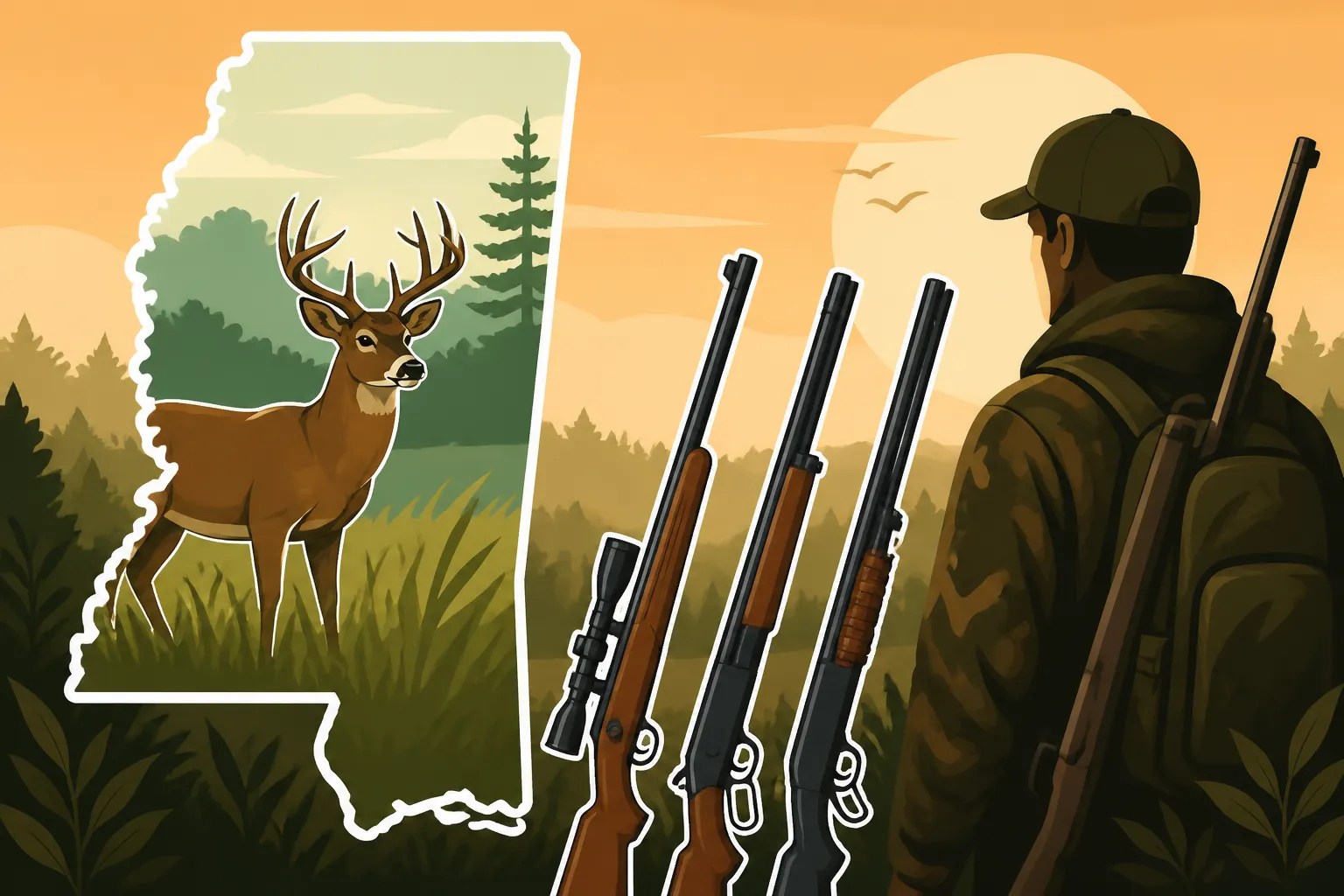
When we talk about rifle types, Mississippi generally allows most common action types for deer hunting, as long as they meet the caliber requirements and aren't prohibited by other regulations. This includes bolt-action, lever-action, pump-action, and semi-automatic rifles. Each type has its adherents, and what works best often comes down to personal preference and hunting style.
Bolt-action rifles are incredibly popular for their accuracy and reliability. Many hunters prefer them for their precision, especially when hunting larger properties or food plots where longer shots might be possible. Lever-actions, like the classic .30-30, are iconic and perfect for brushy areas where quick follow-up shots might be needed, or for those who just love a touch of tradition. Semi-automatic rifles, such as those chambered in .308 or 6.5 Creedmoor, are also legal and offer rapid follow-up shots, though some WMA regulations might limit magazine capacity. Always double-check WMA rules for specific restrictions, as they can sometimes differ from statewide mandates. For instance, the use of a good app like GoHunt can provide overlays for public lands, highlighting any special regulations specific to that area.
Consider the terrain you're hunting in. In the dense bottomland hardwoods of the Delta Unit, where shots are often close and quick, a lever-action or a compact bolt-action might be ideal. If you're hunting the more open pine plantations or clear-cuts of the Southeast Unit, a flat-shooting bolt-action might give you an edge. Knowing your rifle, practicing regularly, and understanding its capabilities are far more important than any specific type, but choosing one that fits your hunting environment will certainly boost your confidence.
Shotguns and Muzzleloaders: Traditional Options and Their Rules
While rifles often grab the spotlight, shotguns and muzzleloaders hold a significant place in Mississippi's deer hunting traditions. These firearms are not only legal but are often mandated during specific seasons or in areas where the use of high-powered rifles might be restricted due to population density or safety concerns. Embracing these tools can open up new hunting opportunities and challenge you to hone different skill sets.
Shotgun Regulations and Ammunition
Shotguns are a versatile option for deer, particularly in areas where rifle hunting might be restricted or for hunters who prefer a heavy-hitting, close-range firearm. In Mississippi, shotguns must be 20 gauge or larger, firing a single slug. This means no buckshot for deer, which is a common misconception for new hunters. The single slug requirement ensures that the projectile has sufficient mass and energy for an ethical deer harvest, similar to a rifle bullet.
Common shotgun gauges used for deer include the 20 gauge and the 12 gauge, with the 12 gauge being perhaps the most popular due to the wide availability of slugs and its robust performance. Modern slug technology, especially from manufacturers like Winchester, Federal, or Hornady, has drastically improved shotgun slug accuracy and range, making them effective out to 100-150 yards with a rifled barrel and appropriate optics. Smoothbore shotguns are still effective, particularly at shorter ranges, but rifled slug barrels significantly enhance precision. When planning your hunt, be sure to review the overall Mississippi Deer Season Structure Explained to see when shotguns are a primary or even sole option.
Shotgun hunting for deer often shines in thick cover or smaller tracts of land where long-range rifle shots aren't practical or safe. Many hunters appreciate the simplicity and robust nature of a pump-action shotgun for deer hunting. It’s a reliable tool, and with the right slug, it’s undeniably effective. Just remember, the focus is always on a single, well-aimed shot with a proper slug, not peppering an area with buckshot.
Muzzleloader Season Specifics and Equipment
Muzzleloaders, often referred to as "primitive weapons," offer a truly unique hunting experience that transports you back to a simpler, more deliberate time. Mississippi dedicates specific seasons to muzzleloader hunting, providing an extended opportunity to pursue deer before or after the general gun season. These seasons are a fantastic chance to get into the woods with fewer crowds and to test your skills with a single-shot firearm. You can find detailed dates and rules in the Mississippi Muzzleloader Season Rules article.
For deer hunting, legal muzzleloaders include single-shot, primitive firearms loading from the muzzle. This typically encompasses traditional flintlock and percussion cap rifles, as well as modern in-line muzzleloaders. The minimum caliber requirement for muzzleloaders is .38 caliber for deer, though most hunters opt for larger calibers like .50 or .54 caliber for their superior energy and availability of projectiles. Common projectiles include round balls, conical bullets, or saboted bullets, all designed for ethical deer harvest.
Hunting with a muzzleloader demands patience and precision. You get one shot, so making it count is paramount. This means meticulous practice at the range, understanding your rifle's capabilities, and being intimately familiar with its loading and cleaning procedures. For many, the challenge and tradition of muzzleloader hunting are deeply rewarding, connecting them to the past and forcing a greater appreciation for the hunt itself. It's a slower, more intentional pursuit, offering a different kind of satisfaction than high-speed rifle hunting.
| Firearm Type | Minimum Caliber/Gauge | Legal Ammunition | Typical Effective Range (yards) | Pros | Cons |
|---|---|---|---|---|---|
| Rifle | .22 Centerfire | Expanding bullets (soft-point, hollow-point) | 150-300+ | High accuracy, long range, wide caliber selection | Can be overkill at close range, louder, more recoil with larger calibers |
| Shotgun | 20 Gauge | Single slug (no buckshot) | 50-150 | Versatile, good for thick cover, powerful at close range | Limited range compared to rifles, less precise at distance |
| Muzzleloader | .38 Caliber | Round ball, conical, or saboted projectile | 50-200 | Extended primitive seasons, traditional experience, powerful | Single shot, slow reloading, sensitive to weather |
| Handgun | .38 Caliber | Expanding bullets (e.g., .357 Mag, .44 Mag, .45 Colt) | 25-75 | Compact, secondary weapon, challenging | Very limited range, high skill required, significant recoil |
Handguns for Deer: When and How They Fit In
Hunting deer with a handgun is a niche but incredibly rewarding challenge that really tests a hunter's skill and discipline. While not as common as rifle or shotgun hunting, handguns are perfectly legal for deer in Mississippi, provided they meet specific criteria. This method often appeals to those looking for a close-quarters engagement or an added layer of difficulty in their pursuit.
Legal Handgun Requirements
Similar to rifles and muzzleloaders, Mississippi has minimum caliber requirements for handguns used to hunt deer. A centerfire handgun must be at least .38 caliber and use an expanding bullet. This means smaller rimfire calibers like a .22LR are out, as are full metal jacket (FMJ) bullets. The intent, again, is to ensure humane harvesting.
Popular handgun calibers for deer include the .357 Magnum, .44 Magnum, .45 Colt, and even some of the more powerful semi-automatic calibers like 10mm Auto or .45 Super, as long as they deliver sufficient energy and use appropriate expanding ammunition. When considering a handgun for deer, think about its effective range – typically much shorter than a rifle or even a shotgun slug. Most ethical handgun deer hunters limit their shots to within 50-75 yards, often much closer. A useful resource like GoHunt can help you find regulations or even specific WMA rules that might pertain to handgun use, which can vary.
The choice of handgun is personal. Revolvers are very popular due to their reliability and powerful calibers, while some experienced handgun hunters opt for large-frame semi-automatics. Regardless of type, the key is proficiency. A handgun requires more practice to shoot accurately at hunting distances than a rifle, due to its shorter sight radius and often heavier trigger pull.
Practical Considerations for Handgun Hunting
Handgun hunting is not for the faint of heart, nor is it a substitute for a rifle if you're uncomfortable with its limitations. It requires an intimate understanding of deer anatomy, excellent shooting fundamentals, and immense patience to wait for the perfect, close-range shot. You'll likely spend more time still-hunting or stalking to get within effective handgun range.
Many handgun hunters utilize optics, such as a red dot sight or a low-magnification scope, to improve accuracy at typical hunting distances. Stability is also paramount, so a good shooting rest, whether it's shooting sticks, a bipod, or bracing against a tree, is crucial for making an ethical shot. This method is often favored during archery or primitive weapon seasons, or by hunters who enjoy the challenge of getting truly close to their quarry. When hunting the Mississippi Youth Gun Season Rules, for example, a handgun could be an option for an experienced youth hunter seeking a different challenge, though safety and proficiency remain paramount.
For those venturing into handgun deer hunting, I highly recommend spending significant time at the range. Practice from various field positions, not just off a bench. Understand your handgun's limitations and your own. This isn't a method where you can "spray and pray"; it's about making that single, perfect shot. It’s a rewarding experience that harks back to the purest forms of hunting, demanding precision and a deep connection with the natural world.
Navigating Ammunition Types and Other Equipment Considerations
Beyond the firearm itself, the ammunition you choose and the supplemental equipment you carry play a pivotal role in a successful and legal deer hunt in Mississippi. It’s not just about pulling the trigger; it's about ensuring every component works together effectively and adheres to the state’s regulations.
The Importance of Ammunition Choice
We've touched on this a bit already, but it bears repeating: ammunition choice is absolutely critical. For any centerfire firearm used on deer in Mississippi, you must use expanding projectiles. This includes soft-point (SP), hollow-point (HP), or ballistic tip bullets for rifles and handguns, and expanding slugs for shotguns. The goal is to ensure the bullet expands upon impact, creating a larger wound channel and delivering maximum energy transfer to the animal, leading to a quick, humane kill.
Forget about full metal jacket (FMJ) ammunition for deer hunting. These bullets are designed for penetration with minimal expansion, which means they pass through an animal without imparting enough energy to cause a quick, ethical harvest. Using FMJ for deer hunting is not only unethical but also generally illegal in most states, including Mississippi, for big game. Always ensure the ammunition you're carrying matches the regulations and is appropriate for the game you're pursuing. Checking a resource like GoHunt or your MDWFP guide will often clarify these specifics.
Additionally, consider the grain weight of your bullet in relation to your chosen caliber. Heavier bullets often perform better in terms of energy retention and penetration on larger game like deer, especially at longer ranges. Match your bullet weight to your firearm's twist rate for optimal accuracy. Experiment at the range with different brands and bullet weights to see what shoots best in your particular firearm. What works well in one .308 might not be ideal in another, so personalization is key.
Essential Gear Beyond the Firearm
While your firearm and ammunition are central, other gear ensures you're ready for anything the Mississippi woods throw at you. First and foremost, safety cannot be overstated. When hunting during gun season, make sure you're compliant with Mississippi Blaze Orange Requirements. This isn't just a rule; it's a critical safety measure that makes you visible to other hunters and significantly reduces the risk of accidents.
Optics are another major consideration. A quality scope on your rifle or muzzleloader can dramatically improve accuracy, especially as light fades or at longer ranges. Red dot sights or low-power variable optics (LPVOs) can be excellent for shotguns and handguns in thick cover. Don't cheap out on optics; clear glass and reliable adjustments are worth the investment. Beyond the shot, carrying a good knife, game bags, and a way to drag or transport your deer are all essential. If you tag out, you’ll need to comply with Mississippi Deer Reporting Requirements, so have your phone or license ready.
Finally, consider scouting tools. Whether it's aerial maps on your phone, a GPS, or simply a compass and paper map, knowing your hunting area is vital. Understanding things like wind direction, deer trails, and bedding areas will put you in the right spot for a shot. Even if you're just hunting a local spot, a little preparation goes a long way. This forethought, combined with your knowledge of Hunting the Mississippi Rut by Unit, can put you right in the middle of the action.
Disclaimer
Please remember that hunting regulations can change. While this guide aims to provide accurate and up-to-date information, it is your responsibility to consult the official Mississippi Department of Wildlife, Fisheries, and Parks (MDWFP) regulations each year before heading afield. This content is for informational purposes only and should not be considered legal advice.