Reading Delta Mud for Fresh Deer Movement
Hunting in the Mississippi Delta presents a unique set of challenges, doesn't it? That vast, flat landscape, often shrouded in thick bottomland hardwoods or endless agricultural fields, can make finding consistent deer movement feel like trying to find a needle in a haystack. You spend hours walking, thinking you're on to something, only to realize the "fresh" sign you're seeing is days old. It's frustrating, especially when you know big bucks are roaming these parts. But here’s the secret weapon: learning to truly read the Delta mud. This guide is all about honing those skills, so you can pinpoint exactly where and when those elusive whitetails are moving.
Understanding the Delta Environment and Its Unique "Sign"
The Delta isn't like the rolling hills or pine plantations you find in other parts of Mississippi. Its flat topography, punctuated by numerous sloughs, oxbow lakes, and agricultural fields, means deer behave differently and leave their mark in distinct ways. If you're used to finding rubs and scrapes on hard ground, you'll need to adjust your expectations here.
Why Mud is So Critical in the Delta
Think about it: the Delta is defined by its water. From the mighty Mississippi River itself to the countless sloughs, oxbows, and drainage ditches, water is everywhere. This constant presence means the ground is often soft, damp, or outright muddy, especially during and after rainfall. Unlike dry, sandy, or hard-packed earth where tracks might quickly erode, get blown away by wind, or become indistinguishable, mud is a fantastic preserver of sign.
When a deer steps in mud, it leaves a clear, defined impression. These tracks, scrapes, and disturbances don't just disappear overnight. They can remain legible for hours, or even days, giving you a window into recent deer activity. Knowing how to interpret these muddy hieroglyphs is paramount. Without this skill, you're essentially walking blind, missing the most reliable indicator of fresh deer movement in this unique environment. The constant fluctuation of water levels in these bottomlands also heavily influences where deer travel, often forcing them onto slightly higher ground or along defined routes, making the mud sign even more concentrated and telling. You might find some of your best insights into Hunting Delta Unit Bottomland Deer by focusing intently on these muddy areas.
Common Delta Terrain Features That Hold Sign
Deer in the Delta are creatures of habit and efficiency, just like deer anywhere, but their pathways are dictated by the landscape. They aren't going to climb a steep ridge when they can skirt a slough. This means they often concentrate their movement along specific natural or man-made features that offer the easiest travel.
Slough and Ditch Banks: These are absolute goldmines. Deer will consistently walk the slightly elevated banks of sloughs, creeks, and drainage ditches. The edges of these water features often provide the driest, most stable footing and serve as natural travel corridors, connecting different areas of bedding and feeding. You'll find a higher concentration of tracks, droppings, and even occasional rubs or scrapes along these linear features. Looking for these natural "highways" is often the first step in Hanging a Stand on a Delta Bottomland Funnel.
Field Edges and Turn Rows: Where the dense timber meets the open agricultural fields, you'll almost always find deer sign. Whether it's a soybean, corn, or winter wheat field, deer use these edges for cover while moving to and from feeding. Turn rows, those areas where farm equipment turns around, are often slightly disturbed and muddy, making them perfect for showing fresh tracks.
Logging Roads and Trails: Any sort of man-made path through the woods becomes an instant deer highway. Logging roads, even old overgrown ones, offer clear, easy travel for deer. These roads often hold water in low spots, creating prime muddy stretches to check for tracks. Similarly, well-used deer trails, worn down by generations of hooves, will be the first places to show fresh mud prints after a rain.
Deciphering Freshness: The Art of Reading Mud Tracks
This is where the rubber meets the road—or rather, where the boot meets the mud. It's one thing to see a track; it's another entirely to know if that track was left an hour ago or a week ago. And in hunting, those few hours can make all the difference between a sighting and a long, cold sit.
Identifying Fresh vs. Old Tracks
The most crucial skill in reading Delta mud is discerning the age of a track. It’s not just about seeing a deer print; it’s about understanding its story.
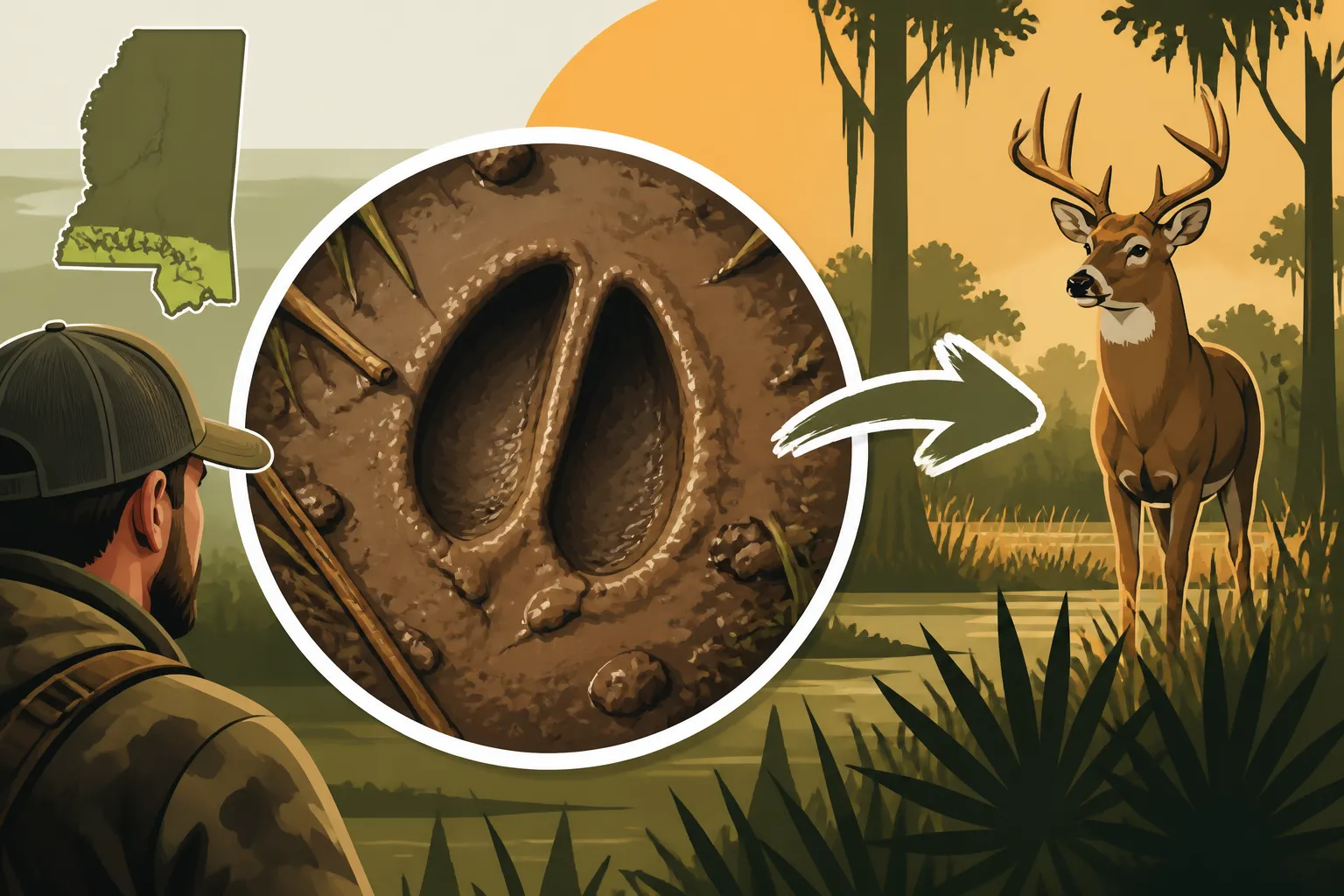
Fresh Tracks: A truly fresh track looks like it was just made. The edges will be sharp, crisp, and well-defined, with the mud around the print showing clear displacement or "splash-out." If you see tiny mud crumbs or small bits of displaced soil still clinging to the edges, that’s a fantastic indicator of recent activity. The bottom of the print might still look wet and shiny, or if it’s been a bit, it’ll be a dull, moist earth color without any pooling water inside the print (unless it's actively raining). There will be no debris like leaves, twigs, or fallen pine needles settled within the print. If you push your finger into the mud next to it, the consistency will often match the mud inside the track, showing it hasn't had time to dry out or crust over. Pay close attention to these details – they're the difference between tracking a ghost and tracking a living, breathing buck.
Old Tracks: Older tracks tell a different tale. Their edges will be rounded, softened by the elements like rain, sun, or even subtle changes in humidity. The mud itself might have started to dry out and crack around the edges, or if it's been exposed to multiple rainfalls, the print will be filled with water, silt, or a layer of fallen leaves and debris. The displaced mud around the edges will be flattened or washed away. The bottom of the print will often be dull, sometimes even showing a crust. A track that's been sitting for a few days might have insects, spiderwebs, or even small plant growth starting within it. These are signs that the deer passed through a while ago, and while it confirms deer are in the area, it doesn't give you the immediacy you need for a successful hunt. This skill is vital when you’re out Finding Sign in Big Delta Timber and trying to piece together recent activity.
Size, Gait, and Direction: What Tracks Tell You
Once you've got a handle on freshness, you can start to extract more information from those muddy prints. Tracks aren't just dots on a map; they're sentences in a story about what a deer was doing.
Estimating Size and Sex: Look at the overall size and shape of the track. Generally, a buck's hooves are broader and blunter at the toe than a doe's, which tend to be more pointed and daintier. The length and width are key. While a big doe can leave a substantial track, an extra-wide track or one with significantly splayed toes (especially if the deer was moving fast or in very soft mud) can often indicate a heavier-bodied buck. Don't rely solely on track size to determine sex, but it's a strong indicator when combined with other observations. A wide, deep track is always worth investigating further.
Reading Gait: How a deer places its hooves can tell you a lot about its behavior.
- Walking: A deer walking calmly will typically "direct register," meaning its hind foot steps directly into or very close to the impression left by its front foot. The stride length will be consistent and relatively short. This indicates casual movement, perhaps browsing or heading to a bedding area.
- Trotting: When a deer trots, its hind foot often lands slightly in front of the front foot's impression. The stride length increases, and the tracks might look a bit more spaced out. This suggests the deer is moving with purpose, but not necessarily alarmed.
- Running/Bounding: In a full run or bound, the tracks will be widely spaced, often showing all four prints. The mud displacement will be significant, indicating speed and power. If you find a series of running tracks, it's a good bet the deer was spooked, which means you might be looking for bedding areas a bit further away.
Determining Direction: This seems obvious, but it's often overlooked. The dewclaws (the small secondary hooves higher up on the leg) leave small indentations behind the main hoof print, pointing in the direction of travel. Also, the front of the hoof print, where the deer pushed off, often shows a slight "kick-out" of mud, while the heel part of the print is usually deeper and cleaner. Carefully observe these details, then pick a direction and follow it. Are the tracks leading towards a known food source, a dense bedding thicket, or a water crossing? Knowing the direction helps you anticipate where the deer is going and set up accordingly, potentially even leading you to Where Delta National Forest Bucks Bed.
| Feature | Fresh Track Indicators | Old Track Indicators |
|---|---|---|
| Edges | Sharp, crisp, well-defined, often with small mud crumbs. | Rounded, softened, eroded; might show cracking if dried. |
| Mud Inside | Moist, dull earth tone; might be shiny; no standing water. | Dry, crusted, or filled with water, silt, or debris. |
| Displacement | Clear "splash-out" or raised edges around the print. | Flattened, washed away, or filled in by elements. |
| Debris | Absent or minimal; may have active insect activity if recent. | Leaves, twigs, pine needles, or other debris settled within. |
| Color/Texture | Consistent with surrounding disturbed mud. | Different color due to drying, fading, or siltation; crusty. |
Beyond Tracks: Other Mud Sign and Behavior Patterns
Tracks are definitely the headline act when it comes to reading mud, but they're not the only show in town. Deer leave other subtle (and not-so-subtle) cues in soft ground that can round out your understanding of their movements and intentions.
Mud Scrapes and Rubs: Interpreting Ground Disturbance
We often think of scrapes as those perfectly pawed-out circles on dry ground beneath an overhanging branch, or rubs as bark scraped clean off a sapling. But in the Delta, where wet ground is king, deer adapt, and so does their sign.
Mud Scrapes: While true "power scrapes" with deeply pawed earth might be less common in perpetually wet areas, deer absolutely make scrapes in the mud. Look for areas of disturbed, churned-up mud, often about the size of a dinner plate or larger. These scrapes might not be as perfectly circular as their dry-ground counterparts, but they will clearly show pawing marks. Crucially, look for a "licking branch" overhead – a low-hanging branch that the deer will mouth and rub scent glands on. If the mud is still wet and freshly disturbed, often with a distinct odor (especially if they've urinated in it), you're on a hot sign. These are often found along those same slough banks or logging road edges where tracks are prevalent.
Mud Rubs: Bucks still rub their antlers in the Delta, but the type of tree and the visual evidence can change. In areas of softer ground or near water, smaller, limber saplings might show mud smeared onto their trunks, along with fresh antler marks and perhaps even some deer hair caught in the bark. This is distinct from a classic hard-ground rub where bark is completely stripped away. The mud itself becomes part of the rub, transferring from the buck's antlers to the tree. If you find this kind of sign, especially when fresh and low, it can indicate a buck is regularly working that area and defining his territory.
Observing Muddy Water Crossings and Wallows
The presence of water dictates so much in the Delta, and deer are masters of navigating it.
Water Crossings: Deer need to cross water to get from one area to another, whether it's a narrow ditch or a wide slough. Look for subtle signs at crossing points. The banks will often be muddy and disturbed, with tracks leading into and out of the water. You might see mud transferred from the deer's legs onto the bank as it exits, or even a faint "swish" mark in the water's edge where it pushed through. These crossing points are fantastic natural funnels. A spot where a slough narrows, or where a downed log creates a natural bridge, will be used repeatedly. These are prime locations to scout with apps like GoHunt, which can help you identify these pinch points on satellite imagery. Learning about Hunting a Funnel Between Two Sloughs will further enhance your understanding of these critical crossing points.
Wallows: While not as common for deer as for hogs, deer will occasionally "wallow" or lie in shallow muddy depressions, especially during hot weather, to cool off or escape insects. These won't look as heavily churned as a hog wallow, but you might find an impression of a deer's body in the mud, sometimes with matted hair around the edges. Distinguishing this from a hog wallow is important; hog wallows are usually larger, deeper, and show evidence of rooting or extensive mud-caking on nearby trees.
Strategic Scouting with Mud in Mind
Understanding how deer interact with mud is one thing; putting that knowledge to practical use in your scouting is another. It's about combining boots-on-the-ground observation with modern technology and knowing when to hit the woods.
Using Technology to Pinpoint Muddy Hotspots
Gone are the days when scouting was solely about pounding the pavement. Now, we have incredible tools that let us "virtually" scout, identifying promising areas before we even step foot on them.
Satellite Imagery and Mapping Apps: Before you even leave your truck, pull up a mapping app like GoHunt or onX Hunt. Zoom in on your chosen hunting area, whether it's public land or a private lease. Look for dark green areas indicating dense timber, but more importantly, identify those serpentine lines of water—the sloughs, creeks, and ditches. These are your primary targets for mud sign. Pay attention to changes in elevation, even subtle ones. A slightly higher bank or a small ridge within the bottomland will concentrate deer movement, and these are the places where mud will be most evident. Use the topography and satellite layers to mark potential crossing points, funnel areas, and where dense cover meets open fields. This digital reconnaissance can save you hours of aimless walking and direct you straight to promising locations. Utilizing the features on a service like GoHunt can significantly cut down your scouting time by highlighting these natural funnels and terrain changes. Also, don't forget the power of Scouting With the MDWFP App for specific WMA boundaries and regulations.
Understanding Water Levels: Many modern mapping apps also offer historical satellite imagery or integrate with weather data. Knowing if the water levels were high or low during a particular period can help you understand older sign. For instance, if an area was flooded a week ago, any tracks you find there now are very fresh. Conversely, if an area is currently flooded, deer won't be using it, and you'll need to look for higher ground. Always consider how water influences Wind and Thermals in Delta Bottomland when planning your approach.
Best Times to Scout for Mud Sign
Timing is everything, and that goes for scouting too. You want to be out when the mud is most likely to reveal its secrets.
After a Rain Event: This is arguably the best time to scout for fresh mud sign. A good rain washes away older tracks and smooths out the ground, creating a fresh canvas. Any tracks you find after a significant rain are by definition, very recent. Head out a few hours or a day after a good rain, and you'll be able to see exactly what has passed through since the precipitation. This is also a fantastic time to find fresh "mud scrapes" that bucks might create.
Early Morning: Just like hunting, early morning scouting offers advantages. Tracks left overnight will be at their freshest, undisturbed by human activity or the heat of the day. The dew can also highlight tracks, making them easier to spot in certain light conditions.
During Dry Spells: While rain creates a fresh canvas, dry spells can also be informative. If much of the Delta is dry and cracked, any patches of persistent mud become crucial. These muddy spots might be around springs, seeps, or low-lying areas that retain moisture longer. Deer will gravitate to these spots for water and easier travel, concentrating their sign. Finding fresh tracks in these isolated muddy pockets during a dry spell tells you that deer are actively using that specific resource. You might even discover new Entry Routes Through Standing Soybeans where a forgotten drain still holds moisture.
Disclaimer
Please note that hunting regulations, license requirements, and local conditions can change. Always consult the latest Mississippi Department of Wildlife, Fisheries, and Parks (MDWFP) regulations before planning any hunting trip. This guide is for informational purposes and does not replace official guidelines or experienced professional advice.