Mallards in Delta Flooded Timber
Hunting mallards in flooded timber in the Mississippi Delta is a quintessential experience, but it's also notoriously tough. The fluctuating water levels, thick cover, and the sheer elusiveness of these intelligent greenheads can leave even seasoned hunters scratching their heads and shivering in the predawn darkness. This guide is dedicated to breaking down the intricacies of chasing mallards in this unique environment, offering practical insights and strategies to help you find more success.
The Enchantment and Challenge of Delta Flooded Timber
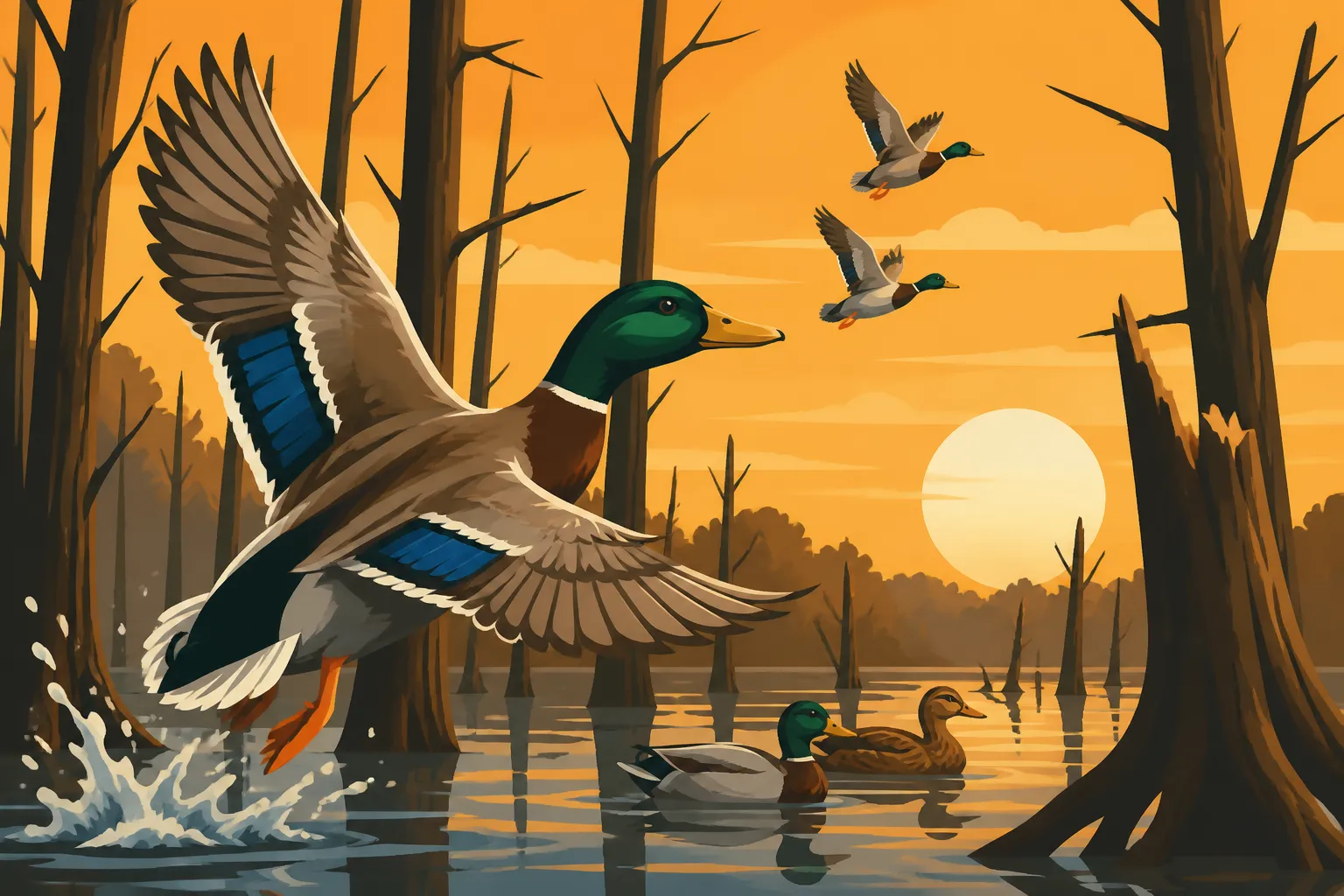
There's nothing quite like the sound of whistling wings overhead, cutting through the frosty morning air, as a flock of mallards dips and weaves through the bare limbs of a flooded oak forest. It’s a scene etched into the soul of every serious Mississippi waterfowler. But let's be real: hunting flooded timber isn't just picturesque; it's a brutal test of patience, persistence, and often, sheer luck. The environment itself is a character in this story, a vast, dynamic wetland that changes with every rain shower and every drop in the river.
A Unique Ecosystem for Waterfowl
The Mississippi Delta’s flooded timber stands out as one of the most vital wintering habitats for migrating waterfowl along the Mississippi Flyway. We're talking about bottomland hardwood forests – a dense, diverse ecosystem dominated by various oak species, cypress, and water tupelo, all designed to thrive in periodic inundation. When the water rises in late fall and winter, these forests transform into vast, shallow-water feeding grounds. The acorns dropped by the oaks become a critical food source, a true energy jackpot for weary ducks that have flown thousands of miles. This rich buffet is what draws the mallards, pintails, gadwall, and even the occasional Hunting Flooded Timber for Wood Ducks into these unique areas. Places like the Delta National Forest, including its famed Sunflower WMA, and Panther Swamp National Wildlife Refuge hunting areas are prime examples of this crucial habitat, drawing hunters from all over.
This isn't your average duck pond. The water can be crystal clear one day and muddy the next, reflecting the dense canopy above. The timber itself creates an intricate maze, offering endless hiding spots for ducks and hunters alike. Navigating these submerged forests requires a keen understanding of the terrain, an intimate knowledge of the currents, and a healthy respect for the power of nature. It’s this wild, untamed nature that makes the hunt so rewarding, but also so incredibly challenging. You're not just calling ducks; you're immersing yourself in an ancient, living system that has supported these birds for millennia.
Fluctuating Water Levels and Their Impact
One of the biggest frustrations and defining characteristics of hunting the Delta’s flooded timber is the constant, often unpredictable, fluctuation of water levels. We’ve all been there: you scout a perfect spot, only for a sudden cold front or heavy rain upriver to either flood it out completely, making it unhuntable, or drop the water so low that the ducks simply can’t access their preferred feeding areas. This isn't just a minor inconvenience; it dictates everything from duck behavior to your access strategy. A few inches of difference can turn a prime feeding flat into dry ground or make a previously impassable slough suddenly navigable.
The Mississippi River, its tributaries, and local rainfall govern these levels. When the Mississippi River stages are high, backwater floods vast sections of timber. As the river recedes, so does the water in the timber. Knowing when and where the water is rising or falling is paramount. This is where scouting intelligence becomes your most valuable asset. Hunters often rely on local knowledge, river gauge data, and satellite imagery (tools like GoHunt can be invaluable for tracking these changes from afar) to predict where the ducks might move next. This dynamic environment means that a spot that was hot last week might be completely barren this week, forcing hunters to be incredibly adaptable and always on the move, chasing the water and the ducks it brings. The mental game here is as critical as your calling skills; staying positive when the water isn't cooperating is a challenge in itself.
Decoding Mallard Behavior in the Delta's Green Timber
To consistently find success in flooded timber, you have to think like a mallard. These aren't dumb birds; they've survived migratory journeys and countless hunting seasons by being smart, adaptable, and incredibly sensitive to their surroundings. Understanding their daily routines, dietary preferences, and how they react to pressure is the bedrock of a good timber hunt.
Dietary Preferences and Feeding Patterns
Mallards, especially during the colder months, are energy machines. They need a lot of calories to fuel their bodies and maintain warmth. This is why acorns are king in the flooded timber. Various oak species, like Nuttall, willow, water, and pin oaks, drop their bounty in the fall, and when the water covers them, it creates an irresistible underwater smorgasbord. Mallards will tip up, dabble, and even dive shallowly to get at those nutrient-rich acorns. You’ll often find them working in shallow, two-to-three-foot depths where they can easily reach the bottom.
Beyond acorns, mallards will also feed on seeds from other submerged plants, aquatic invertebrates, and even waste grain from nearby agricultural fields. When you're scouting, look for "dug-up" areas where the water is muddy from ducks actively feeding, or tell-tale "rims" of mud on trees where the water level has dropped, showing where ducks have been working. Understanding these feeding patterns is crucial for Reading a Delta Slough for a Morning Flight and identifying high-percentage spots. If you're not seeing fresh feed sign, you might be in the prettiest timber in the world, but the ducks just aren't using it. It's a humbling lesson we all learn: just because you like a spot, doesn't mean the ducks do.
Roosting Habits and Pressure Avoidance
Mallards typically have two primary needs: a safe place to rest and a rich place to eat. Their roosting habits often involve larger, thicker stands of timber, sometimes in deeper water, where they feel secure from predators and hunting pressure. They'll spend the night there, and then as dawn approaches, they'll fly out to shallower feeding areas. This daily commute is what timber hunters capitalize on. The birds will often return to these same roosting spots, or similar secure areas, in the late morning or early afternoon for a mid-day rest.
However, hunting pressure can drastically alter these patterns. Mallards are incredibly wary. If a particular block of timber gets hammered day after day, they’ll quickly adjust. They might fly out later, return earlier, or abandon the area altogether for more secluded spots. This is why hunting "fresh" birds is so vital. If a spot hasn’t been disturbed in a few days, the ducks are often more cooperative. This also means you have to consider your approach and exit strategy to avoid flaring birds from your chosen spot or, worse, their roost. The goal is to be a silent ghost, slipping in and out without leaving a trace that says "hunter." If you consistently bust birds leaving your spot, they're going to teach you a hard lesson in humility.
The Importance of Migration Timing and Weather
The arrival of fresh mallards in Mississippi’s flooded timber is heavily dependent on Mississippi Waterfowl Migration Timing. While resident birds exist, the real action starts when the major northern migrations push down the Mississippi Flyway. Cold fronts, especially those with strong north winds, are a timber hunter’s best friend. These weather systems literally push new birds south, often bringing a fresh wave of naive (and hungry) ducks who haven’t yet learned the ropes of dodging decoys and calls.
Conversely, mild weather can hold birds farther north or cause them to scatter, making finding concentrations of mallards much more challenging. A warm spell can also lower river levels, impacting the flooded timber directly. You'll often hear hunters talking about "new birds" versus "old birds," with new birds being far more susceptible to calling and decoying tactics. Keeping an eye on weather patterns stretching all the way up into the Midwest and Canada can give you a significant advantage, helping you predict when the next big push of mallards might be heading your way. Tools like GoHunt can provide detailed weather overlays and long-range forecasts, which are invaluable for planning those critical hunting days. The old adage holds true: "Ducks fly south on the north wind."
Strategic Approaches for Hunting Flooded Timber Mallards
Once you understand the birds and their habitat, it’s time to put that knowledge into action. Timber hunting is a chess match, requiring careful planning, precise execution, and the ability to adapt on the fly. It’s not just about setting out decoys; it’s about creating an irresistible illusion.
Scouting Smart: Water Levels, Sign, and Entry Points
Effective scouting is the single most important factor in consistent timber hunting success. You simply cannot just show up and expect to find ducks. It involves boots-on-the-ground (or waders-in-the-water) exploration, often days or even weeks before the season, and certainly between hunts. First, always check the water levels. Are they rising, falling, or stable? This dictates where the ducks will be and how you’ll get there. Utilize online resources, local river gauges, and mapping applications like Scouting Mississippi Public Land Before Season or GoHunt that provide satellite imagery and topographic maps. These tools can help you identify potential sloughs, ridges, and open pockets that might hold water or offer access.
Next, look for duck sign. This means fresh droppings on logs or stumps, matted-down areas where ducks have been resting, and especially, muddy water or "rims" around trees indicating active feeding. Pay close attention to the species of oak trees – Nuttall and willow oaks are often favorites. Finally, plan your entry and exit routes meticulously. You want to be able to get into your spot quietly, well before legal shooting light, without disturbing any birds that might be roosting nearby. This often involves navigating through thick brush, submerged logs, and sometimes even tricky currents. Scouting isn't just a pre-season activity; it’s an ongoing process throughout the Mississippi Duck Zone Split Rules, adapting to changes as they happen.
Decoy Spreads and Concealment for Success
Decoy spreads in flooded timber are an art form. Unlike open water hunting, you’re not trying to create a massive spectacle. Instead, you're aiming for realism in a confined space. A common strategy is to create an "opening" or a "landing zone" within the timber, surrounded by your decoys. Mallards want to see a safe, easy place to land, preferably where they can get straight to feeding. You don’t need a hundred decoys; 1-3 dozen high-quality mallard decoys, mixed with a few pintails or gadwall, are often plenty. Consider adding a jerk string or a spinning-wing decoy (used judiciously) to create movement and draw attention.
Concealment is non-negotiable. Mallards have incredible eyesight, and they’re looking for anything out of place. Most timber hunters use natural cover – standing behind large trees, blending into thick brush, or even using specialized Using a Ground Blind on Mississippi Public Land that are well-brushed in. Face coverings, gloves, and camouflage that matches the timber environment are essential. Your blind shouldn't just hide you; it should make you invisible. That means no fidgeting, no shiny objects, and keeping dog movement to a minimum. The trick is to disappear into the woods, becoming just another tree trunk until it’s time to shoot.
Mastering the Call: When and How to Speak Their Language
Calling mallards in flooded timber is a different beast than calling them in open fields. It’s often more intimate, more subtle, and requires a deep understanding of duck vocalizations. You’re not trying to blast them out of the sky from half a mile away; you're often coaxing them into tight quarters. The key is to be conversational and responsive. Start with soft greeting calls or a few contented clucks and quacks. If the birds respond, then you can be more aggressive, but if they’re coming in, back off. Let them work.
A crucial technique is the "comeback call" – a series of excited quacks and greetings when ducks start to leave your spread. It’s a plea, a siren song to bring them back. Don’t be afraid to experiment with different calls: feeding chuckles, lonesome hen calls, and even soft whistles can all play a role. However, remember that sometimes the best call is no call at all. If the birds are committed and circling, just shut up and let them come. Overcalling is one of the quickest ways to flare a flock of mallards. Here's a quick reference for common calling scenarios:
| Scenario | Mallard Behavior | Calling Strategy | Notes |
|---|---|---|---|
| Ducks far out (first sight) | High, circling, assessing | Long, loud greeting calls, highball quacks | Get their attention, don't overdo it. |
| Ducks heading away | Leaving the spread, not interested | Urgent comeback call (multiple excited quacks) | Try to turn them, then go soft if they respond. |
| Ducks circling, interested | Lowering altitude, cupped wings, looking | Soft clucks, contented feeding chuckles, single quacks | Build confidence, indicate safety and food. Avoid loud calls. |
| Ducks committed (in the hole) | Wings set, dropping in | No calling, complete silence | Let them work, they're coming. Prepare to shoot. |
| Ducks landing naturally | Silent descent, splashing down | Soft, contented clucks | Maintain realism if more ducks are expected. |
Essential Gear for the Flooded Timber Hunter
Flooded timber hunting is tough on gear. The thick cover, submerged obstacles, and damp conditions demand durable, reliable equipment. Skimping here can lead to a miserable, or even dangerous, hunt.
Boats, Motors, and Waders: Your Lifelines
Accessing many prime timber holes often requires a specialized boat. Jon boats with shallow-running motors are the workhorses of the Delta. Mud motors, like those from Gator-Tail or Go-Devil, are incredibly popular because they can push through incredibly shallow water, mud, and over submerged logs that would destroy a traditional outboard. These aren't speed demons, but they're built for brute force and navigating the unforgiving terrain of the timber. You need a boat that can take a beating and still get you home.
Beyond the boat, good waders are non-negotiable. You'll be spending a lot of time in the water, setting decoys, retrieving birds, and brushing in your blind. Neoprene or insulated breathable waders are preferred, especially when dealing with the chilling waters of a Mississippi winter. Look for sturdy boots with good traction to navigate slick mud and submerged roots. Having a spare pair of dry socks and clothes back at the truck isn't just a luxury; it’s a necessity to avoid hypothermia, particularly if you take an unexpected spill. Trust me, we’ve all been there, standing in numbingly cold water, regretting that cheap pair of waders.
Shotguns, Ammunition, and Decoys: The Hunting Arsenal
Your shotgun needs to be reliable, capable of cycling through mud and water, and comfortable to shoulder in tight spaces. Many timber hunters opt for 12-gauge semi-automatics or pump-action shotguns, often with shorter barrels for maneuverability in the thick cover. Brands like Benelli, Beretta, and Browning are popular for their reliability. As for ammunition, steel shot is mandatory for waterfowl hunting, and you'll want to choose shot sizes that match the conditions. Many hunters prefer #2 or #4 steel for mallards in timber, providing a good balance of pattern density and energy. Mississippi Legal Firearms for Deer Hunting and specific regulations on waterfowl equipment can differ, so always double-check the latest rules.
When it comes to decoys, as mentioned earlier, realism trumps quantity in timber. Invest in good quality, lifelike mallard decoys, and consider adding a few confidence decoys like pintails or gadwall. Keep them clean and free of unnatural glare. A sturdy decoy bag is essential for hauling them through the muck. Don't forget a reliable call lanyard and a variety of calls to match different situations. Remember, your setup is an invitation; make it as appealing and realistic as possible.
Navigation, Safety, and Your Retriever
Navigating flooded timber, especially in the dark before dawn, can be disorienting. A reliable GPS or a mapping app like GoHunt on your phone (with downloaded offline maps, as cell service can be spotty) is critical. Mark your entry point, your hunting spot, and any potential hazards. A good headlamp with a red light setting (to preserve night vision and avoid spooking birds) is also a must. Carry a fully charged power bank for your phone and other electronics. Safety first, always. Tell someone where you're going and when you expect to return. The Delta can be a truly remote place.
And then there's the unsung hero of many timber hunts: the retriever. A well-trained duck dog is an invaluable asset, saving you countless trips into the freezing water to retrieve downed birds. They also add to the pure joy of the hunt. Ensure your dog is wearing a bright, high-visibility vest and is well-conditioned for the cold water and demanding environment. Just like you, they need to be protected from the elements.
Overcoming Obstacles and Ensuring a Rewarding Hunt
Even with the best gear and knowledge, timber hunting throws curveballs. The Delta can be a demanding mistress, and success often comes down to how well you adapt to its ever-changing moods.
Dealing with Hunting Pressure and Changing Conditions
The popularity of Mallards in Delta Flooded Timber means that prime hunting spots, especially on public land like the Sunflower WMA, can see significant pressure. Mallards quickly become "educated" and warier as the season progresses. If your favorite hole is suddenly quiet, it might be that other hunters have pushed the birds out, or the birds have simply wised up to that particular area. This is where adaptability comes in. Be willing to move, to explore new areas, and to hunt during less popular times (like weekdays) to avoid crowds. Sometimes, the best strategy is to embrace the "hunt where they ain't" mentality, looking for those overlooked pockets that still hold quiet, unpressured birds.
Changing conditions go beyond water levels. A sudden warm spell might send ducks scattering, while an unexpected deep freeze can lock up feeding areas. Always keep a close eye on the forecast, and be ready to pivot your plans. Flexibility is your secret weapon. If the timber isn't producing, perhaps a Hunting Greentree Reservoirs for Mallards area nearby is a better bet, or even trying a field hunt if conditions allow. The most successful timber hunters are those who can read the signs and adjust their game plan, rather than stubbornly sticking to a plan that isn't working.
Ethical Hunting and Conservation in Fragile Habitats
Hunting in the Delta's flooded timber isn't just about bagging ducks; it's about being a responsible steward of a precious resource. Always adhere to Mississippi Duck and Goose Bag Limits, season dates, and all other hunting regulations. Be mindful of your impact on the environment: pack out everything you pack in, avoid damaging trees, and always prioritize clean, ethical shots. The future of this incredible hunting tradition depends on all of us doing our part.
Furthermore, recognize the critical role that conservation efforts play. The purchase of your Mississippi Federal Duck Stamp Requirement and other state licenses directly funds habitat restoration and protection efforts that benefit these very flooded timber ecosystems. Organizations like Ducks Unlimited and Delta Waterfowl are tirelessly working to preserve and enhance these vital wintering grounds. By supporting these efforts, you're not just ensuring hunting opportunities for yourself, but for future generations who will also hopefully get to experience the magic of greenheads dropping through the timber. It’s a privilege, not a right, to hunt in such an awe-inspiring landscape.
Disclaimer
The information provided in this guide is for general informational purposes only and does not constitute legal advice. Hunting regulations, seasons, and licensing requirements can change, and it is the responsibility of each individual hunter to consult the most current regulations published by the Mississippi Department of Wildlife, Fisheries, and Parks (MDWFP) before engaging in any hunting activities. Always prioritize safety and ethical hunting practices.