Mississippi Buck-to-Doe Ratio by Region
It's a common feeling, isn't it? You spend hours in the stand, seeing does and fawns moving through, maybe a young basket-rack buck, but the mature deer seem to be ghosts. You start wondering if there are any big bucks left, or if the woods are just packed with does. Understanding the buck-to-doe ratio in Mississippi's different regions can offer some crucial insights into what you're seeing, why you're seeing it, and how you might adjust your hunting strategy to find those elusive mature whitetails. This guide will break down what these ratios mean for you, the Mississippi hunter, and how they vary across our diverse landscape.
Understanding the Buck-to-Doe Ratio and Its Importance
When we talk about the buck-to-doe ratio, we're simply referring to the number of bucks compared to the number of does in a given deer population. It's often expressed as something like 1:3, meaning one buck for every three does. This isn't just a number for wildlife biologists; it's a critical piece of information for any hunter trying to understand the deer herd they're pursuing.
Why the Ratio Matters for Deer Management
From a management perspective, a balanced buck-to-doe ratio is a sign of a healthy deer herd. When the ratio gets too skewed, meaning too many does for too few bucks, it can lead to a host of problems. Does might not get bred during their first estrous cycle, leading to later fawning and weaker fawns. The rut, that exciting period every hunter dreams about, can become drawn out and less intense, with bucks having to work harder and longer to find receptive does. This added stress can impact buck health and antler growth, which ultimately affects the trophy potential of the herd. Conversely, a more balanced ratio usually means a more intense and synchronized rut, healthier deer, and better overall herd dynamics.
What it Means for Your Hunting Strategy
For you, the hunter, knowing the general buck-to-doe ratio in your hunting area can profoundly influence your strategy. If you're hunting in a region with a highly skewed ratio (say, 1:5 or more), you might expect to see a lot of does, but fewer mature bucks actively chasing during the rut. Your focus might shift to food sources and travel corridors that does frequent. However, in an area with a more balanced ratio (closer to 1:1 or 1:2), you might anticipate more aggressive buck behavior, more daylight movement, and a more predictable rut timing. This knowledge helps you set realistic expectations and informs your scouting efforts, whether you're looking at aerial maps on a platform like GoHunt or walking the timber.
Mississippi's Key Deer Management Units and Their Ratios
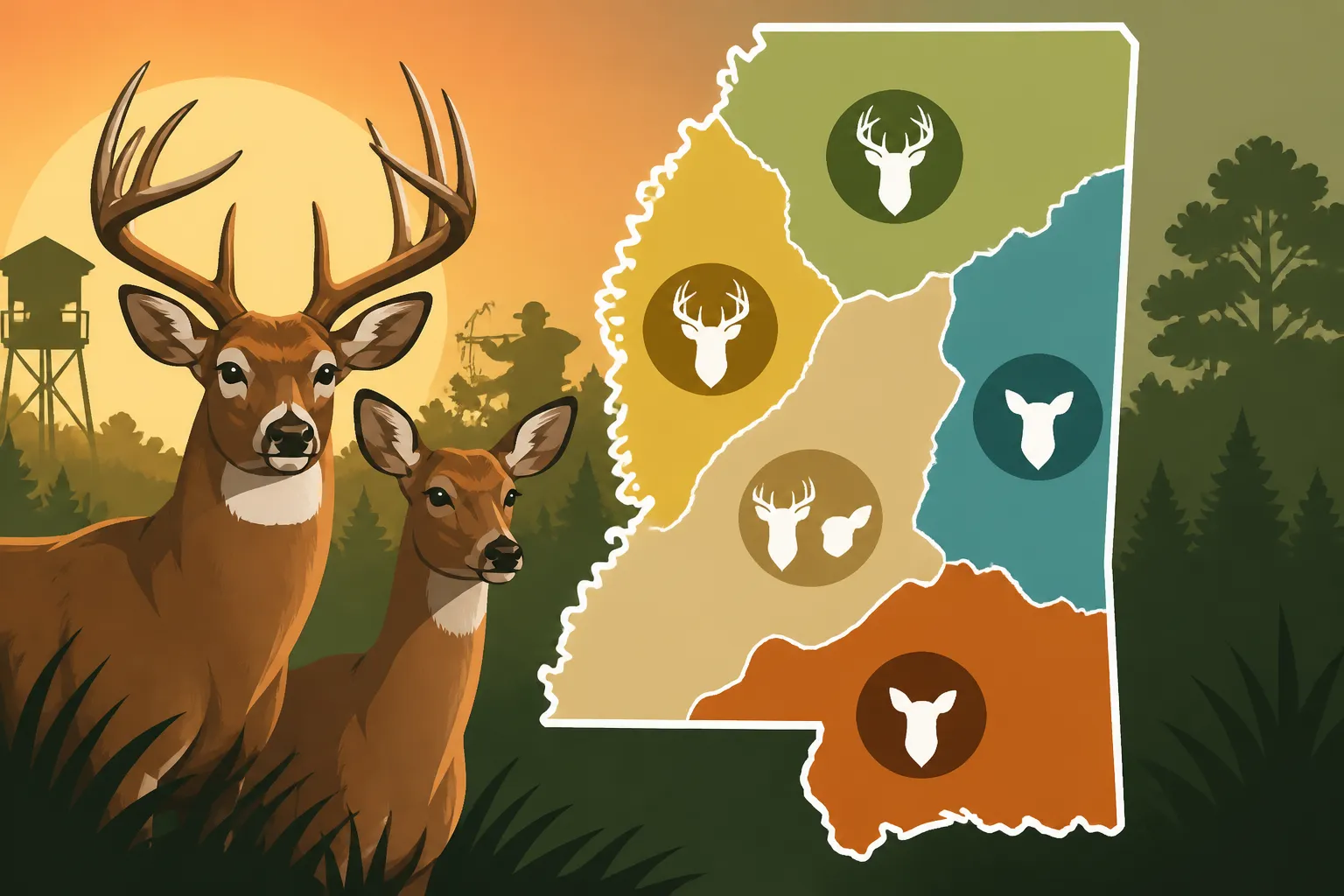
Mississippi is far from uniform when it comes to its deer population and the habitat they call home. Our state is divided into distinct deer management units, and each has its own characteristics that influence the local buck-to-doe ratio. Understanding these differences is key to becoming a more effective hunter across the Magnolia State.
The Delta Unit: Agriculture's Influence on Herd Dynamics
The Delta Unit, with its rich, fertile soil and vast agricultural fields, is known for growing some truly impressive deer. The sheer abundance of high-quality forage, from soybeans and corn to winter wheat and natural browse, allows deer to reach their genetic potential. However, this environment also presents unique challenges and opportunities that shape the buck-to-doe ratio.
Historically, intense pressure on antlered bucks, combined with liberal antlerless harvest regulations to control crop damage, could lead to a skewed ratio. You might see groups of 10-15 does in a beanfield for every one or two bucks. The MDWFP has implemented specific antler restrictions in the Delta Unit, requiring bucks to have at least a Delta Unit Twelve-Inch Spread Rule Explained or a main beam length of 15 inches to be legal, which is designed to protect younger bucks and allow them to mature. This regulation, along with careful doe harvest on private lands, is aimed at pushing that ratio closer to a more balanced state. While you'll still encounter plenty of does, especially where food sources are abundant, the goal is to ensure a healthier population structure. Hunters in the Delta often spend considerable time scouting those crucial pinch points between bedding cover and vast food plots, using tools like GoHunt to analyze field edges and dense timber where bucks might stage before entering fields at last light.
The Hills Unit: Forested Landscapes and Varied Pressures
Moving east from the Delta, we enter the Hills Unit, characterized by rolling timber, mixed forests, and smaller agricultural patches. This unit offers a different type of deer habitat, and with it, a different set of factors influencing the buck-to-doe ratio. Public lands here, like the Homochitto National Forest Hunting or Bienville National Forest Hunting, often see significant hunting pressure, which can affect the age structure of bucks.
In areas with high hunting pressure and less selective harvest, the buck-to-doe ratio might be more skewed, simply because bucks are harvested at a younger age. Does, being less targeted in some instances, can become overpopulated relative to the available mature bucks. However, on well-managed private lands within the Hills Unit, where quality deer management practices are in place, you can find much more balanced ratios. These landowners focus on selective doe harvest and letting younger bucks walk, resulting in a more intense rut and a healthier age structure. The Hills Unit also has antler restrictions, requiring a buck to have at least a Hills Unit Ten-Inch Spread Rule Explained or a main beam length of 13 inches, again, aimed at promoting buck maturity. Hunters here often focus on ridgelines, creek bottoms, and thick bedding areas, understanding that deer movements can be more subtle and cover-dependent than in the open Delta fields.
Southeast Unit and North Central Unit: Unique Challenges and Opportunities
The Southeast Unit, often characterized by pine plantations and sandy soils, and the North Central Unit, a mix of hardwood bottoms and smaller agricultural fields, both have their own unique deer population dynamics and buck-to-doe ratios.
The Southeast Unit, with its extensive pine timber, can sometimes have lower overall deer densities than the Delta or prime Hills habitat. However, properly managed pine stands that incorporate prescribed burns and thinnings can create fantastic forage and cover, leading to healthy deer. Hunting pressure on bucks can still skew the ratio, especially if hunters are less selective. The North Central Unit, often seen as a transition zone, can offer a blend of both Delta-like agricultural influence and Hills-like timber. Here, local habitat quality and hunting club management practices play a huge role in the buck-to-doe ratio. Areas with good habitat, controlled doe harvest, and a focus on buck age can boast surprisingly balanced ratios, leading to exciting rut activity. Hunting the Southeast Unit's Longer Archery Run gives hunters extra opportunity in this distinct habitat.
These units, while generally having similar antler restriction guidelines to the Hills Unit (10-inch spread or 13-inch main beam), rely heavily on local landowner management to truly shape the herd. Whether you're hunting vast timber tracts or smaller private parcels, understanding the local habitat and management efforts can give you a better idea of the buck-to-doe ratio you might encounter. Tools like GoHunt can be invaluable in scouting these varying landscapes, helping you pinpoint potential buck bedding areas or key travel corridors.
Here's a quick comparison of our main deer management units and what to generally expect:
| Unit | Primary Habitat | General Buck-to-Doe Ratio (Managed Land Goal) | Key Antler Restriction (Bucks) | General Characteristics for Hunters |
|---|---|---|---|---|
| Delta | Vast Agriculture, Bottomland Hardwoods | 1:2 to 1:3 | 12-inch inside spread OR 15-inch main beam | High deer density, impressive antlers, later rut |
| Hills | Mixed Forests, Rolling Timber, Small Fields | 1:2 to 1:4 | 10-inch inside spread OR 13-inch main beam | Varied density, good age structure on managed land, active rut |
| Southeast | Pine Plantations, Mixed Forests, Coastal Plain | 1:3 to 1:5 | 10-inch inside spread OR 13-inch main beam | Lower density, habitat specific, later rut in some areas |
| North Central | Mixed Hardwoods, Agriculture, Upland Forests | 1:2 to 1:4 | 10-inch inside spread OR 13-inch main beam | Diverse habitat, can be good age structure with management |
Note: These ratios are general goals or observations and can vary wildly on specific properties based on local management, habitat, and hunting pressure.
Factors Influencing Mississippi's Buck-to-Doe Ratio
The buck-to-doe ratio isn't static; it's a dynamic figure influenced by a complex interplay of natural and human factors. Understanding these can help you interpret what you're seeing in the woods and anticipate deer behavior.
Hunting Pressure and Harvest Strategies
Undoubtedly, human hunting pressure is one of the most significant factors affecting the buck-to-doe ratio. If hunters consistently harvest bucks as soon as they reach legal size, it can dramatically reduce the number of older, more mature bucks in the population. This isn't necessarily "bad" if the goal is meat harvesting, but it does skew the ratio towards a higher number of does per buck.
Conversely, aggressive doe harvest, particularly on private land, can help bring the ratio back into balance. Many quality deer management programs focus on harvesting a certain number of antlerless deer each year to keep the population within the habitat's carrying capacity and improve the buck-to-doe ratio. The MDWFP's antler restrictions across the units are a direct effort to allow more bucks to survive their younger years and contribute to a more balanced ratio and older age class. Public land, especially popular WMAs, often sees concentrated hunting pressure, which can make achieving balanced ratios more challenging without strict regulations and hunter cooperation.
Habitat Quality and Food Availability
The quality of habitat and the availability of food sources directly impact a deer herd's health and its ability to support a balanced ratio. Areas with abundant, year-round, high-quality nutrition will generally have healthier deer that can support a more balanced ratio. Does in these areas are more likely to conceive during their first estrous cycle and produce healthy fawns, while bucks can express their full antler potential.
In contrast, poor habitat or limited food can lead to stressed deer. Overpopulated herds in poor habitat might have lower fawn survival rates, and bucks might struggle to put on mass and grow impressive antlers. Agricultural areas like the Delta often provide an explosion of seasonal food, leading to high deer densities. However, without adequate cover and controlled harvest, these areas can still see skewed ratios. Late-Season Food Sources for Mississippi Whitetails are crucial, especially in areas where agriculture might be harvested early.
Predation and Disease
While hunting pressure is a major human-influenced factor, natural elements like predation and disease also play a role. Predators such as coyotes certainly impact fawn survival, and a lower fawn recruitment rate can indirectly affect future buck-to-doe ratios as those fawns mature. However, it's important to remember that coyotes are just one piece of a much larger ecological puzzle.
Diseases, particularly Mississippi's Chronic Wasting Disease Zones and EHD Die-Offs in Mississippi Deer, can also impact herd numbers and, in severe outbreaks, potentially alter local buck-to-doe ratios. CWD, for instance, affects deer unequally, and while it's still being studied, it can reduce deer populations over time. The MDWFP monitors these factors closely, and hunters play a vital role in reporting sick deer or submitting samples for CWD testing. Understanding these broader ecological pressures helps us appreciate the complexity of deer management beyond just hunting numbers.
How Hunters Can Utilize Buck-to-Doe Ratio Information
Knowing the general buck-to-doe ratio in your hunting region isn't just a fun fact; it's a powerful tool that can sharpen your hunting plans and increase your chances of success, especially when combined with other scouting efforts.
Setting Realistic Expectations for Your Hunt
One of the best ways to use ratio information is to set realistic expectations. If you're hunting in a region known for a higher buck-to-doe ratio (meaning more does per buck), you'll probably see a lot of does. That's not a bad thing; it just means you shouldn't get discouraged if you're not seeing a shooter buck every sit. Instead, focus on observing doe movement patterns, as bucks will eventually follow. In contrast, if you're lucky enough to hunt an area with a more balanced ratio, you might anticipate seeing more buck-on-doe action and more aggressive rutting behavior.
This awareness helps you stay patient and persistent. For example, knowing that the Delta Unit often has a slightly later, more spread-out rut due to high doe numbers means you might need to adjust your Hunting the Rut in the Delta Unit tactics and stay flexible with your timing. For the Hills Unit, where a more traditional rut might occur, focusing on a shorter, more intense window could be more productive.
Adjusting Scouting and Stand Placement
The buck-to-doe ratio can directly influence your scouting efforts and where you decide to hang a stand or set up a blind. In areas with a high doe population, focusing your scouting on primary food sources and the trails leading to and from them makes sense. Bucks, especially during the pre-rut and rut, will be cruising these areas, checking does. You might find success by Hanging a Stand on a Delta Bottomland Funnel or Setting Up on a Delta Field Edge where does are abundant.
If you're in a more balanced ratio area, you might expand your focus to include more buck-specific sign like rubs and scrapes, understanding that those bucks are more likely to be actively seeking out does rather than just waiting for them to appear. Using mapping tools, like those found on GoHunt, to identify natural funnels, pinch points, and cover close to doe bedding and feeding areas will be crucial. This targeted approach, informed by the regional ratio, can save you time and put you in a better position when the season opens.
Informing Doe Harvest Decisions
For those hunting on private land or within specific WMAs that allow it, understanding the buck-to-doe ratio can directly inform your doe harvest decisions. If your property's ratio is skewed heavily towards does, taking a few does out each year can actually improve herd health and contribute to a more balanced ratio down the line. This isn't about eliminating does, but rather managing the population responsibly to ensure healthier deer, stronger fawns, and a more robust rut.
Conversely, if your area already has a balanced ratio, you might be more conservative with your doe harvest, especially if you're seeing signs of good fawn recruitment and healthy deer overall. Every property and region is different, and local observations, combined with regional data, provide the best guide for ethical and effective deer management.
Disclaimer
This article is for general informational purposes only and does not constitute professional advice. Laws, prices and regulations vary by location and change over time. Consult a qualified professional for guidance on your specific situation.