Why Mississippi Foresters Burn Longleaf Pine
Few things trigger immediate frustration quite like pulling up to your favorite public hunting tract in the Piney Woods, only to discover the timber charred black, smelling of soot, and stripped of cover. It looks like a total wasteland. However, this guide breaks down why foresters use prescribed fire, how longleaf pine relies on heat to thrive, and how you can turn freshly burned ground into a magnet for game species.
The Ecological Science Behind Prescribed Fire in Longleaf Pine
To understand why wildlife managers regularly set fire to longleaf pine timber, you first have to understand the evolutionary history of southern forests. Longleaf pine ecosystems once dominated millions of acres across the Southeastern coastal plain, stretching deep into south and central Mississippi. Unlike shortleaf or loblolly pines, longleaf pine evolved hand-in-hand with low-intensity fire. Before modern roads, highways, and residential developments fragmented the landscape, lightning strikes sparked naturally occurring surface fires every two to three years across the region.
These frequent fires swept through the pine savannas, burning off leaf litter and killing off encroaching broadleaf brush while leaving mature longleaf trees completely unscathed. Over thousands of years, longleaf pine developed specific biological traits that make fire not just something it tolerates, but something it requires to survive and reproduce.
Historical Fire Regimes and the Longleaf Life Cycle
The life cycle of a longleaf pine is built entirely around fire survival. In its earliest stage, known as the grass stage, a young longleaf seedling looks like a dense tuft of green needles sitting flush against the dirt. During this phase, which can last anywhere from two to several years, the seedling focuses nearly all its energy on driving a thick taproot deep into the soil. The growing tip of the plant remains hidden in the center of a dense cluster of fire-resistant needles.
When a surface fire sweeps through a grass-stage seedling, the outer needles singe and burn, but the moisture-packed center shields the vital bud from lethal heat. Once the taproot stores enough energy, the seedling enters the bolt stage, rapidly growing several feet tall in a short period to lift its growth terminal above the heat zone of future fires. Mature longleaf pines develop thick, flaky bark that acts as thermal insulation, protecting the delicate cambium layer beneath from scorching temperatures.
Suppressing Brush and Hardwood Encroachment
When fire is excluded from a longleaf pine stand for more than four or five years, dramatic and unfavorable ecological changes occur. Shade-tolerant hardwood species like sweetgum, water oak, red maple, and yaupon holly quickly invade the understory. Left unchecked, these hardwoods form a dense, mid-story canopy that blocks sunlight from reaching the forest floor.
As sunlight disappears, native ground vegetation dies off, leaving the soil covered in a thick mat of slow-decaying pine needles and hardwood leaves. This buildup of leaf litter seals out moisture and prevents native seeds from germinating. For timber managers working on Public Hunting Land in Mississippi, controlled burns are the most efficient, cost-effective tool available to knock back invasive brush, keep the mid-story open, and allow direct sunlight to hit the ground.
Ecological Attributes of Burned versus Unburned Longleaf Stands
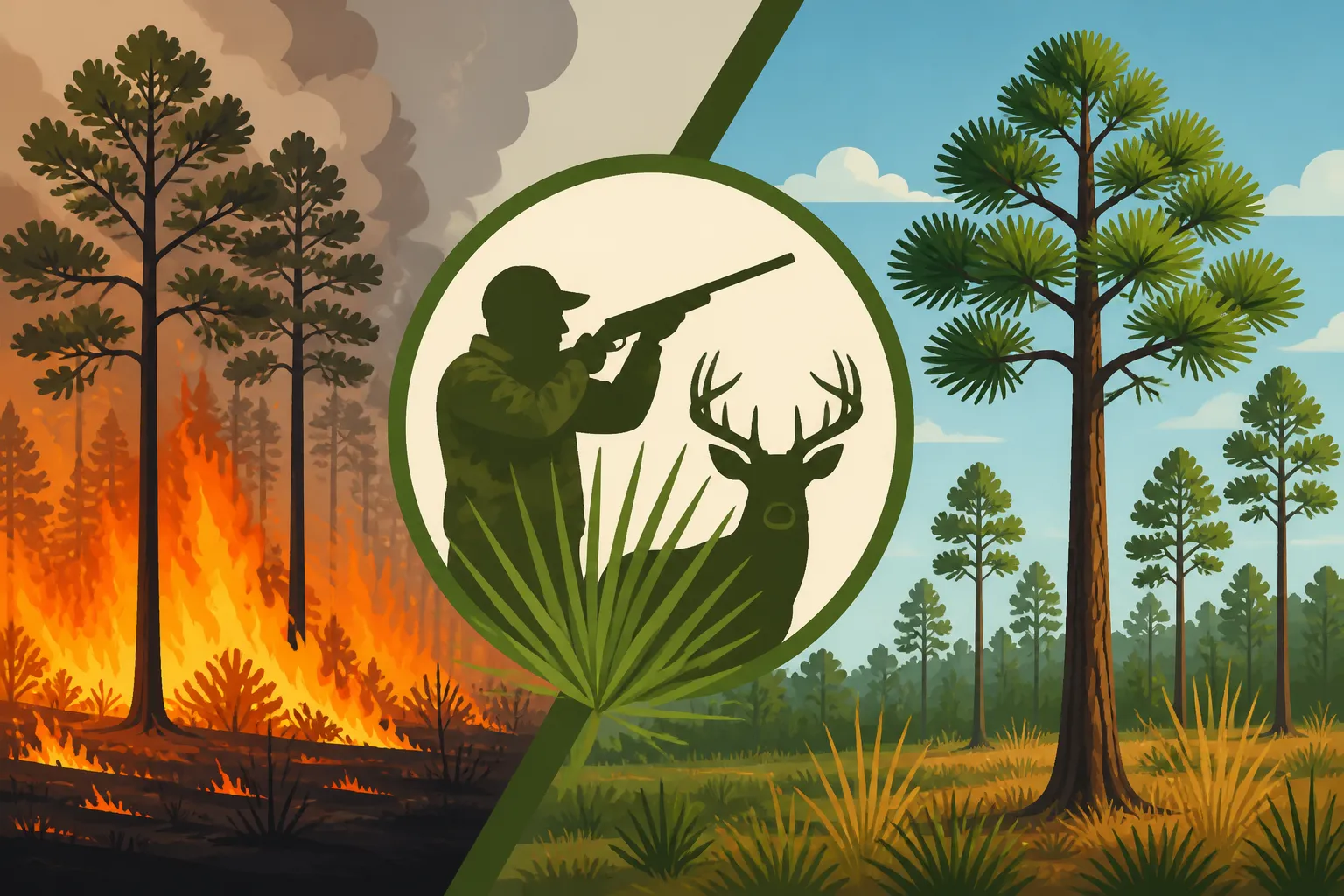
Understanding the physical differences between a managed, fire-maintained longleaf ecosystem and an overgrown, fire-suppressed stand helps explain why wildlife shifts toward burned ground.
| Ecological Attribute | Fire-Suppressed Stand (5+ Years No Fire) | Fire-Maintained Stand (1 to 2 Years Post-Burn) |
|---|---|---|
| Ground Level Sunlight | Extremely limited (under 10% penetration) | High (60% to 90% penetration) |
| Understory Vegetation | Sparse; dominated by woody brush and thick leaf litter | Dense forage; high diversity of native grasses and legumes |
| Forage Protein Content | Low; mature foliage is woody and tough | High; young shoots offer elevated crude protein and phosphorus |
| Game Wildlife Access | Restricted travel paths for young animals | Easy ground movement for quail chicks and turkey poults |
| Wildfire Fuel Hazard | High risk of destructive, canopy-killing wildfire | Low risk due to minimal volatile ground fuels |
How Controlled Burns Directly Benefit Game Species
While a freshly burned timber stand looks desolate in the days immediately following a ignition, the ecological transformation that occurs weeks later is remarkable. Rain washes nutrients contained in the ash back into the soil, creating a burst of plant growth that dramatically improves wildlife habitat.
White-Tailed Deer Forage Quality and Cover
White-tailed deer are selective browsers. They prefer tender, nutrient-rich plant growth over old, woody stem tissue. In fire-suppressed pine stands, most browse grows far out of reach above a deer’s head, leaving very little food near the forest floor. Controlled burns reset this vegetation. Within weeks of a fire, native legumes like partridge pea, beggarweed, and lespedeza sprout from the ash.
These young plants pack significantly higher concentrations of crude protein, calcium, and phosphorus than mature plants growing in unburned areas. When managing for healthy herds of White-Tailed Deer Across Mississippi, foresters use rotational burning to create a shifting mosaic of feeding zones. Bucks and does flock to these fresh green-up zones to feed on highly digestible vegetation. Furthermore, two to three years after a burn, thick patches of briars and sprouts emerge, creating ideal bedding thickets alongside feeding sites. Hunters target these transitional zones by Hunting Longleaf Pine Savanna for Deer.
Wild Turkey Nesting, Brooding, and Roosting Habitat
No southern game bird relies more on regular prescribed burning than the wild turkey. For property owners and state biologists focused on managing Wild Turkeys in Mississippi, burning pine ground on a two-to-three-year rotation is essential for flock survival. Turkeys require open timber structures that allow them to see approaching predators like coyotes and bobcats from a safe distance.
Brooding habitat is especially critical. Newly hatched turkey poults are fragile, lack flight feathers, and must feed almost constantly on high-protein insects to survive their first few weeks. In a fire-maintained longleaf savanna, sunlight fuels rich populations of grasshoppers, leafhoppers, and beetles beneath a canopy of native grasses. Poults can walk freely through thin wiregrass to catch bugs, whereas thick, unburned brush traps young birds and leaves them vulnerable to predators and damp conditions.
Bobwhite Quail and Small Game Restoration
The historical decline of northern bobwhite quail across the South directly mirrors the decline of active forest management and fire application. Quail require a bare-ground component beneath herbaceous vegetation to walk, forage, and escape overhead hawks. When pine needles mat thick on the ground, quail seeds get trapped beneath the litter, making them impossible for birds to reach.
Regular prescribed burns strip away this suffocating thatch and stimulate native weeds that produce heavy seed crops. By maintaining open ground cover, land managers support Mississippi Longleaf Pine and Quail Habitat, reviving local populations of quail, cottontail rabbits, and songbirds that depend on open woodland savannas.
Strategic Hunting Tactics on Recently Burned Mississippi Ground
Finding out that your target area was recently burned does not mean you need to cancel your hunt. In fact, if you understand how game animals react to fresh burns, you can turn a burnt timber block into one of your most productive setups of the season.
Timing the Regeneration Phase
To hunt a burned area effectively, you must match your tactics to the age of the burn.
- Immediate Post-Burn (Days 1 through 14): Directly after a burn, game movement inside the burn perimeter slows down. Deer and turkeys often travel along the extreme outer edge of the burn, inspecting the changes but avoiding open ash patches during daylight. Focus your efforts on the unburned thickets immediately adjacent to the burn line.
- Early Green-Up (Weeks 2 through 8): As soon as warm sun and rain hit the exposed dirt, bright green shoots sprout through the ash. Deer will travel long distances to feed on these tender sprouts, especially in late winter and early spring. Set up stands on subtle terrain features like drainages or saddles that lead into the greening burn.
- Mid-Stage Regeneration (Months 6 through 24): By the second growing season post-burn, vegetation reaches knee-to-waist height. Cover and food reach peak balance. Turkeys use these areas for nesting, while deer use the waist-high cover to feed and stage before dark.
Mapping and Scouting Fresh Burn Edges
Navigating large public timber tracts like those found in DeSoto National Forest Hunting or Homochitto National Forest Hunting requires efficient scouting strategies. Instead of burning gas driving endless forest roads, rely on digital mapping platforms to identify active management zones before stepping into the woods.
Using tools like onX Hunt or GoHunt, examine recent satellite imagery and forestry layer overlays to identify clearcuts, thin lines, and burned compartments. Look closely for sharp borderlines where a burn ended against a creek bottom, hardwood drain, or firebreak road. These burn edges create natural funnels where deer love to travel, browsing on tender green sprouts inside the burn while staying just a jump away from thick escape cover.
Before heading into the field, spend time Scouting Mississippi Public Land Before Season to mark firebreaks, disked lines, and ridge lines that intersect newly burned timber. These man-made breaks often become high-traffic wildlife highways once vegetation starts recovering.
Navigating Area Closures and Local Regulations
Prescribed burning is a dynamic process dependent on strict weather windows, including wind direction, humidity, and soil moisture. Federal and state agencies frequently close specific forestry compartments on short notice to perform burns safely.
Always review notices regarding Prescribed Burns and Mississippi Hunting Closures before heading afield during late winter and early spring. Respect all temporary road closures, smoke warning signs, and active fire perimeter boundaries. Fire crews use heavy equipment and ignitions that can change direction quickly with shifting winds.
By staying adaptable and using modern mapping tools like onX Hunt and GoHunt, you can easily pivot to nearby unburned compartments or locate hidden burn edges by Finding Ground Others Walk Past. Embracing prescribed fire as a positive habitat reset rather than an inconvenience will ultimately make you a more successful hunter across Mississippi’s timber country.
Disclaimer
This article is for general informational purposes only and does not constitute professional advice. Laws, prices and regulations vary by location and change over time. Consult a qualified professional for guidance on your specific situation.