Mississippi Gun Season Opening Day
There’s nothing quite like the feeling of anticipation as Mississippi’s gun season approaches. For many, it's the culmination of months of scouting, dreaming, and preparing. But that excitement can quickly turn to frustration if you're not fully clued into the nuances of opening day across our diverse state. This guide is here to break down the ins and outs of Mississippi's gun season opening day, ensuring you're informed, prepared, and ready to make the most of those first critical hours in the stand.
The Electric Buzz of Mississippi Gun Season Opening Day
That first morning of gun season in Mississippi is a pilgrimage for countless hunters. The air is crisp, the woods are alive with possibility, and the scent of damp leaves mixes with anticipation. It’s a feeling that gets deep into your bones, a tradition passed down through generations. But let’s be real, with that electric buzz comes a unique set of challenges. It’s not just about pulling the trigger; it’s about navigating crowds, understanding deer behavior under pressure, and making sure you’re playing by all the rules.
When you think about "opening day," it conjures images of pristine woods and unpressured deer. The reality, especially on public land or smaller private tracts, is often quite different. You'll likely encounter more vehicles on the forest roads, more orange in the woods, and certainly more gunshots echoing through the timber. This isn't a complaint, it's just the truth of the matter. The sheer number of hunters getting out there means the deer are going to be on high alert from the moment legal shooting light breaks.
The initial rush of opening day can also be overwhelming for newer hunters or those visiting from out of state. It can feel like a mad dash, and if you haven't done your homework, you might find yourself in an area that's already saturated with other hunters. This is where a solid plan and an understanding of how local deer react to immediate pressure become invaluable. It’s not just about when the season opens, but how you choose to hunt those first few crucial days.
The Rush and the Reality of Hunter Pressure
The minute that gun season opens, it's a game changer for deer. They've likely been hearing bowhunters for weeks, but the concussive sound of rifles and shotguns is a whole different ballgame. They're going to alter their patterns, often immediately. You might find that once-visible deer become completely nocturnal, or they shift to bedding areas that offer maximum security, deep in thickets, swamps, or overlooked corners of the woods. This sudden shift is a major frustration for many, especially if their pre-season scouting showed consistent daytime movement.
On public lands, this phenomenon is even more pronounced. Areas near road access points or easy-to-reach food plots can become crowded, pushing deer into harder-to-reach terrain. Hunters who are willing to put in the extra miles or brave the thickest cover often find themselves in untouched pockets where deer feel safer. It's a testament to the idea that effort often directly correlates with success on high-pressure days.
Even on private land, if your property is bordered by public hunting areas or smaller tracts with active hunters, you’ll see the impact. Deer that were comfortable moving during daylight hours might suddenly stick to the shadows, moving only at dawn and dusk, or retreating to cover during the midday. It means your opening day strategy needs to be adaptable, not just a carbon copy of what worked during archery season. Being prepared for these changes is key to avoiding disappointment.
Shifting Deer Behavior and Adapting Your Strategy
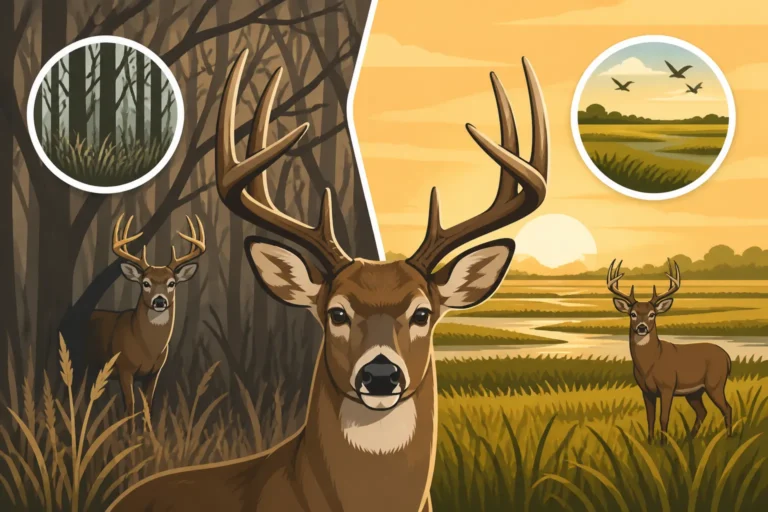
Deer are incredibly resilient and quick learners. The sudden influx of hunters, the scent of human activity, and the sounds of gunshots will trigger their natural survival instincts. They'll gravitate towards areas with dense cover, often choosing the path of least resistance to escape perceived threats. This might mean moving through creek bottoms, thick pine plantations, or even bedding down in agricultural fields that offer tall, concealing crops.
Your best bet for success on opening day, given this behavioral shift, is to target transition areas. Think about the routes deer might take when moving from a high-pressure feeding area to a safer bedding location. Creek beds, fencerows, small woodlots, or even subtle changes in elevation that offer cover can become prime ambush points. It's about thinking like a deer and predicting their escape routes and safe havens. For a deeper dive into preparation, consider checking out "Scouting Mississippi Public Land Before Season".
Another critical element is understanding how long the pressure will last. Often, the highest intensity of hunter activity is during the first few days of gun season. After that initial burst, things can settle down, and deer might start to resume more "normal" patterns, especially during the middle of the week. So, if you don't connect on opening day, don't despair. Your chances might actually improve a few days later when the initial crowds have thinned. Adaptability is your greatest asset.
Decoding Mississippi's Unit-Specific Gun Season Start Dates
Here’s where it can get a little tricky, and it’s a point of frequent confusion for hunters, especially those new to Mississippi or crossing unit lines. Unlike some states with a universal opening day, Mississippi’s gun season isn't a one-size-fits-all event. Our state is divided into four distinct Deer Management Units, and each one has its own specific set of dates. You absolutely need to know which unit you're hunting in, because showing up on the wrong day can lead to a frustrating experience or, worse, a violation.
The Mississippi Department of Wildlife, Fisheries, and Parks (MDWFP) has implemented this unit system to manage deer populations more effectively, taking into account different habitats, deer densities, and harvest goals across the state. This means the prime time for gun hunting in the Delta might be different from the Piney Woods or the Hills. Failing to consult the official regulations for your specific unit is like showing up to a party a day early – or a day late!
It’s not just about the opening day itself; these unit-specific regulations often dictate the length of the season, antler restrictions, and even bag limits. So, before you load up the truck and head out, a quick check of the MDWFP website or the latest hunting guide is non-negotiable. You can find a comprehensive breakdown of these regions by looking into "Mississippi's Four Deer Management Units".
Understanding the Unit System and Key Opening Dates
Mississippi's four deer management units are the Delta, Hills, North Central, and Southeast. Each one is a distinct beast, and their gun season opening days reflect that. Generally speaking, the Hills and Delta Units typically open for gun season in late November, often around the third or fourth Saturday of the month. The North Central Unit usually follows a similar timeline. The Southeast Unit, however, often has a slightly earlier opening, sometimes in mid-November, and often boasts a longer archery season as well.
This staggered opening can be a real headache if you hunt properties in different units. For example, if you hunt near Vicksburg, you might be in the Hills Unit, but just across the river, you're looking at different regulations. The MDWFP provides clear maps, and many mapping applications like GoHunt integrate these unit boundaries, so there's no excuse for not knowing where you stand. Always double-check the current year's regulations because dates can shift slightly from season to season. This variability is also why it's wise to review the "Mississippi Deer Season Structure Explained" for a broader context.
To give you a general idea, here's a quick reference table for typical gun season opening days. Always consult the current MDWFP hunting guide for the most accurate and up-to-date information for the specific season you plan to hunt, as dates can change annually.
| Deer Management Unit | Typical Gun Season Opening Day |
|---|---|
| Delta Unit | Fourth Saturday in November |
| Hills Unit | Fourth Saturday in November |
| North Central Unit | Fourth Saturday in November |
| Southeast Unit | Third Saturday in November |
Remember, these are general guidelines. For instance, the Mississippi Youth Gun Weekend Dates often precede the general gun season, offering a special opportunity for young hunters. It's just another example of how nuanced our state's hunting calendar can be.
Legal Firearms, Ammunition, and Blaze Orange Requirements
So, you've got your unit and your date squared away. Now, let's talk about what you can actually carry into the woods. Mississippi has specific regulations regarding legal firearms for deer hunting. Generally, centerfire rifles, shotguns using slugs or buckshot (depending on the area and specific regulations), muzzleloaders, and handguns are permitted during gun season. There are caliber minimums for rifles, typically .243 caliber or larger, and specific rules for shotgun gauges. It’s crucial to understand these details; for example, you can’t just grab any old rimfire rifle and head out.
Ammunition choice is also important. Ensure your rounds are appropriate for big game and meet any local restrictions. For example, some wildlife management areas (WMAs) may have specific rules about using only slugs or even archery equipment, even during statewide gun seasons. Always check the WMA-specific regulations if you're hunting public land. You can find detailed information on what firearms are permitted in "Mississippi Legal Firearms for Deer Hunting".
And then there's the vibrant, unmistakable requirement: blaze orange. During any gun season for deer, turkey, or bear, all hunters on public or private lands, including archers and muzzleloader hunters, must wear at least 500 square inches of solid unbroken hunter orange, visible from all sides. This isn’t just a suggestion; it’s a critical safety regulation. Hats, vests, and sometimes even full outfits are required. Don’t risk a fine or, more importantly, your safety. Make sure you know "How Much Blaze Orange Mississippi Requires" before you ever step foot in the woods.
Essential Preparations and Strategies for Opening Day Success
You can have the best gear in the world, but without proper preparation and a smart strategy, opening day can quickly turn into a bust. The real work for opening day success starts long before the season ever arrives. It’s about knowing your ground, understanding deer patterns, and having a flexible plan for when those patterns inevitably change under pressure. Don't underestimate the impact of those first few hours when deer are reacting to the sudden influx of human activity.
A lot of hunters make the mistake of relying solely on what they saw during the early archery season. While that data is valuable, it doesn’t always translate directly to gun season opening day. The change in hunting methods, combined with increased pressure, means you often have to shift your focus from passive observation to more active, strategic placement. Think about escape routes and bedding cover as much as you think about food sources.
Moreover, preparation extends beyond just scouting. It includes making sure your rifle is sighted in, your gear is in working order, and you've got everything you need for a long sit, from extra layers to snacks and water. The more prepared you are, the less you'll be distracted by minor issues, allowing you to stay focused on the hunt.
Early Season Scouting and Stand Placement
Effective scouting is the bedrock of any successful hunting season, and it's especially critical for opening day. Start well before the season, ideally in late summer or early fall. Look for deer sign – rubs, scrapes, tracks, and droppings – to identify travel corridors and areas of consistent activity. Pay close attention to food sources. Are the acorns dropping? Are green fields being utilized heavily? This intelligence is invaluable. Services like GoHunt can be incredibly helpful here, offering satellite imagery and property line overlays that let you virtually scout areas and plan entry and exit routes without disturbing the woods. This also helps you identify potential pinch points and funnels that deer might use.
When placing your stand, think about prevailing winds and sun direction. You want the wind in your favor, carrying your scent away from where you expect deer to approach. Consider the sun’s angle at dawn and dusk, ensuring you’re not silhouetted or staring directly into the sun. On opening day, consider placing stands deeper in cover than you might during archery season. Deer, anticipating pressure, will often retreat to thicker areas, and being positioned slightly off the obvious travel routes can pay off.
Don’t forget about escape routes for the deer. If you can place your stand overlooking a likely escape route from a pressured area, you might catch a deer on the move. Also, having multiple stand options for different wind directions is a huge advantage. You don’t want to be forced into a bad setup just because you only have one spot scouted. Remember, the goal is to observe deer behavior before the pressure, then adjust for the opening day reality.
Adapting to Pressure and Weather on Opening Day
Deer are incredibly sensitive to pressure. On opening day, especially on public land, expect deer to go nocturnal or move into the densest, most overlooked cover available. Your opening day strategy needs to account for this. Instead of sitting on obvious food plots that might be swarming with other hunters, consider focusing on bedding areas or the thick transition zones between food and bedding. These are the places pressured deer will retreat to. This is where a robust mapping tool, like the one offered by GoHunt, can help identify overlooked pockets of habitat.
Weather also plays a massive role. A sudden cold front can ignite deer movement, pushing them to feed more actively. A warm spell, on the other hand, might make them more lethargic and less inclined to move during daylight. Pay close attention to the forecast leading up to opening day. If a cold front is coming through, be prepared to sit longer and deeper. If it's unseasonably warm, you might need to focus on early morning and late evening hunts, or even consider mid-day still-hunting through thick cover when deer are likely bedded down. For specific tactics, read up on "Hunting Deer After a Cold Front".
Finally, don't be afraid to adjust your plans on the fly. If your initial spot isn't producing, or you encounter unexpected hunter pressure, be willing to move. Sometimes, simply getting up and still-hunting slowly through a less accessible area can yield results. The worst thing you can do is stick with a plan that clearly isn't working, especially when so much is happening in the woods on opening day. Remember that "Opening Weekend Crowds on Mississippi Public Land" mean you'll need to be flexible.
The All-Important Post-Shot Protocol
Connecting with a deer on opening day is exhilarating, but the work isn't over when the shot rings out. The post-shot protocol is critical for ethical hunting and successful recovery. First and foremost, resist the urge to immediately jump out of your stand. Give the deer time, especially if the shot wasn't perfect. A general rule of thumb is to wait 30 minutes to an hour for a well-hit deer, and 4-6 hours (or even overnight if temperatures allow) for a questionable hit.
When you do begin tracking, move slowly and methodically. Mark the spot where the deer was standing, and where you last saw it, with flagging tape or brightly colored toilet paper. Look for blood, hair, bone fragments, or disturbed earth. Even a minimal blood trail can lead to a successful recovery if you're patient. Pay attention to the deer's behavior after the shot – did it run hard, stumble, or crash? This information helps gauge the severity of the hit. You can get more expert advice on "Tracking a Deer Through Mississippi Leaf Litter" and "Blood Trailing After Dark in Mississippi".
Once recovered, your next step is field dressing the animal quickly, especially if temperatures are mild, to begin the cooling process and preserve the meat. Lastly, don't forget your legal obligations. All harvested deer in Mississippi must be reported to the MDWFP within 72 hours of harvest. This can be done via the MDWFP website or their official mobile app. Familiarize yourself with "Reporting a Deer Through Mississippi's App" beforehand, so you're not fumbling with it in the field.
Beyond the Hunt: Respecting the Rules and the Resource
Bringing down a deer on opening day is a moment to savor, but the hunter's responsibility extends far beyond the shot. As ethical sportsmen and women, we have a duty to adhere to all regulations, respect the resource, and ensure the future of hunting in Mississippi. This means understanding bag limits, knowing how to handle your harvest in the context of Chronic Wasting Disease (CWD) zones, and generally being a good steward of the land and its wildlife.
These regulations aren't arbitrary; they're in place to ensure a healthy and sustainable deer population for generations to come. Ignoring them undermines the conservation efforts of the MDWFP and casts a shadow on the entire hunting community. So, let’s talk about those important "after the shot" details.
Understanding Bag Limits and Reporting Requirements
Mississippi has specific bag limits for deer, which vary by unit and sometimes by season (e.g., archery vs. gun). Generally, hunters are allowed to harvest a certain number of antlered and antlerless deer per season. For example, in many units, the statewide limit might be one antlered buck per day, not to exceed three per annual season, and certain antler restrictions might apply (like a minimum inside spread). Antlerless deer limits also vary, often restricted to specific seasons or dates.
It is absolutely crucial to know the specific bag limits for the unit you are hunting in, as well as any special regulations on public lands like WMAs or National Forests. Exceeding bag limits or harvesting an illegal deer can result in significant fines and loss of hunting privileges. Consult the official MDWFP hunting guide every season to confirm current limits, as they can occasionally change. For a full breakdown, check out "Mississippi Deer Bag Limit Rules".
As mentioned earlier, all harvested deer must be reported within 72 hours. This data is vital for wildlife biologists, allowing them to track harvest numbers, monitor deer populations, and make informed management decisions. Reporting your harvest is not just a rule; it's a direct contribution to conservation and sound wildlife management in our state.
Chronic Wasting Disease CWD Considerations
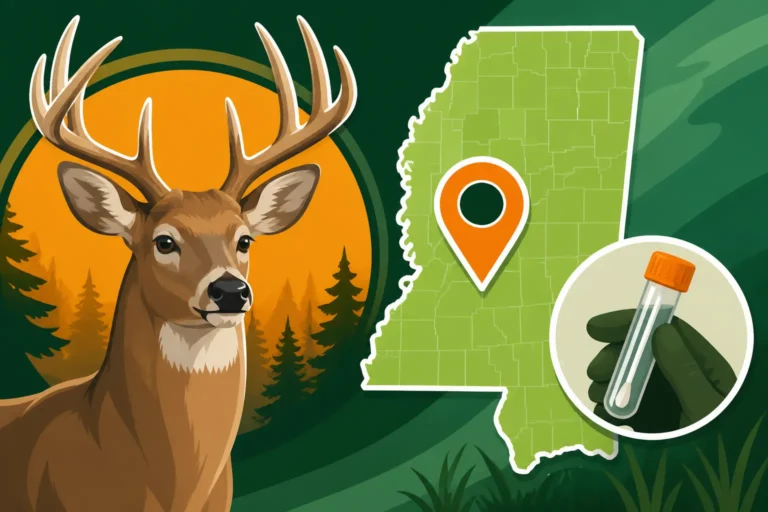
Chronic Wasting Disease (CWD) is a serious neurological disease that affects deer, elk, and moose. It is always fatal and has no known cure. Mississippi first detected CWD in 2018, and since then, the MDWFP has established CWD Management Zones in various counties across the state. If you are hunting in one of these zones, there are additional, very important regulations you need to be aware of.
These regulations primarily concern carcass movement restrictions. To prevent the spread of CWD, hunters harvesting deer in a CWD Management Zone are generally prohibited from moving whole deer carcasses or certain high-risk parts (like the brain, spinal cord, and lymphoid tissue) out of that zone. Only deboned meat, clean antlers, hides, and taxidermy-ready skulls (with brain matter removed) can typically be transported out. This can be a major logistical hurdle if you live outside a CWD zone but hunt within one.
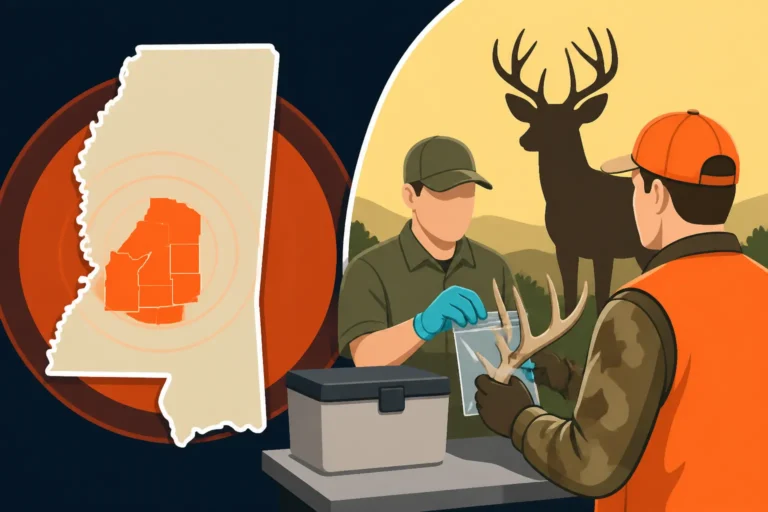
Additionally, mandatory CWD testing may be required in some CWD Management Zones during specific periods, particularly on opening weekends or other high-harvest dates. Hunters may be asked to bring their harvested deer to designated sampling stations. Stay informed by checking "Mississippi's Chronic Wasting Disease Zones" before your hunt, especially if you plan to travel through multiple counties or bring your harvest home across unit lines. These measures are critical to containing this devastating disease and protecting Mississippi's deer herd.
Disclaimer
The information provided in this guide is for general informational purposes only and is subject to change. Hunting regulations, seasons, and bag limits are set by the Mississippi Department of Wildlife, Fisheries, and Parks (MDWFP) and can be modified annually. It is the responsibility of every hunter to consult the most current official MDWFP hunting guide and regulations prior to engaging in any hunting activities. Failure to comply with all state and federal hunting laws may result in penalties.