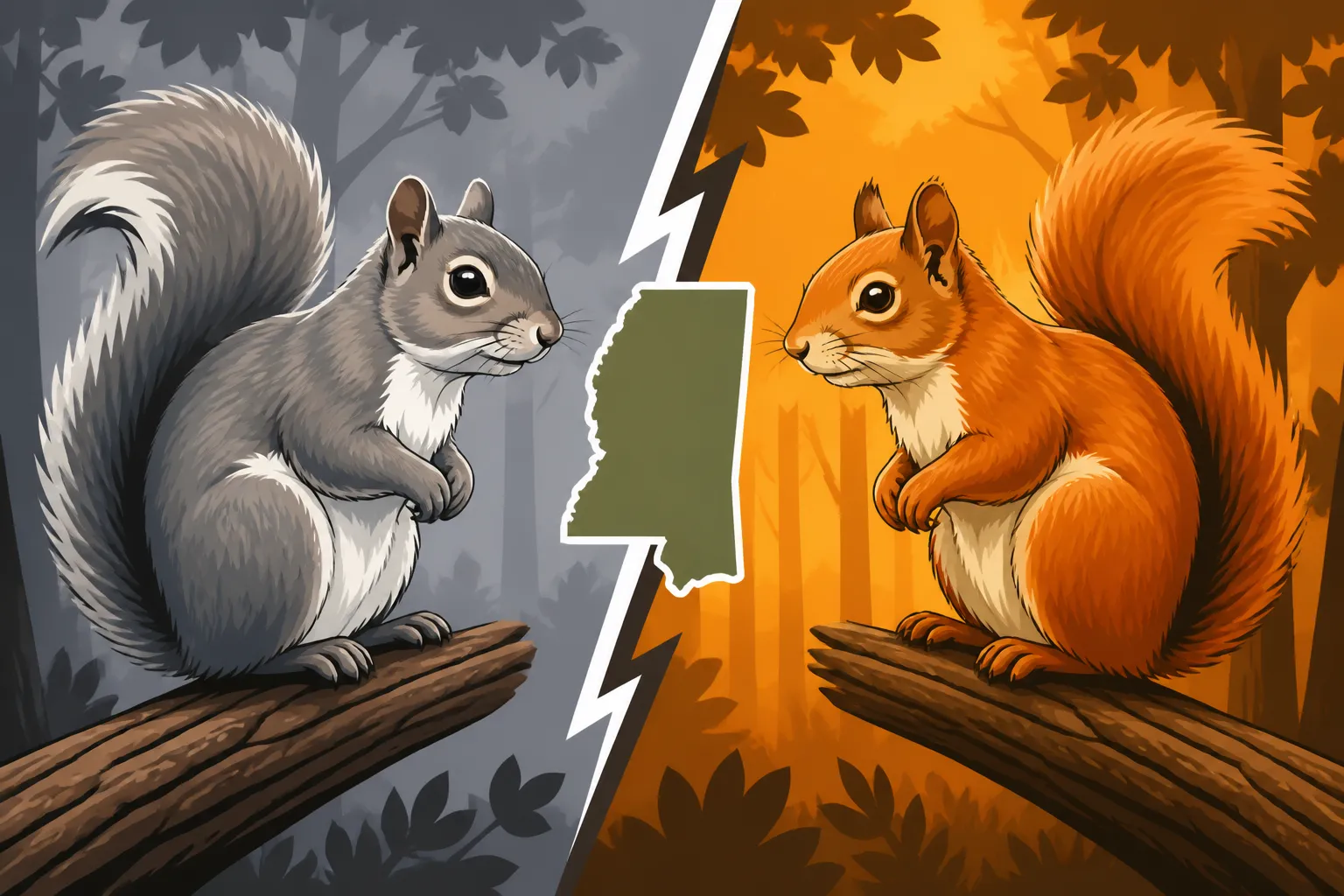
Gray Versus Fox Squirrels in Mississippi
If you've spent any time at all in the Mississippi woods, you know that not all squirrels are created equal. While both gray squirrels and fox squirrels offer exciting small game hunting opportunities, mistaking one for the other can lead to frustration when you're trying to dial in your hunting strategy. This guide is all about helping you understand the real, tangible differences between these two incredibly popular species, so you can identify them on sight, predict their movements, and ultimately become a more successful squirrel hunter in our beautiful state.
Spotting the Differences: Size, Color, and Markings
When you're out in the timber, whether you're still-hunting a creek bottom or posting up against a big oak, the first step to successful squirrel hunting is knowing what you're looking at. Gray and fox squirrels might both be "squirrels," but they're as distinct as a beagle and a black lab once you know what to look for. It's not just about their size; their coloration, markings, and even the way they hold their tails can give them away.
The Elusive Gray Squirrel (Sciurus carolinensis)
Our common gray squirrel, often affectionately called "cat squirrels" by many Mississippi hunters, is generally the smaller and more abundant of the two species. Think of them as the acrobats of the canopy. Typically, an adult gray squirrel will weigh in at around one to one-and-a-half pounds, making them quite a bit more diminutive than their fox squirrel cousins. Their fur is primarily grayish, often with a reddish or brownish tint on their back and sides, and a distinct white or light gray belly. This white belly is a key identifier. Their tails are usually bushy and tipped with white or lighter hairs, which they often twitch and flag, especially when agitated or communicating with other squirrels.
Behaviorally, gray squirrels are masters of the trees. They are incredibly arboreal, meaning they spend the vast majority of their lives in the canopy. You'll see them scampering up and down trunks, leaping from limb to limb with astonishing agility, and often disappearing into cavities or dense leaf nests high above. They are fast, nervous, and constantly on the move, particularly during peak feeding times in the early morning and late afternoon. If you're trying to get a bead on a gray squirrel, you'll need quick reflexes and a keen eye, as they use the tree itself as their primary escape route, often circling the trunk to keep it between themselves and any perceived threat.
Their typical habitat leans heavily towards mature, dense hardwood forests. We're talking about those gorgeous bottomland hardwoods along our rivers and creeks, where oak, hickory, and other mast-producing trees create a thick, interconnected canopy. You'll find them abundant in places like the Sunflower WMA Inside Delta National Forest or any of the rich river bottoms that crisscross our state. They thrive where there's plenty of overhead cover and a consistent food source from hard mast.
The Robust Fox Squirrel (Sciurus niger)
Now, the fox squirrel is a different beast entirely. When you spot a fox squirrel, it's often a "whoa, that's a big squirrel!" moment. They are noticeably larger and stockier than gray squirrels, often weighing between two and three pounds, sometimes even more. Their coloration is far more variable and can be a bit tricky, but it's typically a mix of rusty orange, brown, and black, with a lighter, often reddish-orange, belly. Some fox squirrels can be almost entirely black, particularly in certain localized populations, while others might have striking patches of white on their nose or ears. This wide range of color variations can sometimes confuse hunters, but their sheer size usually gives them away.
Their tails are also bushy, but unlike the gray, they tend to be reddish or dark, lacking the distinct white tip. Fox squirrels are also known for their powerful hind legs, which they use for impressive leaps and, more often, for bursts of speed across the forest floor. You'll notice they tend to move with a more deliberate, almost lumbering gait compared to the frantic scurrying of a gray squirrel. They are generally less nervous and can sometimes even seem a bit bolder, occasionally pausing to survey their surroundings from a tree limb or log.
When it comes to behavior, fox squirrels are more terrestrial. While they can certainly climb trees and will do so for food or safety, they spend a significant amount of their time foraging on the ground. You'll often spot them kicking through leaf litter, digging for buried nuts, or moving across more open areas. When spooked, they might run along the ground for a considerable distance before finally heading up a tree. This ground-dwelling tendency greatly influences how you might hunt them.
Their habitat preferences also differ quite a bit. Fox squirrels are more associated with open pine forests, pine-hardwood mixes, and areas with a scattered understory. You'll find them in places like the DeSoto National Forest Hunting or other piney woods regions of Mississippi, where longleaf pine, various oaks, and even agricultural fields create a mosaic of cover and food. They are often found on the edges of forests, near pastures, or in smaller woodlots where the canopy isn't as dense and continuous as a gray squirrel prefers.
Here's a quick table to help you keep track of these key distinctions:
| Feature | Gray Squirrel (Sciurus carolinensis) | Fox Squirrel (Sciurus niger) |
|---|---|---|
| Size | Smaller, slender (1-1.5 lbs) | Larger, stockier (2-3+ lbs) |
| Primary Color | Gray, sometimes reddish/brown tint | Highly variable: rusty, orange, brown, black |
| Belly Color | White or light gray | Reddish-orange, sometimes dark |
| Tail | Bushy, often white-tipped, twitchy | Bushy, reddish/dark, less pronounced flagging |
| Movement | Highly arboreal, fast, agile, tree-focused | More terrestrial, slower, deliberate, ground-focused |
| Habitat | Dense hardwood forests, bottomlands | Open pine, mixed woods, forest edges |
Habitat Preferences and Regional Distribution in Mississippi
Understanding where these squirrels like to hang out is paramount for planning your hunt. Just like deer have their preferred cover and food sources, so do squirrels, and these preferences often diverge significantly between gray and fox squirrels. Knowing their preferred zip codes can save you a lot of aimless wandering and put you in the right spot for the right species.
Where Gray Squirrels Call Home
Gray squirrels are truly creatures of the deep woods, particularly favoring mature, continuous canopies. In Mississippi, this means they absolutely thrive in our extensive bottomland hardwood forests, which are predominantly found along the major river systems and throughout the Mississippi Delta. Think of those ancient oak, hickory, and pecan groves that line the Yazoo, Big Black, Pearl, and Mississippi Rivers. These areas provide the dense overhead cover they need for protection from avian predators, countless cavities for denning, and a consistent supply of hard mast.
If you're looking for gray squirrels, focus your efforts on areas with a high density of mature mast-producing trees. Creek bottoms, sloughs, and riverine forests are prime locations. They need that interconnected canopy to travel from tree to tree without touching the ground, which is their preferred mode of travel. While they will venture to the ground to bury nuts, they're rarely far from the safety of a tree trunk. Places like Squirrel Hunting Delta Bottomland Hardwoods are classic gray squirrel country, where you can find them feasting on acorns and pecans. The density of trees means they can often be found in large numbers, making for some fast-paced hunting if you can keep up with their quick movements.
You'll also find healthy populations of gray squirrels in the hardwood draws and creek drainages within the Hills Unit, areas like the Homochitto National Forest, and some of the more mature stands in the Bienville National Forest where hardwoods haven't been entirely replaced by pine plantations. Anywhere there's a significant amount of older growth deciduous trees, you're likely to encounter gray squirrels. They are less common in areas dominated by pure pine stands or heavily fragmented habitats.
The Fox Squirrel's Domain
Fox squirrels, on the other hand, are much more versatile in their habitat choices, though they still have clear preferences. They tend to be more at home in open, park-like pine forests, mixed pine-hardwood stands, and the edges of agricultural fields. You're more likely to find them in the Piney Woods region of South Mississippi, the Loess Bluff Hills, and even in suburban areas with scattered mature trees and open lawns. They don't require the dense, continuous canopy that gray squirrels do, often preferring areas where they can easily move between trees on the ground.
Their ability to adapt to more fragmented landscapes means you'll find them in places that gray squirrels often avoid. They'll frequent areas where pines are mixed with a few large oaks, offering a dual food source of pine cones and acorns. The edges of fields, where they can forage for dropped corn or soybeans, are also highly attractive. They're often found in areas with a more open understory, allowing them to see potential threats while on the ground. This also means that scouting with tools like GoHunt to identify property lines, forest types, and open areas can be incredibly beneficial when targeting fox squirrels, as their preferred haunts are often distinct from those of gray squirrels.
Consider parts of the Homochitto National Forest Hunting or the Bienville National Forest where there are extensive pine stands dotted with oaks. They're also prevalent in the more open, wooded areas surrounding our smaller towns and even larger metropolitan centers like Jackson, where mature pecan and oak trees might be interspersed with grassy areas. Their adaptability allows them to thrive in a wider range of ecosystems, often even coexisting with gray squirrels, but generally preferring the more open conditions.
Behavioral Quirks and Hunting Tactics
Knowing where they live is one thing, but knowing how they behave once you step into their world is another. Gray and fox squirrels exhibit distinct behavioral patterns that demand different approaches from hunters. What works for one might just send the other bolting.
Hunting the Shifty Gray Squirrel
Hunting gray squirrels is often a game of quick reflexes, stealth, and acute observation. Their primary defense mechanism is speed and their ability to quickly put a tree trunk between themselves and danger. When you're after gray squirrels, you often need to be as agile as they are, or at least be prepared to make quick, precise shots.
Still-hunting is a classic and effective tactic for gray squirrels. This involves moving slowly and deliberately through suitable habitat, pausing frequently to scan the trees. Listen for the rustle of leaves high in the canopy, the distinctive "bark" of a squirrel, or the tell-tale shower of nut fragments falling from a feeding tree. Focus on areas with high concentrations of oaks, hickories, and pecan trees, especially during fall and early winter when they're actively feeding on mast. Squirrel Hunting Delta Hickory Groves can be incredibly productive. When you spot one, try to anticipate its movement. If it circles the tree, try to move silently to the opposite side or have a hunting partner ready to cover that angle.
Another effective method, particularly in dense woods, is ambushing. Find a promising stand of mast trees, especially near a creek bottom or a well-used game trail, and settle in silently. The key is patience. Gray squirrels will often emerge from their dens or return to feeding areas once they believe the coast is clear. Using squirrel calls, mimicking their barks and chatters, can sometimes provoke a response or draw a curious squirrel into view. Remember, they are masters of camouflage in the dappled light of the canopy, so sharp eyesight and often binoculars are your best friends. Understanding How Early Season Squirrels Give Themselves Away through their movements and feeding habits can also give you a significant advantage.
Pursuing the Resilient Fox Squirrel
Hunting fox squirrels requires a slightly different mindset, often prioritizing patience and a broader scanning technique. Because they spend more time on the ground and move more deliberately, you might not need the same lightning-fast reactions required for grays. However, their larger size and more robust nature can also make them tougher to bring down, requiring good shot placement.
Still-hunting is still a viable option, but instead of just scanning the canopy, you'll want to pay close attention to the forest floor and lower limbs. Fox squirrels will often be seen digging for buried nuts, moving along fallen logs, or even sitting out in relatively open areas near the edge of cover. Focus on mixed pine and hardwood stands, areas with mature oak trees (their preferred food source), and the edges of agricultural fields. A good pair of binoculars can help you pick them out from a distance before they spot you. Unlike gray squirrels, when a fox squirrel is spooked, it might bolt across the ground rather than immediately go vertical, giving you a different kind of shot opportunity.
Using dogs, particularly small game breeds like feist or cur dogs, is an incredibly popular and effective method for hunting fox squirrels. These dogs are trained to tree squirrels, barking furiously at the base of the tree to pinpoint the squirrel's location. This turns the hunt into an active pursuit, where you follow the dog, locate the treed squirrel, and then try to get a clear shot. It's a fantastic way to cover a lot of ground and find squirrels that might otherwise stay hidden. If you're considering this, some of the techniques for Running Dogs on Mississippi Feral Hogs or Running Beagles on Mississippi Cottontails can offer insights into managing dogs in the field, even if the target species is different.
Given their larger size and tendency to be a bit bolder, setting up a ground blind or finding a good natural hide near a consistent food source can also be effective. Fox squirrels will often return to the same feeding areas, especially if there's a good mast crop or access to waste grain. Patience is key; wait them out, and they'll often present a good, steady shot.
Beyond the Hunt: Culinary Notes and Conservation
Once you've successfully harvested your quarry, the adventure isn't over! Both gray and fox squirrels provide delicious wild game meat, and understanding their place in the ecosystem is part of being a responsible hunter.
Taste Test: Flavor Profiles and Cooking
When it comes to the table, both gray and fox squirrels are excellent table fare, though some hunters swear by one over the other. Generally, squirrel meat is lean, flavorful, and versatile.
- Gray Squirrel Meat: Tends to be slightly more tender and milder in flavor, often described as having a delicate, nutty taste. This might be due to their typically smaller size and high-canopy diet. They are excellent in stews, gravies, or fried until crispy. The smaller cuts of meat mean they cook relatively quickly.
- Fox Squirrel Meat: Being larger and often older, fox squirrels can have a slightly richer, more robust flavor. The meat can be a bit tougher, especially from older animals, which makes them perfect for slow-cooking methods. Think squirrel and dumplings, gumbo, or braised dishes where the meat becomes fork-tender. Don't let the potential for a slightly tougher texture deter you; slow cooking transforms it into a savory delight.
No matter the species, quick and clean field dressing is important, especially in Mississippi's warmer climate. Skinning and cleaning a squirrel takes practice, but once you get the hang of it, it's a quick process. For ideas on preparing your harvest, check out resources on Best-Eating Game in Mississippi, which often includes tips for small game.
Conservation and Management Considerations
Both gray and fox squirrels are abundant game species across Mississippi, and their populations are generally healthy. They are well-managed by the Mississippi Department of Wildlife, Fisheries, and Parks (MDWFP) as part of our state's rich small game heritage. The Mississippi Squirrel Season Opening Day is eagerly anticipated by many, and the generous Mississippi Squirrel Daily Bag Limit reflects the healthy populations.
These squirrels play a vital role in our forest ecosystems. They are significant seed dispersers, inadvertently planting countless acorns and nuts as they bury their winter caches. They also serve as a food source for numerous predators, contributing to the overall health and balance of the food chain. Understanding the Mississippi Small Game Season Rules and adhering to them is crucial for ensuring these populations remain robust for future generations of hunters.
While their populations are stable, habitat changes can certainly impact local squirrel densities. For gray squirrels, the loss of mature bottomland hardwoods to development or clear-cutting can reduce available habitat. For fox squirrels, fragmentation of pine and mixed forests can also have an effect. As hunters, supporting sound timber management practices and conservation efforts that protect and restore diverse forest habitats benefits not only squirrels but all wildlife. Using modern scouting tools like those offered by GoHunt allows hunters to understand land types, identify prime squirrel habitats, and ensure they are hunting legally and ethically within designated seasons, contributing to responsible wildlife stewardship.
| Squirrel Species | Preferred Cooking Methods | Conservation Status (Mississippi) | Ecological Role |
|---|---|---|---|
| Gray Squirrel | Frying, stews, gravies, quick-cooking dishes | Abundant, well-managed | Seed disperser, prey for raptors/mammals |
| Fox Squirrel | Slow-cooking (braised, gumbo, dumplings), roasting | Abundant, well-managed | Seed disperser, prey for larger predators |
Disclaimer
This article is for general informational purposes only and does not constitute professional advice. Laws, prices and regulations vary by location and change over time. Consult a qualified professional for guidance on your specific situation.